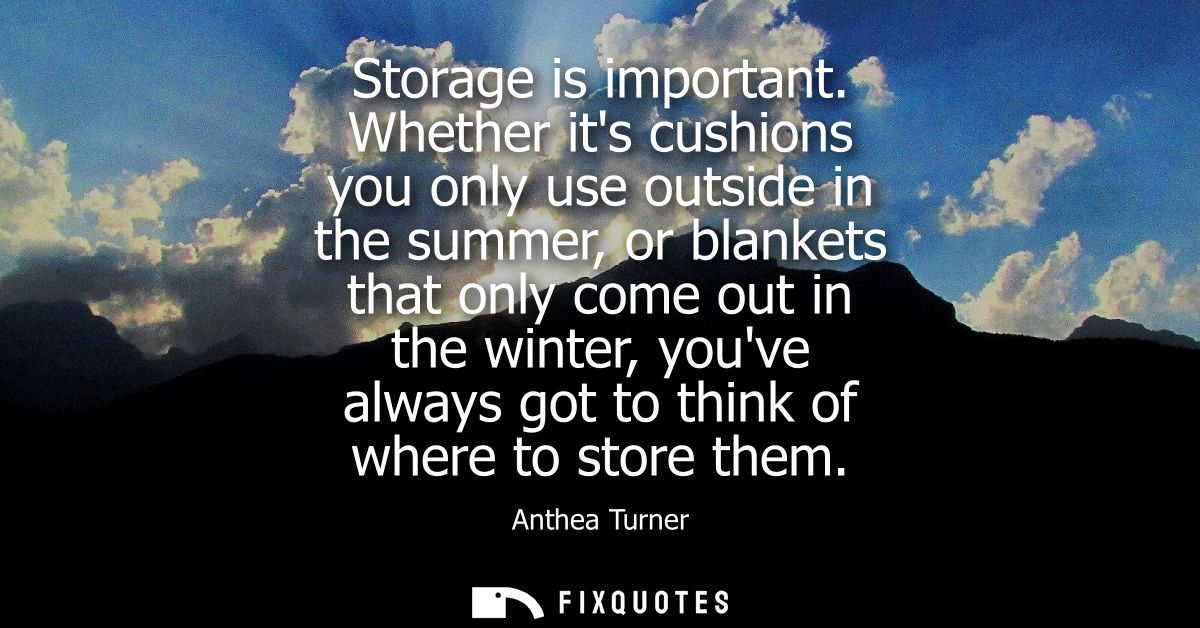
"Storage is important. Whether it's cushions you only use outside in the summer, or blankets that only come out in the winter, you've always got to think of where to store them"
About this Quote
The line works because it treats clutter not as mess but as a failure of planning. The examples are deliberately banal: summer cushions, winter blankets. That ordinariness is the point. She`s not talking about rare heirlooms or dramatic decluttering epiphanies; she`s talking about the seasonal churn of stuff that every home accumulates. In doing so, she normalizes the idea that a well-run life requires systems, not willpower. The real message is: don`t just buy things, buy the infrastructure to hide them.
There`s also a soft moral tone under the friendliness. "You`ve always got to think" lands like a kindly commandment, the voice of daytime television nudging viewers toward self-improvement that feels manageable. It reflects a consumer culture where domestic competence is both performance and reassurance: if you can assign every object a place, maybe you can assign your anxieties one too. Storage becomes a metaphor for emotional management - keep the excess out of sight, rotate it back in when the season demands, and the house (and by extension, the self) stays presentable.
Quote Details
| Topic | Life |
|---|---|
| Source | Help us find the source |
| Cite |
Citation Formats
APA Style (7th ed.)
Turner, Anthea. (2026, January 15). Storage is important. Whether it's cushions you only use outside in the summer, or blankets that only come out in the winter, you've always got to think of where to store them. FixQuotes. https://fixquotes.com/quotes/storage-is-important-whether-its-cushions-you-157738/
Chicago Style
Turner, Anthea. "Storage is important. Whether it's cushions you only use outside in the summer, or blankets that only come out in the winter, you've always got to think of where to store them." FixQuotes. January 15, 2026. https://fixquotes.com/quotes/storage-is-important-whether-its-cushions-you-157738/.
MLA Style (9th ed.)
"Storage is important. Whether it's cushions you only use outside in the summer, or blankets that only come out in the winter, you've always got to think of where to store them." FixQuotes, 15 Jan. 2026, https://fixquotes.com/quotes/storage-is-important-whether-its-cushions-you-157738/. Accessed 30 Mar. 2026.