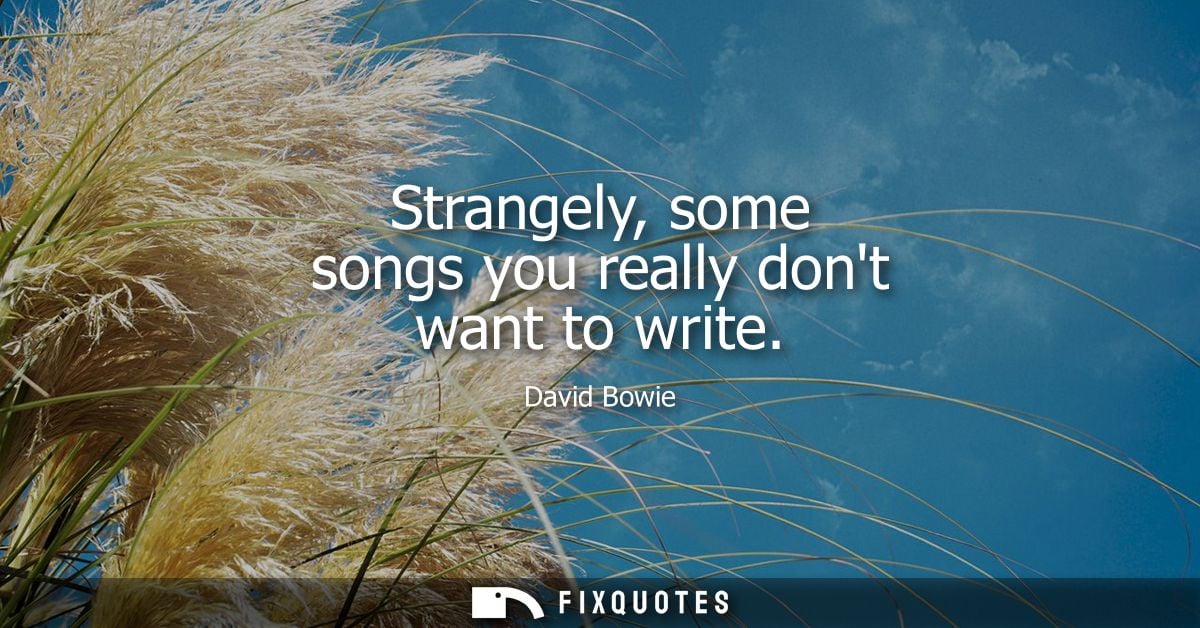
"Strangely, some songs you really don't want to write"
About this Quote
Art isn’t always a diary you open voluntarily; sometimes it’s a door that swings in on its own. When David Bowie says, "Strangely, some songs you really don't want to write", he’s puncturing the romantic fantasy of the musician as a blissed-out conduit. He’s talking about the opposite kind of inspiration: the intrusive, almost adversarial song that arrives with a demand, not a seduction.
The line works because it frames creativity as consent gone fuzzy. "Strangely" signals he knows how odd it sounds to resist the very thing that defines his job, and that self-awareness is pure Bowie: cool detachment masking a nervous system tuned to cultural static. The subtext is that some material carries consequences. Certain songs force you to name what you’d rather keep foggy - grief, fear, desire, complicity. Writing them means turning private corrosion into public product, then performing it on command like a trick.
Bowie’s career context sharpens the edge. He built personas to control exposure, to metabolize vulnerability into theatrical shape. Yet even inside that armor, the work can corner you: a lyric that won’t leave, a melody that feels like evidence. Late Bowie especially made art that read like a reckoning, suggesting the songs he "didn't want to write" were precisely the ones that mattered most.
It’s also an understated ethic: if you’re only writing what you’re comfortable saying, you’re probably just branding. The unwanted song is the one that threatens the mask - and therefore has the best chance of being true.
The line works because it frames creativity as consent gone fuzzy. "Strangely" signals he knows how odd it sounds to resist the very thing that defines his job, and that self-awareness is pure Bowie: cool detachment masking a nervous system tuned to cultural static. The subtext is that some material carries consequences. Certain songs force you to name what you’d rather keep foggy - grief, fear, desire, complicity. Writing them means turning private corrosion into public product, then performing it on command like a trick.
Bowie’s career context sharpens the edge. He built personas to control exposure, to metabolize vulnerability into theatrical shape. Yet even inside that armor, the work can corner you: a lyric that won’t leave, a melody that feels like evidence. Late Bowie especially made art that read like a reckoning, suggesting the songs he "didn't want to write" were precisely the ones that mattered most.
It’s also an understated ethic: if you’re only writing what you’re comfortable saying, you’re probably just branding. The unwanted song is the one that threatens the mask - and therefore has the best chance of being true.
Quote Details
| Topic | Music |
|---|---|
| Source | Help us find the source |
More Quotes by David
Add to List