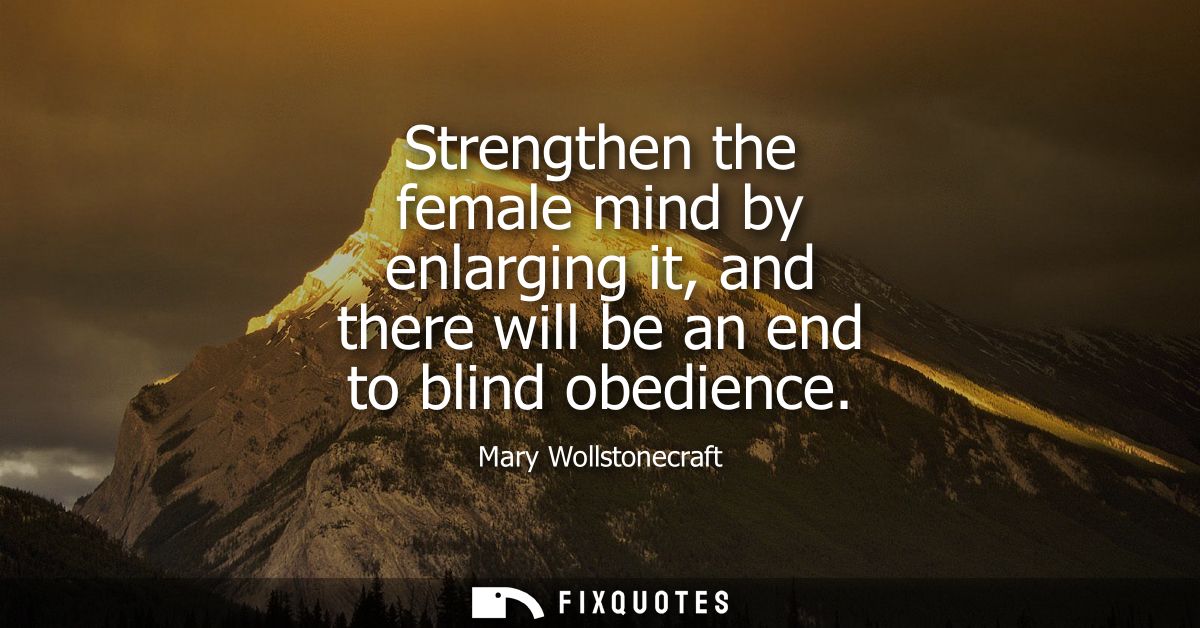
"Strengthen the female mind by enlarging it, and there will be an end to blind obedience"
About this Quote
The intent is surgical. Wollstonecraft targets the root mechanism that keeps women compliant: not temperament, not “nature,” but enforced smallness. “Blind” is doing heavy work here, implying obedience that’s less virtue than sensory deprivation. If you deny someone knowledge, you can call their submission moral. Give them mental breadth and the moral costume falls apart.
The subtext is almost accusatory toward the era’s dominant ideal of femininity. Eighteenth-century Britain marketed female “virtue” as delicacy and dependence, a kind of socially approved weakness. Wollstonecraft flips the script: what’s praised as virtue is actually a political technology, training women to defer to fathers, husbands, clergy, custom. Her remedy isn’t rebellion for its own sake; it’s competence. An “enlarged” mind can evaluate, choose, consent - all the things obedience conveniently bypasses.
Context matters: A Vindication of the Rights of Woman lands amid the aftershocks of the French Revolution, when “rights” were the fashionable noun and women were still expected to clap politely from the balcony. Wollstonecraft insists that a society built on reason can’t keep half its population in cultivated ignorance without exposing itself as a fraud.
Quote Details
| Topic | Equality |
|---|---|
| Source | Verified source: A Vindication of the Rights of Woman (Mary Wollstonecraft, 1792)
Evidence: Strengthen the female mind by enlarging it, and there will be an end to blind obedience; but as blind obedience is ever sought for by power, tyrants and sensualists are in the right endeavour to keep woman in the dark, because only want slaves, and the latter a plaything. (Chapter II ("The Prevailing Opinion of a Sexual Character Discussed"); exact page varies by edition). This line appears in Wollstonecraft’s own text (primary source) in Chapter II of *A Vindication of the Rights of Woman* (1792). The quote is often shortened to the first clause ending at “blind obedience”. The earliest publication is the 1792 book; it was not originally a speech/interview. For a bibliographic confirmation of the first-edition imprint as London: for J. Johnson, 1792, see rare-book catalog records (e.g., Christie’s listing of the first edition). ([barryfvaughan.org](https://barryfvaughan.org/text/philtext/wollstonecraft/vindication/2.html)) Other candidates (1) A Vindication of the Rights of Woman (Mary Wollstonecraft, 1891) compilation95.0% With Strictures on Political and Moral Subjects Mary Wollstonecraft. Like the fair sex , the business of their ... St... |
| Cite |
Citation Formats
APA Style (7th ed.)
Wollstonecraft, Mary. (2026, March 2). Strengthen the female mind by enlarging it, and there will be an end to blind obedience. FixQuotes. https://fixquotes.com/quotes/strengthen-the-female-mind-by-enlarging-it-and-7503/
Chicago Style
Wollstonecraft, Mary. "Strengthen the female mind by enlarging it, and there will be an end to blind obedience." FixQuotes. March 2, 2026. https://fixquotes.com/quotes/strengthen-the-female-mind-by-enlarging-it-and-7503/.
MLA Style (9th ed.)
"Strengthen the female mind by enlarging it, and there will be an end to blind obedience." FixQuotes, 2 Mar. 2026, https://fixquotes.com/quotes/strengthen-the-female-mind-by-enlarging-it-and-7503/. Accessed 1 Apr. 2026.