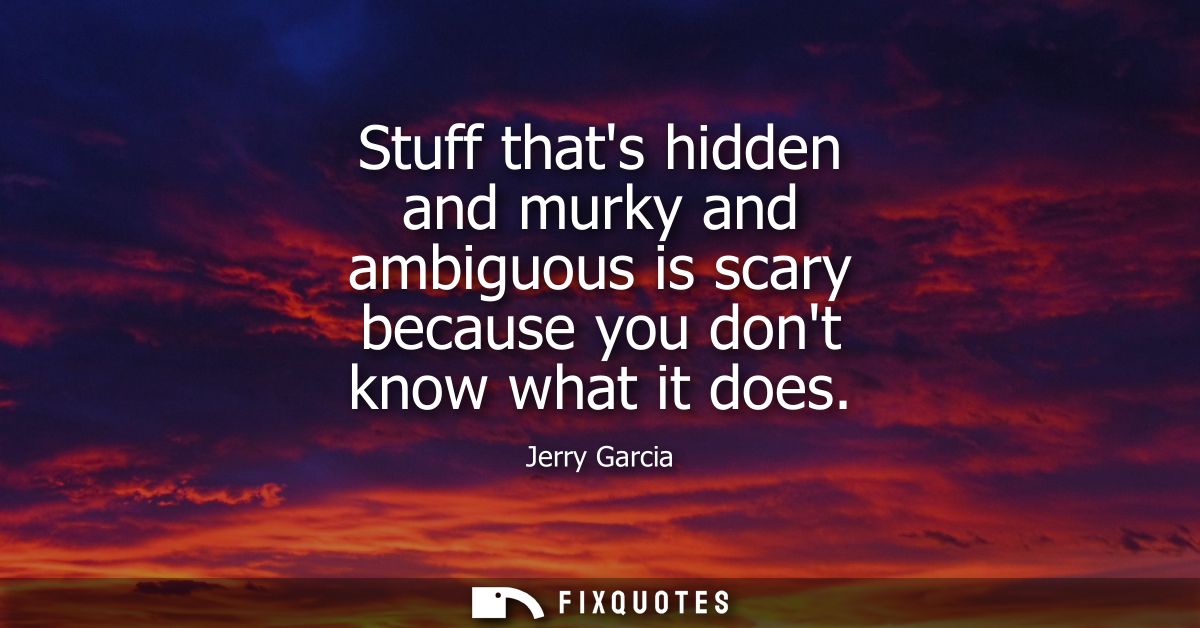
"Stuff that's hidden and murky and ambiguous is scary because you don't know what it does"
About this Quote
Garcia nails a certain American kind of fear: not the monster you can name, but the fog you can’t. “Hidden and murky and ambiguous” isn’t just a spooky mood board; it’s a diagnosis of how anxiety works when information dries up. The line is plainspoken, almost childlike in its logic (“because you don’t know what it does”), and that’s the point. He strips fear of its gothic romance and frames it as a practical reaction to uncertainty: when you can’t predict outcomes, you can’t relax.
Coming from Garcia, that’s more than armchair psychology. The Grateful Dead built an empire on improvisation and open-endedness, yet they also knew how quickly ambiguity flips from thrilling to terrifying. A jam can feel like freedom when you trust the band; it can feel like chaos when you don’t. In that sense, Garcia is talking about control and surrender at the same time: ambiguity is scary precisely when you’re forced into a passive role, watching something operate without understanding its rules.
There’s subtext here about institutions, too: opaque systems (record labels, cops, politics, even the machinery of addiction) become ominous when they’re unreadable. The 60s and 70s promised expanded consciousness, but they also delivered paranoia, surveillance, bad trips, and consequences that arrived late and without clear causality. Garcia’s sentence is a musician’s version of a cultural warning: mystery is only romantic when you believe it’s benign. When you don’t, the unknown stops being art and starts being threat.
Coming from Garcia, that’s more than armchair psychology. The Grateful Dead built an empire on improvisation and open-endedness, yet they also knew how quickly ambiguity flips from thrilling to terrifying. A jam can feel like freedom when you trust the band; it can feel like chaos when you don’t. In that sense, Garcia is talking about control and surrender at the same time: ambiguity is scary precisely when you’re forced into a passive role, watching something operate without understanding its rules.
There’s subtext here about institutions, too: opaque systems (record labels, cops, politics, even the machinery of addiction) become ominous when they’re unreadable. The 60s and 70s promised expanded consciousness, but they also delivered paranoia, surveillance, bad trips, and consequences that arrived late and without clear causality. Garcia’s sentence is a musician’s version of a cultural warning: mystery is only romantic when you believe it’s benign. When you don’t, the unknown stops being art and starts being threat.
Quote Details
| Topic | Fear |
|---|
More Quotes by Jerry
Add to List