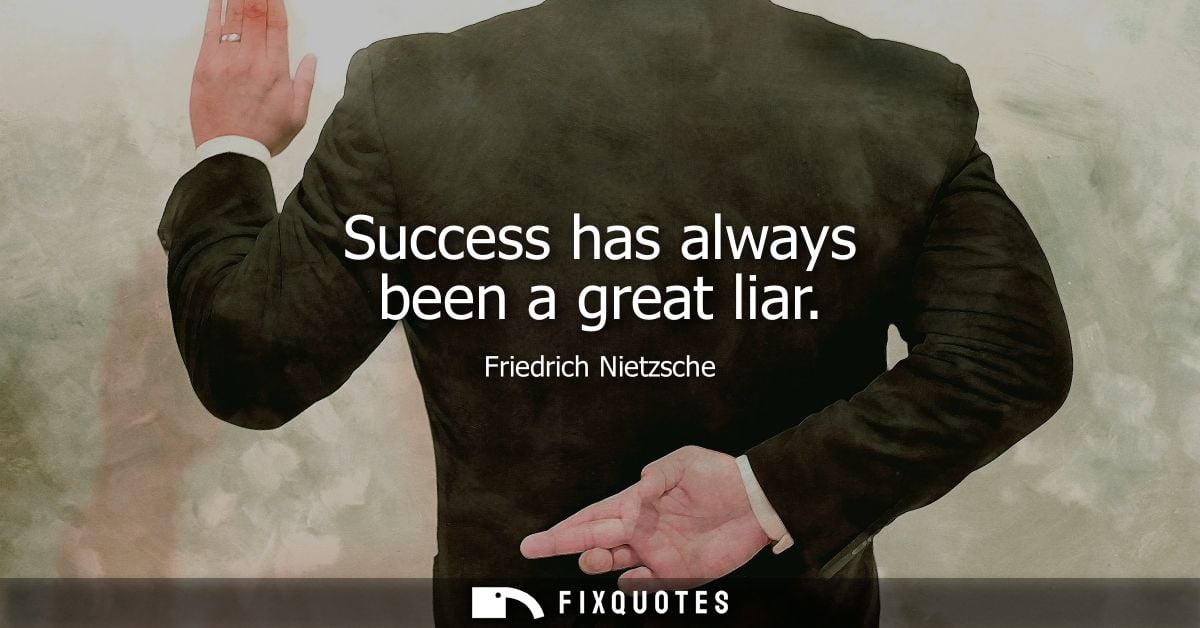
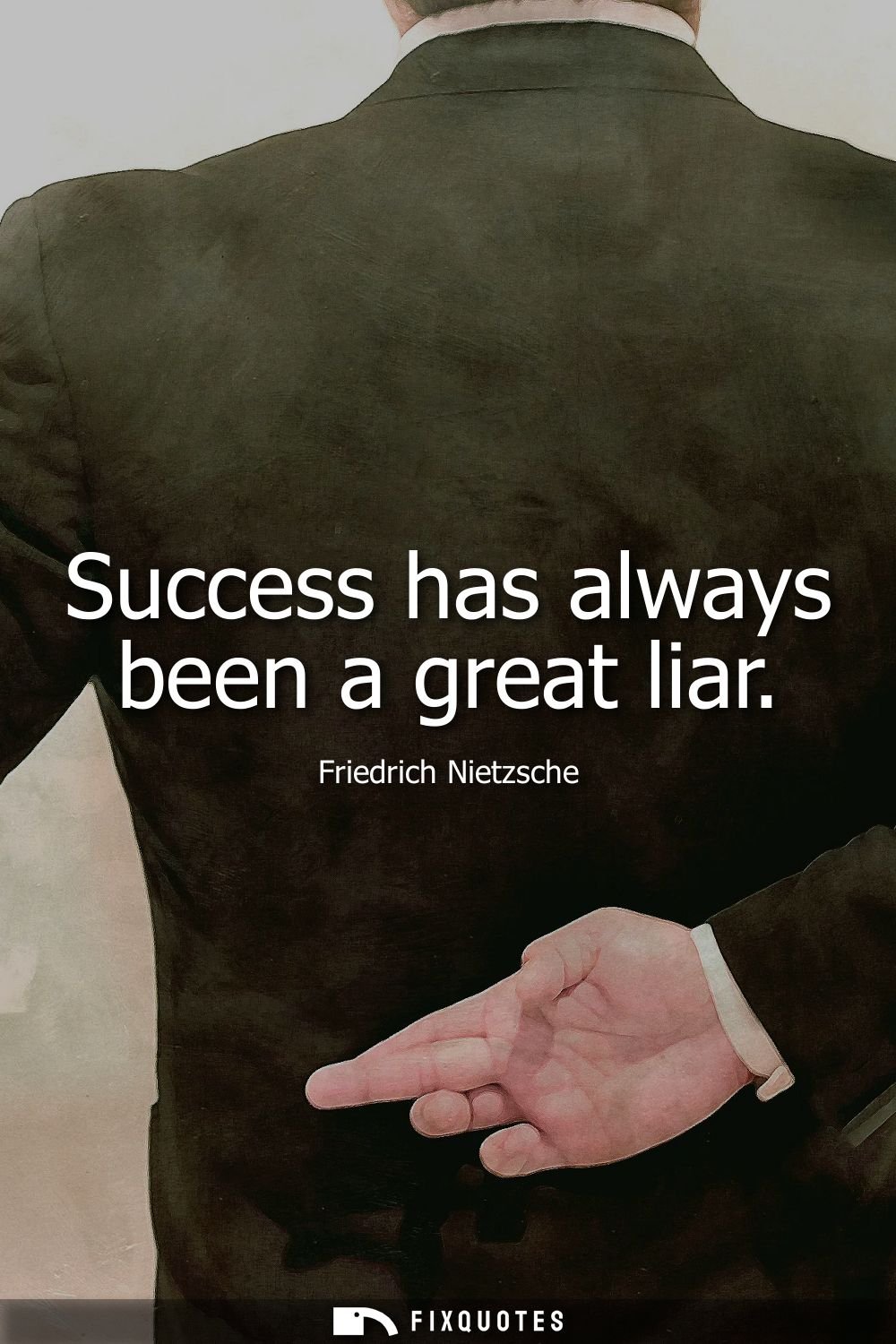
"Success has always been a great liar"
About this Quote
Success isn’t just unreliable in Nietzsche’s line; it’s actively deceitful, a con artist with good press. He’s needling the modern reflex to treat outcomes as evidence of virtue. If it worked, we assume it was right; if someone “made it,” we retrofit nobility onto their methods and character. Nietzsche’s barb collapses that comforting syllogism. Success, in his view, doesn’t reveal truth so much as it manufactures it after the fact, laundering contingency, brute force, luck, timing, even cruelty into a story of merit.
The genius of “great liar” is how it flips the moral ledger. We typically accuse failure of being misleading: it “doesn’t reflect potential,” it “isn’t the whole story.” Nietzsche argues the opposite. Failure can be clarifying, stripping away excuses and inherited ideals; success, by contrast, seduces crowds into confusing power with justification. It turns winners into prophets and survival into proof. That’s not cynicism for its own sake. It’s an attack on herd morality: the way societies sanctify what rises to the top and call it “natural,” “deserved,” or “progress.”
Context matters. Nietzsche is writing in a Europe drunk on bourgeois triumphalism, scientific authority, and moral self-congratulation, even as traditional religious frameworks are cracking. Into that vacuum rushes a new priesthood: respectable achievement. His line warns that the post-God world can still worship, just with better accounting. Success becomes the smoothest theology of all because it doesn’t need arguments; it has receipts.
The genius of “great liar” is how it flips the moral ledger. We typically accuse failure of being misleading: it “doesn’t reflect potential,” it “isn’t the whole story.” Nietzsche argues the opposite. Failure can be clarifying, stripping away excuses and inherited ideals; success, by contrast, seduces crowds into confusing power with justification. It turns winners into prophets and survival into proof. That’s not cynicism for its own sake. It’s an attack on herd morality: the way societies sanctify what rises to the top and call it “natural,” “deserved,” or “progress.”
Context matters. Nietzsche is writing in a Europe drunk on bourgeois triumphalism, scientific authority, and moral self-congratulation, even as traditional religious frameworks are cracking. Into that vacuum rushes a new priesthood: respectable achievement. His line warns that the post-God world can still worship, just with better accounting. Success becomes the smoothest theology of all because it doesn’t need arguments; it has receipts.
Quote Details
| Topic | Success |
|---|---|
| Source | Help us find the source |
| Cite |
Citation Formats
APA Style (7th ed.)
Nietzsche, Friedrich. (2026, January 15). Success has always been a great liar. FixQuotes. https://fixquotes.com/quotes/success-has-always-been-a-great-liar-287/
Chicago Style
Nietzsche, Friedrich. "Success has always been a great liar." FixQuotes. January 15, 2026. https://fixquotes.com/quotes/success-has-always-been-a-great-liar-287/.
MLA Style (9th ed.)
"Success has always been a great liar." FixQuotes, 15 Jan. 2026, https://fixquotes.com/quotes/success-has-always-been-a-great-liar-287/. Accessed 11 Mar. 2026.
More Quotes by Friedrich
Add to List