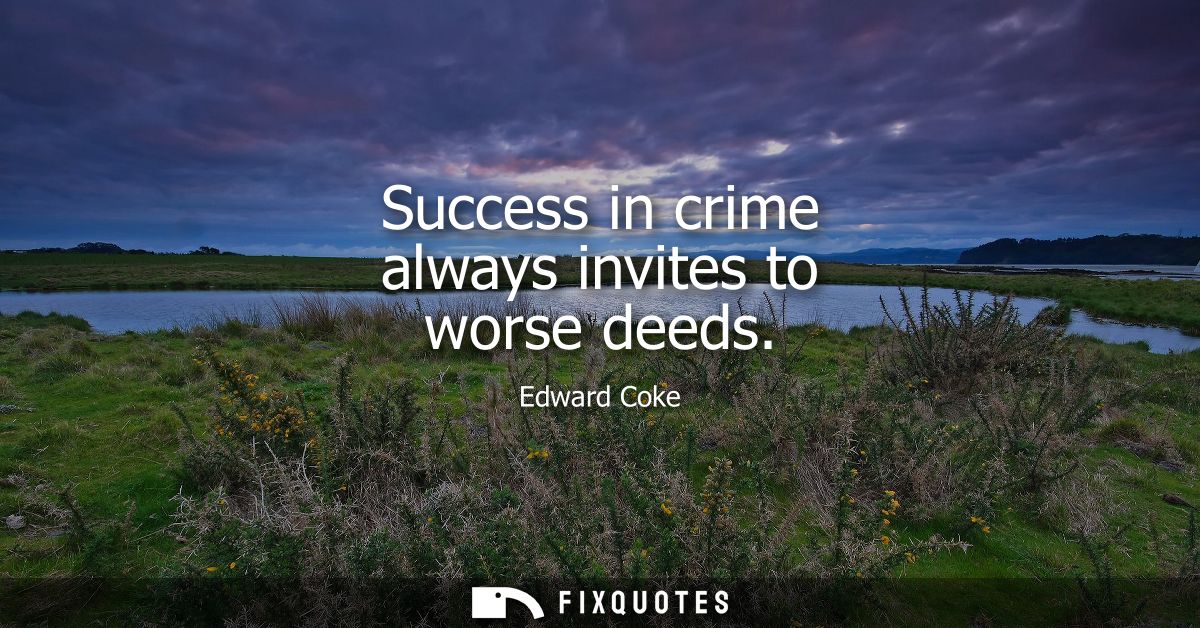
"Success in crime always invites to worse deeds"
About this Quote
“Success in crime always invites to worse deeds” isn’t moral handwringing; it’s a cold-eyed diagnosis of incentives. It treats wrongdoing less as a one-off lapse and more as an escalating business model: if the first job pays, the next one expands. Coke’s phrasing matters. “Success” is the trigger, not desperation. “Invites” personifies temptation as a social offer, like an industry networking event for the unscrupulous. The line implies that the real danger isn’t the initial crime but the proof-of-concept: once a person learns the system can be gamed, restraint becomes an inefficient choice.
The subtext is about feedback loops. Crime that “works” doesn’t just deliver money or power; it delivers confidence, habit, and a sense of impunity. That psychological profit margin is what pushes “worse deeds” from possibility to strategy. The quote also quietly rebukes societies that reward outcomes over ethics. If institutions respond only when the damage becomes spectacular, they effectively subsidize escalation. The first win teaches criminals what regulators and courts are slow to admit: consequences are negotiable.
Context sharpens the edge. Edward Coke lived in an England where law, property, and state authority were being renegotiated amid patronage, corruption, and harsh punishment. Whether or not you buy the “businessman” label, the sensibility is unmistakably transactional: behavior follows returns. In that light, the line doubles as policy advice. Don’t romanticize the “small” crime, and don’t wait for the “worse” one. The earlier you break the chain of reward, the less likely the ladder gets climbed.
The subtext is about feedback loops. Crime that “works” doesn’t just deliver money or power; it delivers confidence, habit, and a sense of impunity. That psychological profit margin is what pushes “worse deeds” from possibility to strategy. The quote also quietly rebukes societies that reward outcomes over ethics. If institutions respond only when the damage becomes spectacular, they effectively subsidize escalation. The first win teaches criminals what regulators and courts are slow to admit: consequences are negotiable.
Context sharpens the edge. Edward Coke lived in an England where law, property, and state authority were being renegotiated amid patronage, corruption, and harsh punishment. Whether or not you buy the “businessman” label, the sensibility is unmistakably transactional: behavior follows returns. In that light, the line doubles as policy advice. Don’t romanticize the “small” crime, and don’t wait for the “worse” one. The earlier you break the chain of reward, the less likely the ladder gets climbed.
Quote Details
| Topic | Justice |
|---|---|
| Source | Help us find the source |
| Cite |
Citation Formats
APA Style (7th ed.)
Coke, Edward. (2026, January 18). Success in crime always invites to worse deeds. FixQuotes. https://fixquotes.com/quotes/success-in-crime-always-invites-to-worse-deeds-15597/
Chicago Style
Coke, Edward. "Success in crime always invites to worse deeds." FixQuotes. January 18, 2026. https://fixquotes.com/quotes/success-in-crime-always-invites-to-worse-deeds-15597/.
MLA Style (9th ed.)
"Success in crime always invites to worse deeds." FixQuotes, 18 Jan. 2026, https://fixquotes.com/quotes/success-in-crime-always-invites-to-worse-deeds-15597/. Accessed 17 Feb. 2026.
More Quotes by Edward
Add to List