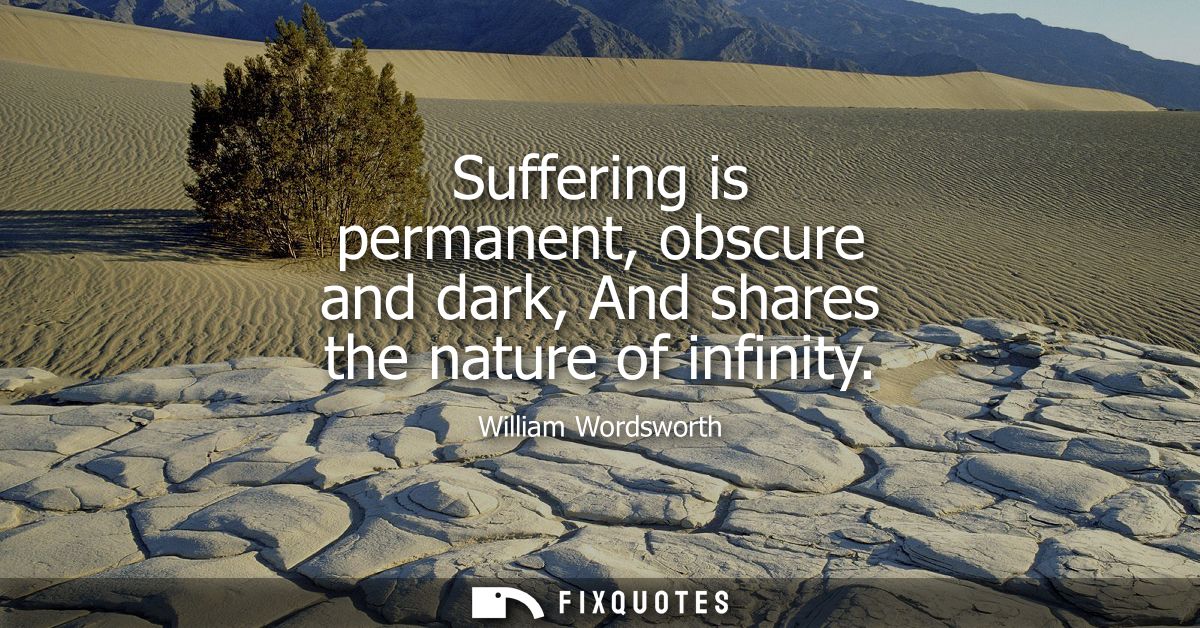
"Suffering is permanent, obscure and dark, And shares the nature of infinity"
About this Quote
The move that really sharpens the blade is the last clause: suffering “shares the nature of infinity.” That’s not poetic exaggeration so much as psychological accuracy. Pain, especially grief, doesn’t feel like a finite event; it feels like a horizon that keeps receding. Wordsworth is writing in a period often caricatured as nature-worship and self-soothing lyricism, yet his best work is obsessed with how memory can both heal and haunt. Infinity here isn’t celestial; it’s the terrifying sense that the mind can loop forever inside an experience it can’t metabolize.
Context matters: the early 19th century is full of political rupture and personal loss, and Wordsworth himself is a poet of aftershocks - what happens once the “event” is over and the psyche keeps paying. The line’s intent is to puncture sentimental consolation: the sublime isn’t only mountains and moonlight; it’s the endless, shadowy magnitude of human hurt.
Quote Details
| Topic | Deep |
|---|---|
| Source | Help us find the source |
| Cite |
Citation Formats
APA Style (7th ed.)
Wordsworth, William. (2026, January 15). Suffering is permanent, obscure and dark, And shares the nature of infinity. FixQuotes. https://fixquotes.com/quotes/suffering-is-permanent-obscure-and-dark-and-15177/
Chicago Style
Wordsworth, William. "Suffering is permanent, obscure and dark, And shares the nature of infinity." FixQuotes. January 15, 2026. https://fixquotes.com/quotes/suffering-is-permanent-obscure-and-dark-and-15177/.
MLA Style (9th ed.)
"Suffering is permanent, obscure and dark, And shares the nature of infinity." FixQuotes, 15 Jan. 2026, https://fixquotes.com/quotes/suffering-is-permanent-obscure-and-dark-and-15177/. Accessed 5 Feb. 2026.