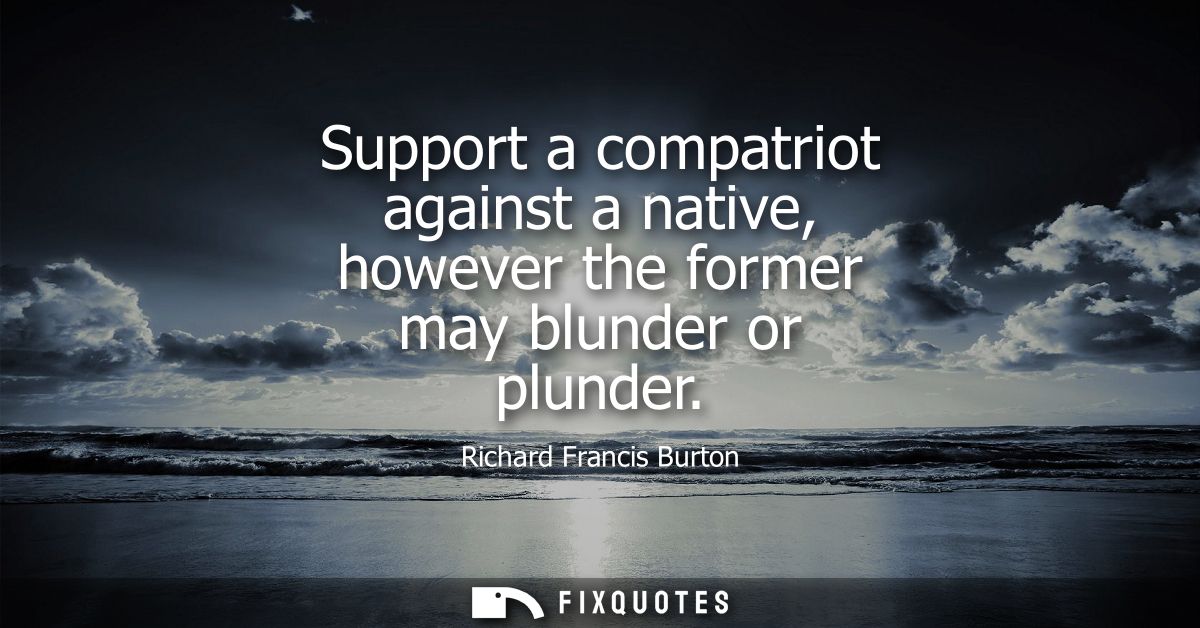
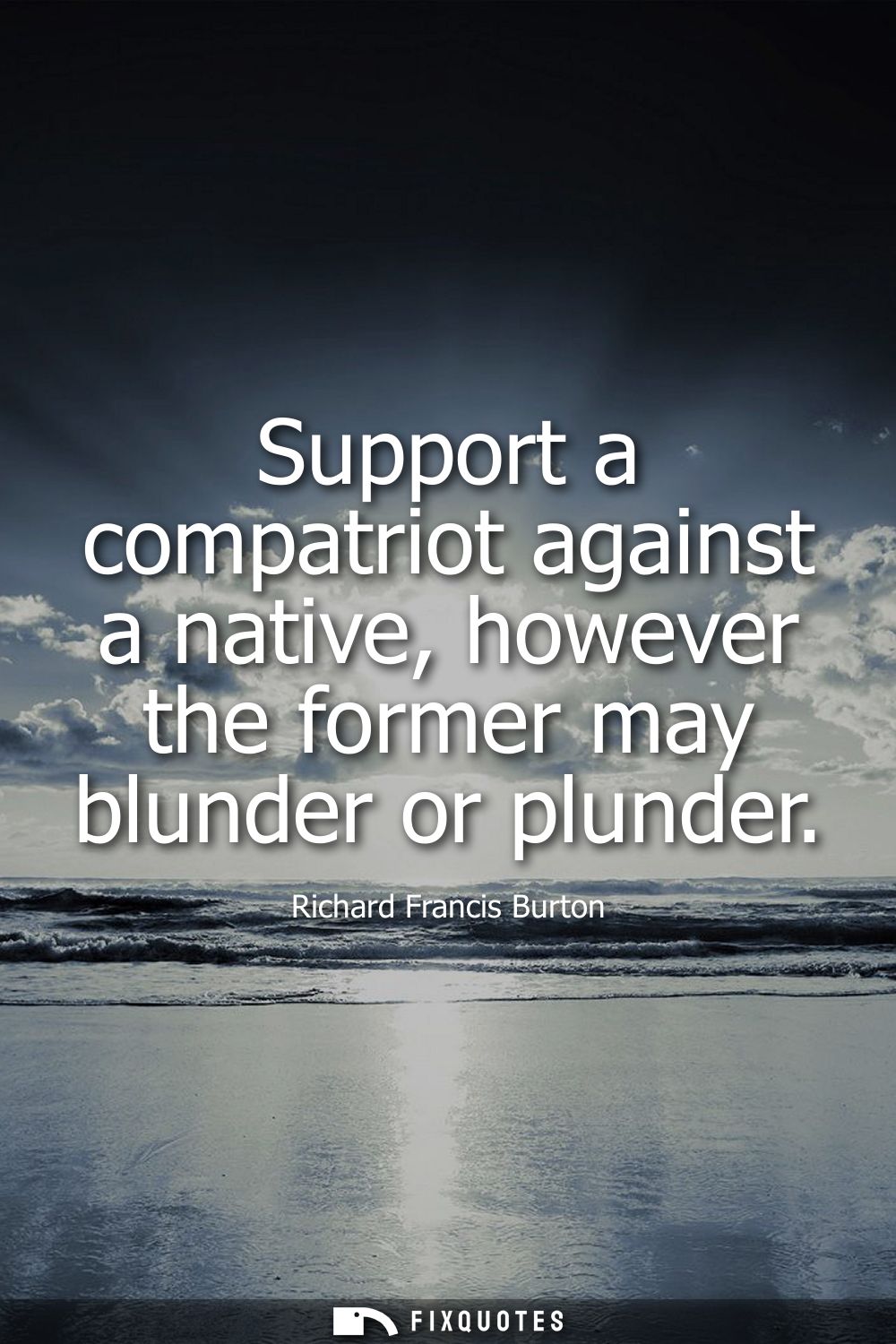
"Support a compatriot against a native, however the former may blunder or plunder"
About this Quote
The line reads like field wisdom stripped of pretense, the kind of rule you learn not from books but from watching how power protects itself. Burton, an explorer moving through the machinery of British expansion, understood the incentives: a European in trouble threatens the larger project; a "native" grievance can be absorbed, ignored, or punished without destabilizing the hierarchy. The sentence's cadence mimics a proverb, which is part of its menace. By packaging the ethic as common sense, it shows how oppression survives not just through policy but through everyday social scripts.
Subtextually, Burton is also hinting at complicity. "Blunder" and "plunder" are not outliers; they're expected occupational hazards of conquest. The quote captures a grim social contract of imperial life: you close ranks, you keep the narrative coherent, you don't let local truth outrank imperial cohesion. It's a candid snapshot of how belonging can become an alibi.
Quote Details
| Topic | Ethics & Morality |
|---|---|
| Source | Help us find the source |
| Cite |
Citation Formats
APA Style (7th ed.)
Burton, Richard Francis. (2026, January 15). Support a compatriot against a native, however the former may blunder or plunder. FixQuotes. https://fixquotes.com/quotes/support-a-compatriot-against-a-native-however-the-153182/
Chicago Style
Burton, Richard Francis. "Support a compatriot against a native, however the former may blunder or plunder." FixQuotes. January 15, 2026. https://fixquotes.com/quotes/support-a-compatriot-against-a-native-however-the-153182/.
MLA Style (9th ed.)
"Support a compatriot against a native, however the former may blunder or plunder." FixQuotes, 15 Jan. 2026, https://fixquotes.com/quotes/support-a-compatriot-against-a-native-however-the-153182/. Accessed 28 Mar. 2026.