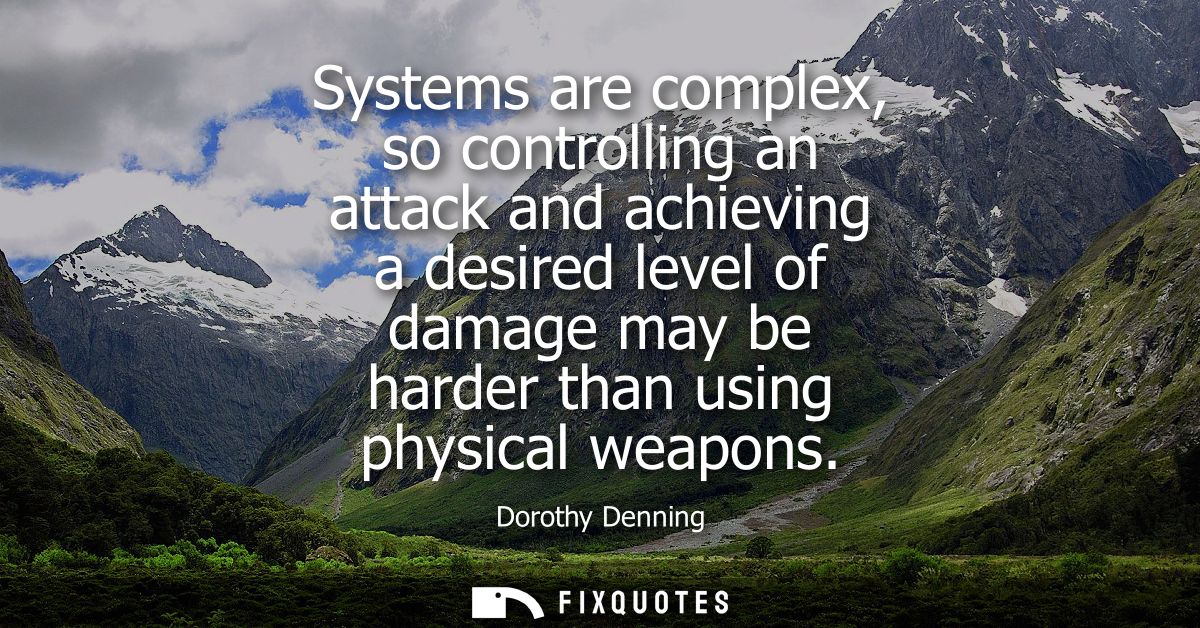
"Systems are complex, so controlling an attack and achieving a desired level of damage may be harder than using physical weapons"
About this Quote
The intent is policy-minded and slightly deflationary. Denning isn’t romanticizing cyber’s power; she’s warning decision-makers against treating digital weapons as clean, precise, reversible tools. That subtext pushes back on the seductive idea of “surgical” cyber options that sit neatly between diplomacy and bombs. If you can’t predict second-order effects, you can’t responsibly promise limited outcomes, and you can’t credibly calibrate escalation.
The context matters: Denning helped shape how governments and institutions think about information security, where accountability and risk management beat adrenaline. Her framing also quietly punctures a popular fear narrative. Yes, cyber can be dangerous, but complexity is a two-way street: it creates vulnerabilities and it creates friction. That friction is why attackers often settle for what’s reliably achievable - disruption, confusion, financial theft - rather than the cinematic fantasy of perfectly metered destruction. The quote is less a reassurance than a demand for humility from anyone who thinks cyberwar comes with a dimmer switch.
Quote Details
| Topic | Privacy & Cybersecurity |
|---|---|
| Source | Help us find the source |
| Cite |
Citation Formats
APA Style (7th ed.)
Denning, Dorothy. (2026, January 16). Systems are complex, so controlling an attack and achieving a desired level of damage may be harder than using physical weapons. FixQuotes. https://fixquotes.com/quotes/systems-are-complex-so-controlling-an-attack-and-88142/
Chicago Style
Denning, Dorothy. "Systems are complex, so controlling an attack and achieving a desired level of damage may be harder than using physical weapons." FixQuotes. January 16, 2026. https://fixquotes.com/quotes/systems-are-complex-so-controlling-an-attack-and-88142/.
MLA Style (9th ed.)
"Systems are complex, so controlling an attack and achieving a desired level of damage may be harder than using physical weapons." FixQuotes, 16 Jan. 2026, https://fixquotes.com/quotes/systems-are-complex-so-controlling-an-attack-and-88142/. Accessed 5 Mar. 2026.