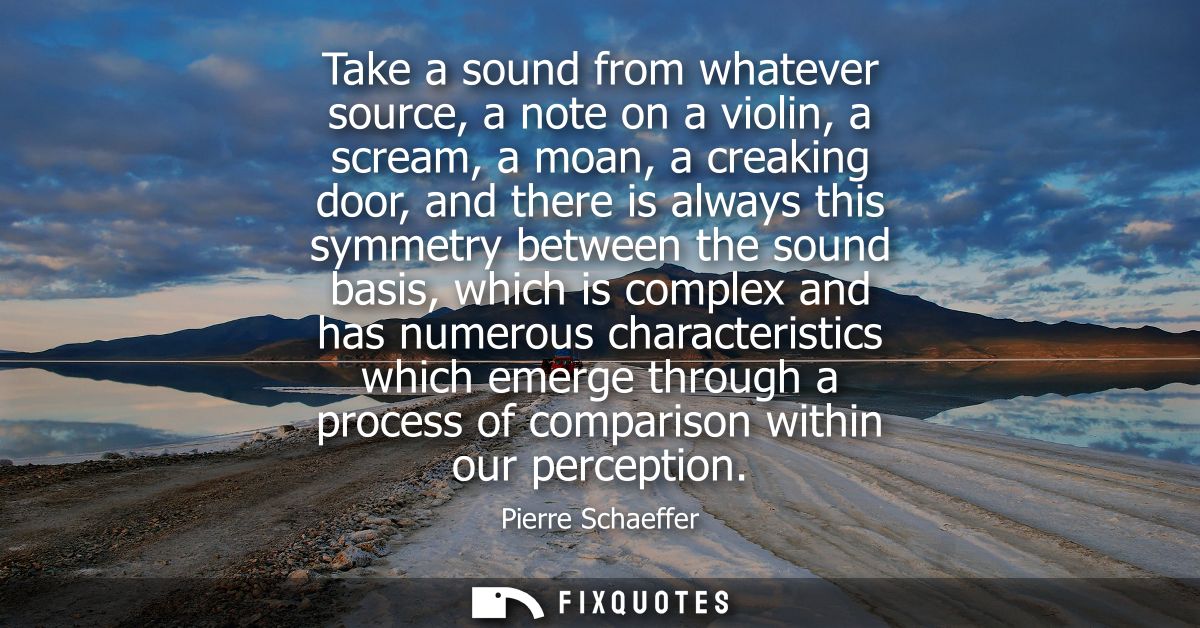
"Take a sound from whatever source, a note on a violin, a scream, a moan, a creaking door, and there is always this symmetry between the sound basis, which is complex and has numerous characteristics which emerge through a process of comparison within our perception"
About this Quote
The key move is “symmetry” between the messy physical event (“sound basis… complex”) and the order we experience (“comparison within our perception”). He’s arguing that meaning in sound isn’t simply found in the source; it’s manufactured in the act of listening. That’s an artist’s alibi and a composer’s mission statement. If perception is an active process of comparing timbres, attacks, textures, durations, then composition can begin anywhere: the studio, the street, the body, the machine.
Context matters: Schaeffer is the architect of musique concrete, working mid-century in the orbit of radio, recording, and playback technology. Tape makes the creaking door repeatable, isolatable, editable; it turns accidents into material. The subtext is a challenge to tradition’s obsession with notation and “pure” tones. By foregrounding perception, Schaeffer smuggles in a new authority figure: the listener as analyst, not just consumer. He’s not romanticizing the everyday soundscape; he’s proposing a discipline for it, a new ear trained to find pattern where culture once heard only interruption.
Quote Details
| Topic | Music |
|---|---|
| Source | Help us find the source |
| Cite |
Citation Formats
APA Style (7th ed.)
Schaeffer, Pierre. (2026, January 15). Take a sound from whatever source, a note on a violin, a scream, a moan, a creaking door, and there is always this symmetry between the sound basis, which is complex and has numerous characteristics which emerge through a process of comparison within our perception. FixQuotes. https://fixquotes.com/quotes/take-a-sound-from-whatever-source-a-note-on-a-115898/
Chicago Style
Schaeffer, Pierre. "Take a sound from whatever source, a note on a violin, a scream, a moan, a creaking door, and there is always this symmetry between the sound basis, which is complex and has numerous characteristics which emerge through a process of comparison within our perception." FixQuotes. January 15, 2026. https://fixquotes.com/quotes/take-a-sound-from-whatever-source-a-note-on-a-115898/.
MLA Style (9th ed.)
"Take a sound from whatever source, a note on a violin, a scream, a moan, a creaking door, and there is always this symmetry between the sound basis, which is complex and has numerous characteristics which emerge through a process of comparison within our perception." FixQuotes, 15 Jan. 2026, https://fixquotes.com/quotes/take-a-sound-from-whatever-source-a-note-on-a-115898/. Accessed 10 Mar. 2026.