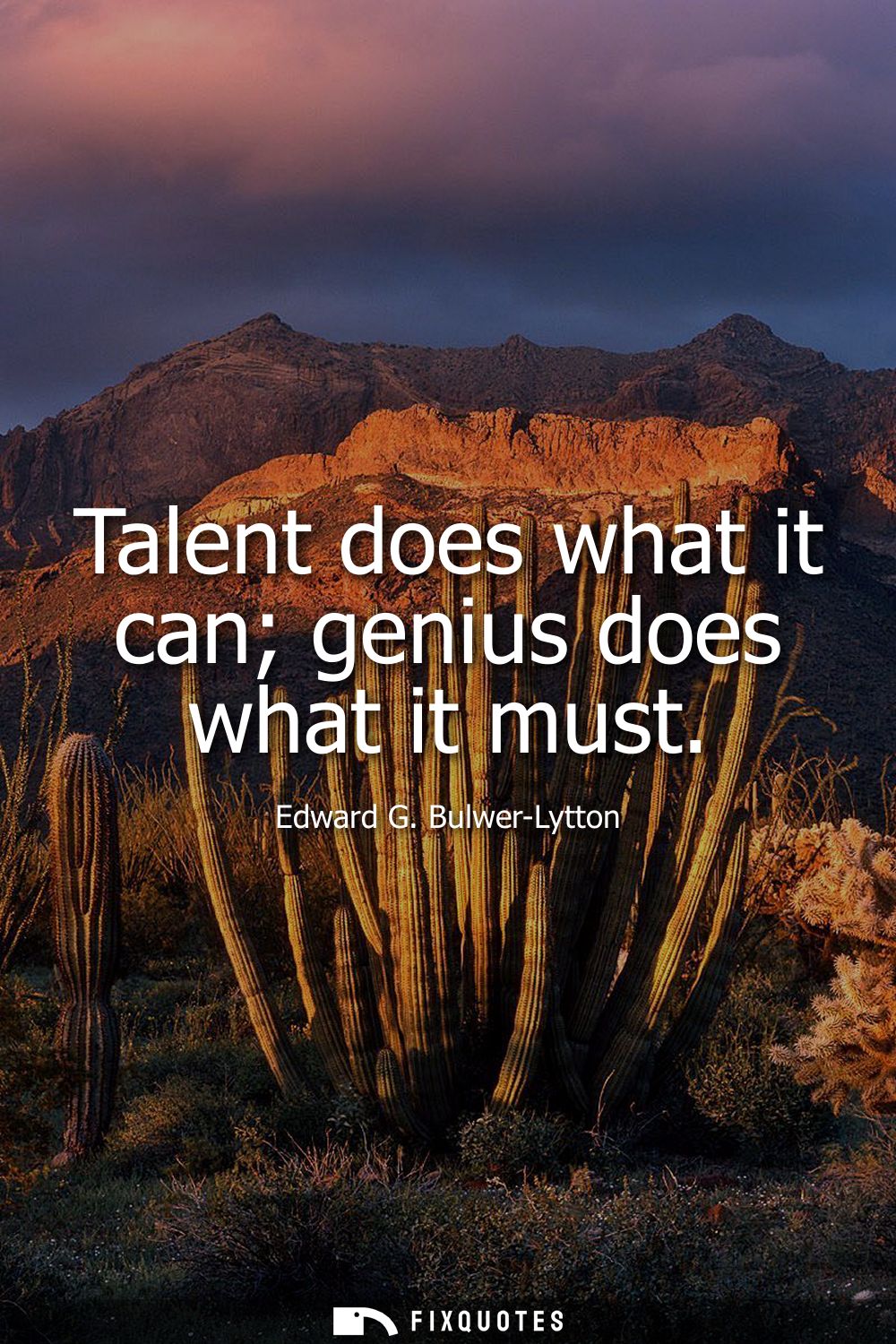
"Talent does what it can; genius does what it must"
About this Quote
A Victorian politician reaching for a theory of greatness wasn’t just being poetic; he was making a case for inevitability. "Talent does what it can; genius does what it must" draws a clean, almost bureaucratic line between ability and compulsion. Talent is framed as optionality: you survey your gifts, pick a lane, perform within the limits of circumstance. Genius, by contrast, is cast as a kind of internal mandate. The key word is "must" - a moral verb disguised as a description. It suggests that the highest form of creation isn’t self-expression, it’s obligation.
That’s a shrewd move in Bulwer-Lytton’s context. In an era obsessed with progress, empire, and the cultivation of "great men", the quote flatters ambition while stripping it of choice. If genius must act, then its disruptions, excesses, even its failures can be reframed as necessary collateral. The line gives permission to be difficult, to offend taste, to ignore convention - not because you want to, but because you can’t not.
There’s also political subtext. A parliamentarian knows the utility of framing decisions as unavoidable: necessity is how power launders preference. By romanticizing compulsion, Bulwer-Lytton turns creative dominance into destiny, insulating it from ordinary critique. Talent competes in the marketplace; genius answers to something higher, or at least claims it does. The aphorism works because it offers a seductive alibi: if you’re driven, you’re exceptional. If you’re exceptional, you’re excused.
That’s a shrewd move in Bulwer-Lytton’s context. In an era obsessed with progress, empire, and the cultivation of "great men", the quote flatters ambition while stripping it of choice. If genius must act, then its disruptions, excesses, even its failures can be reframed as necessary collateral. The line gives permission to be difficult, to offend taste, to ignore convention - not because you want to, but because you can’t not.
There’s also political subtext. A parliamentarian knows the utility of framing decisions as unavoidable: necessity is how power launders preference. By romanticizing compulsion, Bulwer-Lytton turns creative dominance into destiny, insulating it from ordinary critique. Talent competes in the marketplace; genius answers to something higher, or at least claims it does. The aphorism works because it offers a seductive alibi: if you’re driven, you’re exceptional. If you’re exceptional, you’re excused.
Quote Details
| Topic | Wisdom |
|---|---|
| Source | Help us find the source |
| Cite |
Citation Formats
APA Style (7th ed.)
Bulwer-Lytton, Edward G. (2026, January 14). Talent does what it can; genius does what it must. FixQuotes. https://fixquotes.com/quotes/talent-does-what-it-can-genius-does-what-it-must-137443/
Chicago Style
Bulwer-Lytton, Edward G. "Talent does what it can; genius does what it must." FixQuotes. January 14, 2026. https://fixquotes.com/quotes/talent-does-what-it-can-genius-does-what-it-must-137443/.
MLA Style (9th ed.)
"Talent does what it can; genius does what it must." FixQuotes, 14 Jan. 2026, https://fixquotes.com/quotes/talent-does-what-it-can-genius-does-what-it-must-137443/. Accessed 12 Feb. 2026.
More Quotes by Edward
Add to List