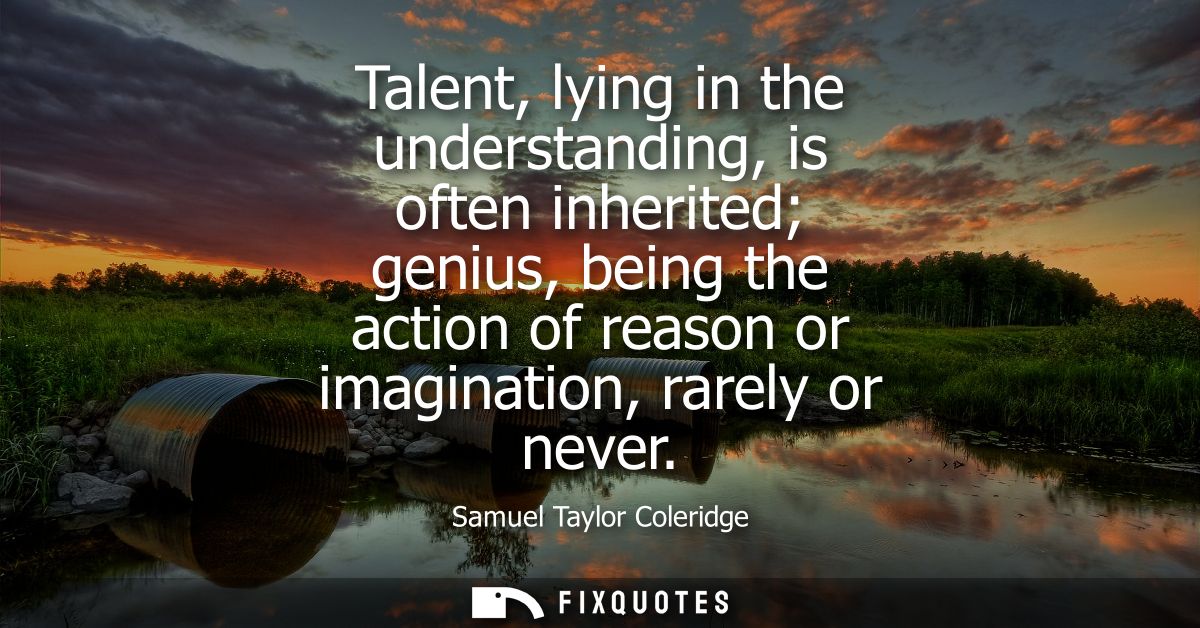
"Talent, lying in the understanding, is often inherited; genius, being the action of reason or imagination, rarely or never"
About this Quote
"Genius", in his framing, is less a possession than a burst of agency: "the action of reason or imagination". That word action matters. He is arguing that the rare thing isn’t mental horsepower but the catalytic moment when mind becomes creation, when thought is transmuted into a new form that didn’t previously have a template. By calling genius "rarely or never" inherited, Coleridge is resisting the comforting Enlightenment idea that brilliance is merely a better-equipped version of the same machinery. Genius, for a Romantic, is qualitative difference, not a higher score.
The subtext has teeth: if talent can be inherited, then the culture that fetishizes pedigree will keep mistaking privilege for brilliance. Coleridge wrote in an era obsessed with lineage and rising professional classes, when "natural" gifts were increasingly used to justify social sorting. His distinction is a quiet refusal of that logic. It also functions as self-defense for the Romantic project: poetry isn’t a parlor trick you get from good schooling; it’s an event of imagination that breaks inheritance patterns, including literary ones.
He’s not flattering genius as mystical. He’s elevating responsibility: genius is reason and imagination in motion, not a family heirloom.
Quote Details
| Topic | Reason & Logic |
|---|---|
| Source | Verified source: Specimens of the Table Talk of the Late Samuel Taylor Col... (Samuel Taylor Coleridge, 1835)
Evidence: Talent, lying in the understanding, is often inherited; genius, being the action of reason and imagination, rarely or never. (Dated entry: May 23, 1830 (exact page not verified from the digitized copy searched)). The quote appears in the primary-source volume 'Specimens of the Table Talk of the Late Samuel Taylor Coleridge', edited by Henry Nelson Coleridge and published in 1835. In the text, it is recorded under the dated conversation entry 'May 23. 1830' and printed under the heading 'Talent and Genius., Motives and Impulses.' This indicates the saying was spoken by Coleridge on May 23, 1830, but the earliest publication I verified is the 1835 book. Some modern quotation sites omit the word 'and' in 'reason and imagination'; the primary-source wording includes it. Other candidates (1) Prose Quotations from Socrates to Macaulay, with Indexes (Samuel Austin Allibone, 1876) compilation96.3% ... Talent , lying in the understanding , is often inherited ; genius , being the action of reason or imagination , r... |
| Cite |
Citation Formats
APA Style (7th ed.)
Coleridge, Samuel Taylor. (2026, March 12). Talent, lying in the understanding, is often inherited; genius, being the action of reason or imagination, rarely or never. FixQuotes. https://fixquotes.com/quotes/talent-lying-in-the-understanding-is-often-154781/
Chicago Style
Coleridge, Samuel Taylor. "Talent, lying in the understanding, is often inherited; genius, being the action of reason or imagination, rarely or never." FixQuotes. March 12, 2026. https://fixquotes.com/quotes/talent-lying-in-the-understanding-is-often-154781/.
MLA Style (9th ed.)
"Talent, lying in the understanding, is often inherited; genius, being the action of reason or imagination, rarely or never." FixQuotes, 12 Mar. 2026, https://fixquotes.com/quotes/talent-lying-in-the-understanding-is-often-154781/. Accessed 27 Mar. 2026.