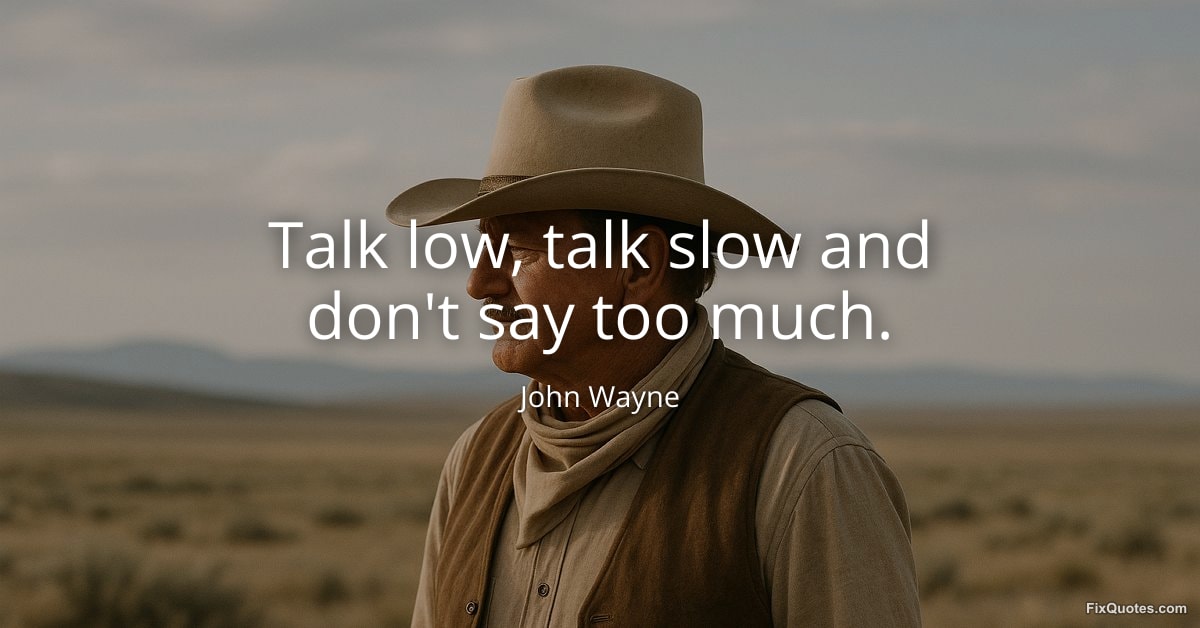
"Talk low, talk slow, and don't say too much"
About this Quote
John Wayne’s advice lands like a stage direction disguised as character philosophy: keep your voice down, pace your words, and treat speech as a limited resource. It’s not just “be polite.” It’s a blueprint for authority in a culture that reads restraint as strength. In Wayne’s screen universe, the loudest person is usually the most insecure, the most performative, the most likely to crack. The hero doesn’t need a speech; he needs composure.
“Talk low” is about control of the room. A lowered voice forces others to lean in, to adjust to you. It makes power feel effortless, almost natural, which is exactly the illusion Wayne perfected: masculinity as gravity rather than display. “Talk slow” stretches time. It signals you’re not chasing approval, not scrambling for words, not reacting. The cadence becomes a kind of moral posture: steady, unflustered, hard to corner.
The punchline is the last clause: “don’t say too much.” Wayne’s persona thrived on scarcity. Fewer words mean fewer liabilities, fewer confessions, fewer openings for contradiction. In a mid-century American context - where stoicism was marketed as virtue and emotional transparency could be read as weakness - silence becomes both armor and intimidation.
There’s also a transactional subtext: if you speak sparingly, people will project depth onto you. Wayne’s line is a lesson in how charisma can be engineered: not by having more to say, but by making every word feel like it cost something.
“Talk low” is about control of the room. A lowered voice forces others to lean in, to adjust to you. It makes power feel effortless, almost natural, which is exactly the illusion Wayne perfected: masculinity as gravity rather than display. “Talk slow” stretches time. It signals you’re not chasing approval, not scrambling for words, not reacting. The cadence becomes a kind of moral posture: steady, unflustered, hard to corner.
The punchline is the last clause: “don’t say too much.” Wayne’s persona thrived on scarcity. Fewer words mean fewer liabilities, fewer confessions, fewer openings for contradiction. In a mid-century American context - where stoicism was marketed as virtue and emotional transparency could be read as weakness - silence becomes both armor and intimidation.
There’s also a transactional subtext: if you speak sparingly, people will project depth onto you. Wayne’s line is a lesson in how charisma can be engineered: not by having more to say, but by making every word feel like it cost something.
Quote Details
| Topic | Wisdom |
|---|---|
| Source | Unverified source: What It's All About (John Wayne, 1992)
Evidence: The earliest primary, attributable publication I can verify from web-accessible sources is Michael Caine’s autobiography (1992), where Caine recounts John Wayne telling him (in the Beverly Hills Hotel lobby, in the 1960s) the advice: “Talk low, talk slow, and don’t say too f****** much.” This is ... Other candidates (2) The Serious Business of Small Talk (Carol A. Fleming, 2018) compilation95.0% ... John Wayne school of speech ? Talk low , talk slow , and don't say too much . Your low voice gets swamped in a so... John Wayne (John Wayne) compilation29.1% rightfully so but we cant all of a sudden get down on our knees and turn everyt |
| Cite |
Citation Formats
APA Style (7th ed.)
Wayne, John. (2026, February 16). Talk low, talk slow, and don't say too much. FixQuotes. https://fixquotes.com/quotes/talk-low-talk-slow-and-dont-say-too-much-32201/
Chicago Style
Wayne, John. "Talk low, talk slow, and don't say too much." FixQuotes. February 16, 2026. https://fixquotes.com/quotes/talk-low-talk-slow-and-dont-say-too-much-32201/.
MLA Style (9th ed.)
"Talk low, talk slow, and don't say too much." FixQuotes, 16 Feb. 2026, https://fixquotes.com/quotes/talk-low-talk-slow-and-dont-say-too-much-32201/. Accessed 11 Mar. 2026.
More Quotes by John
Add to List