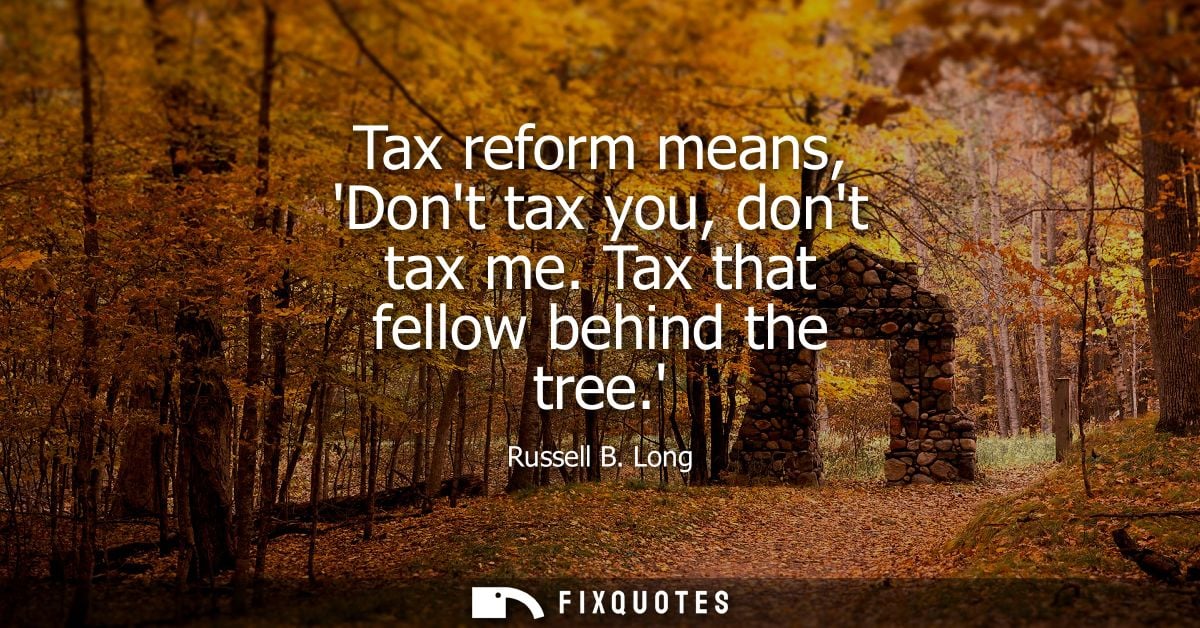
"Tax reform means, 'Don't tax you, don't tax me. Tax that fellow behind the tree.'"
About this Quote
Long wasn't an outsider heckling the system; he was a powerful Senate finance chair from Louisiana, steeped in the horse-trading realities of mid-century tax politics. That background is the subtext. He's admitting, with a wink, that "reform" often means redistributing pain to those with less political leverage: unpopular industries, distant corporations, "special interests" no one will defend on talk radio, or simply taxpayers who are easier to ignore because they're diffuse or poorly organized.
The quote's real target is moral posturing. It anticipates how politicians sell tax changes as neutral technocratic improvements while quietly protecting constituencies at home. Long turns the whole debate into a visibility problem: if you can hide the target behind a tree, you can call it fairness and still get reelected.
Quote Details
| Topic | Witty One-Liners |
|---|---|
| Source | Attributed to Russell B. Long (U.S. Senator). Cited on the Wikiquote page for Russell B. Long: "Tax reform means, 'Don't tax you, don't tax me. Tax that fellow behind the tree.'" |
| Cite |
Citation Formats
APA Style (7th ed.)
Long, Russell B. (2026, January 14). Tax reform means, 'Don't tax you, don't tax me. Tax that fellow behind the tree.'. FixQuotes. https://fixquotes.com/quotes/tax-reform-means-dont-tax-you-dont-tax-me-tax-106815/
Chicago Style
Long, Russell B. "Tax reform means, 'Don't tax you, don't tax me. Tax that fellow behind the tree.'." FixQuotes. January 14, 2026. https://fixquotes.com/quotes/tax-reform-means-dont-tax-you-dont-tax-me-tax-106815/.
MLA Style (9th ed.)
"Tax reform means, 'Don't tax you, don't tax me. Tax that fellow behind the tree.'." FixQuotes, 14 Jan. 2026, https://fixquotes.com/quotes/tax-reform-means-dont-tax-you-dont-tax-me-tax-106815/. Accessed 22 Mar. 2026.