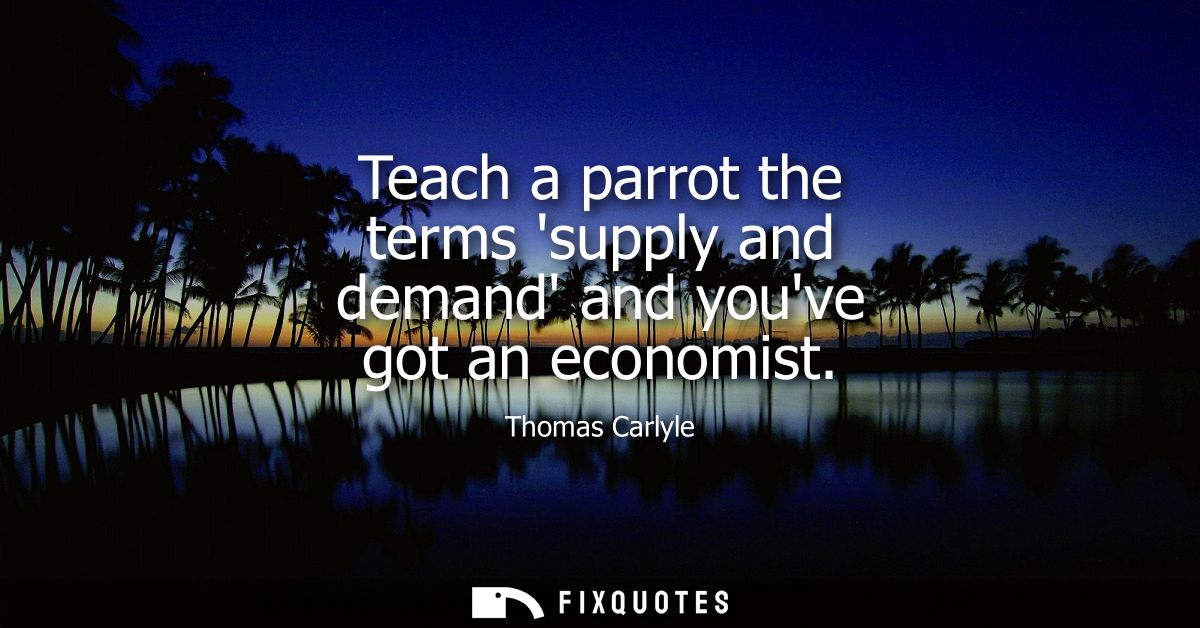
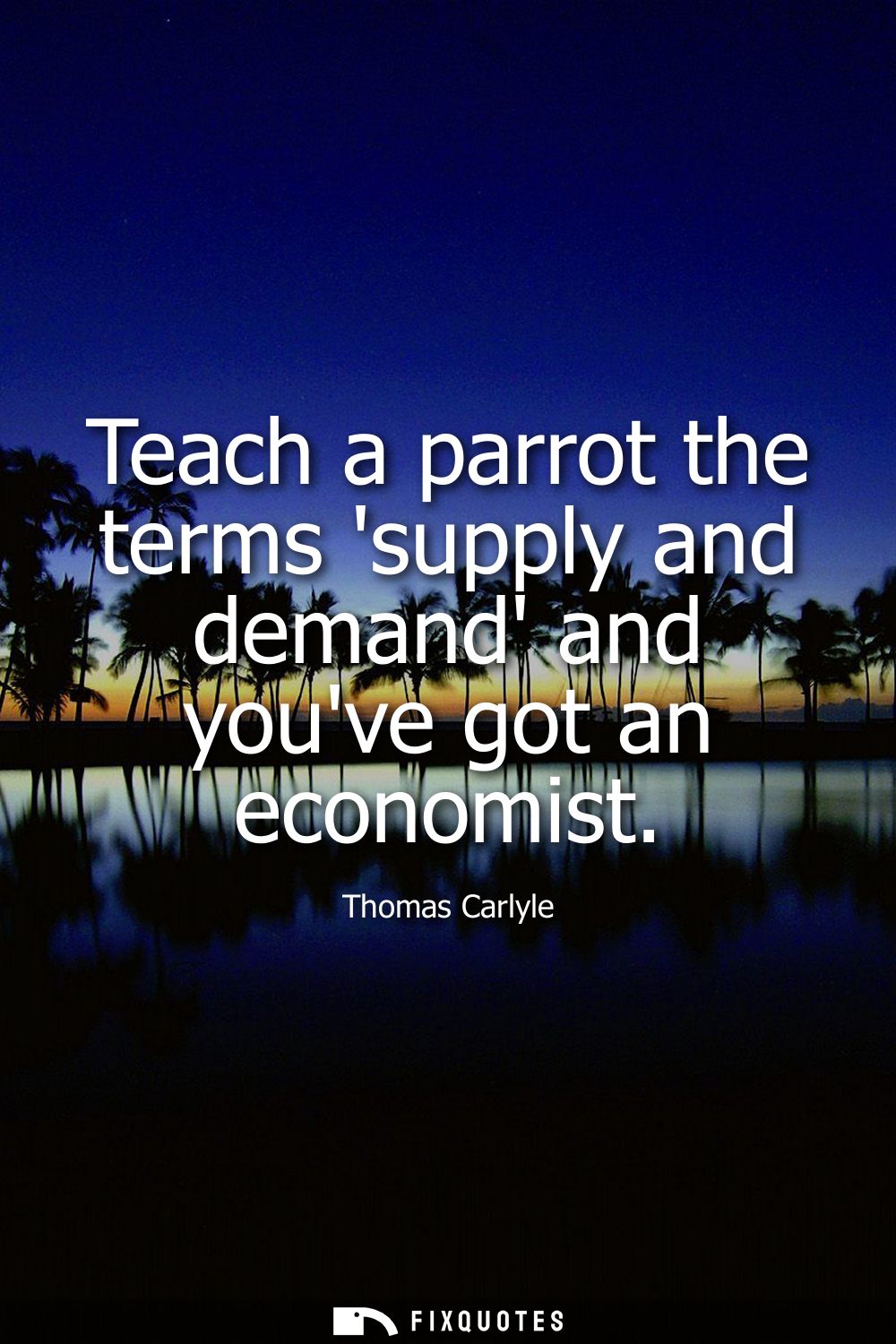
"Teach a parrot the terms 'supply and demand' and you've got an economist"
About this Quote
The target is classical political economy in the wake of the factory system, a moment when “supply and demand” began to function as both explanation and alibi. Carlyle, steeped in moral and spiritual critique, hears in that tidy mechanism a way to launder cruelty into inevitability. If wages are low or poverty persists, the parroted logic can shrug: the market spoke. His subtext is that language like this disciplines empathy, replacing ethical responsibility with a neutral-sounding law of nature.
It also works because it’s aggressively asymmetric: two words versus an entire field. That exaggeration is the satire. Carlyle isn’t arguing economics has no insights; he’s accusing it of becoming a faith that mistakes vocabulary for vision. The quip still stings today because our culture still rewards the confident recital of frameworks - especially ones that promise a clean, amoral answer to messy human problems.
Quote Details
| Topic | Witty One-Liners |
|---|---|
| Source | Help us find the source |
| Cite |
Citation Formats
APA Style (7th ed.)
Carlyle, Thomas. (2026, January 17). Teach a parrot the terms 'supply and demand' and you've got an economist. FixQuotes. https://fixquotes.com/quotes/teach-a-parrot-the-terms-supply-and-demand-and-33082/
Chicago Style
Carlyle, Thomas. "Teach a parrot the terms 'supply and demand' and you've got an economist." FixQuotes. January 17, 2026. https://fixquotes.com/quotes/teach-a-parrot-the-terms-supply-and-demand-and-33082/.
MLA Style (9th ed.)
"Teach a parrot the terms 'supply and demand' and you've got an economist." FixQuotes, 17 Jan. 2026, https://fixquotes.com/quotes/teach-a-parrot-the-terms-supply-and-demand-and-33082/. Accessed 2 Apr. 2026.