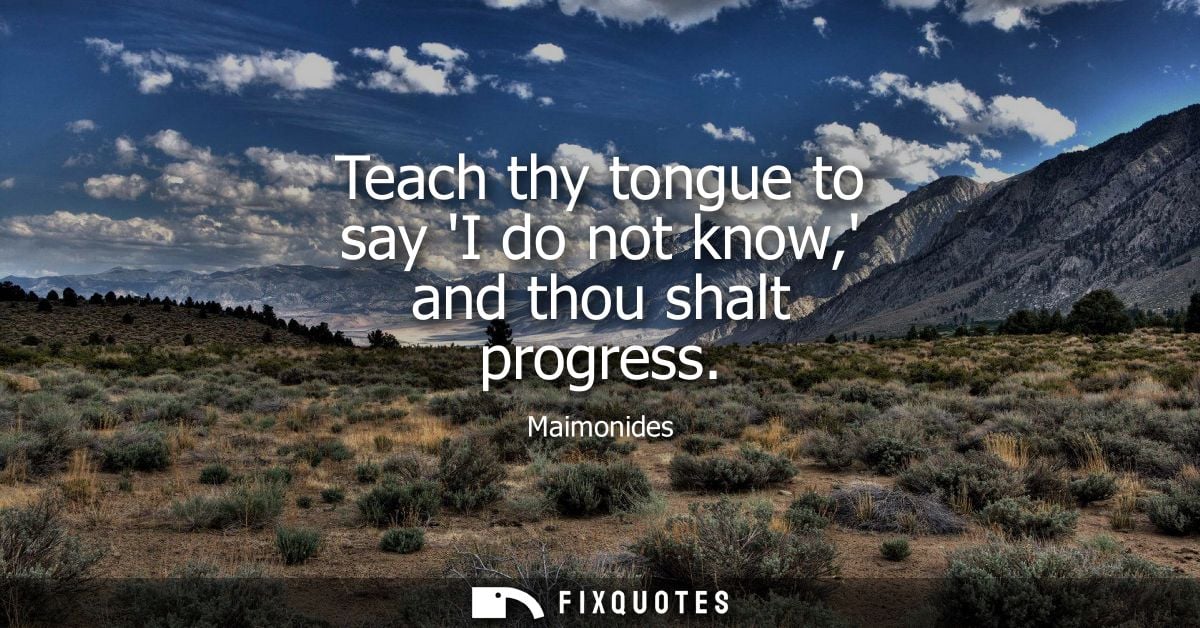
"Teach thy tongue to say 'I do not know,' and thou shalt progress"
About this Quote
Humility is doing the hardest thing a brilliant person can do: putting "I do not know" into public circulation. Maimonides frames it as a discipline of the tongue, not a private feeling. That detail matters. In a culture where authority is performed through confident speech - rabbinic legal argument, courtly debate, medical expertise - ignorance isn’t just a gap in knowledge; it’s a reputational risk. He treats that risk as the price of admission to progress.
The line’s subtext is quietly combative. It rejects the idea that wisdom is a hoard you defend and instead casts learning as a motion you can only sustain by admitting where you’re stuck. "Teach" implies training against instinct: the reflex to bluff, to generalize, to offer a plausible answer because silence feels like defeat. By making uncertainty speakable, Maimonides also makes inquiry possible; questions can only land when the ego stops intercepting them.
Context sharpens the stakes. Maimonides lived at the crossroads of Jewish law, Aristotelian philosophy, and medieval medicine, writing for communities anxious about how faith and reason could coexist without collapsing into either credulity or cynicism. In that world, saying "I do not know" is not skepticism for its own sake. It’s intellectual hygiene, a safeguard against false certainty dressed up as piety or scholarship.
The promise - "thou shalt progress" - is almost clinical: not enlightenment, not virtue signaling, just forward movement. The paradox is the point. Admitting ignorance looks like retreat, but it’s the only honest step that actually advances.
The line’s subtext is quietly combative. It rejects the idea that wisdom is a hoard you defend and instead casts learning as a motion you can only sustain by admitting where you’re stuck. "Teach" implies training against instinct: the reflex to bluff, to generalize, to offer a plausible answer because silence feels like defeat. By making uncertainty speakable, Maimonides also makes inquiry possible; questions can only land when the ego stops intercepting them.
Context sharpens the stakes. Maimonides lived at the crossroads of Jewish law, Aristotelian philosophy, and medieval medicine, writing for communities anxious about how faith and reason could coexist without collapsing into either credulity or cynicism. In that world, saying "I do not know" is not skepticism for its own sake. It’s intellectual hygiene, a safeguard against false certainty dressed up as piety or scholarship.
The promise - "thou shalt progress" - is almost clinical: not enlightenment, not virtue signaling, just forward movement. The paradox is the point. Admitting ignorance looks like retreat, but it’s the only honest step that actually advances.
Quote Details
| Topic | Humility |
|---|---|
| Source | Help us find the source |
| Cite |
Citation Formats
APA Style (7th ed.)
Maimonides. (2026, January 17). Teach thy tongue to say 'I do not know,' and thou shalt progress. FixQuotes. https://fixquotes.com/quotes/teach-thy-tongue-to-say-i-do-not-know-and-thou-70135/
Chicago Style
Maimonides. "Teach thy tongue to say 'I do not know,' and thou shalt progress." FixQuotes. January 17, 2026. https://fixquotes.com/quotes/teach-thy-tongue-to-say-i-do-not-know-and-thou-70135/.
MLA Style (9th ed.)
"Teach thy tongue to say 'I do not know,' and thou shalt progress." FixQuotes, 17 Jan. 2026, https://fixquotes.com/quotes/teach-thy-tongue-to-say-i-do-not-know-and-thou-70135/. Accessed 12 Feb. 2026.
More Quotes by Maimonides
Add to List