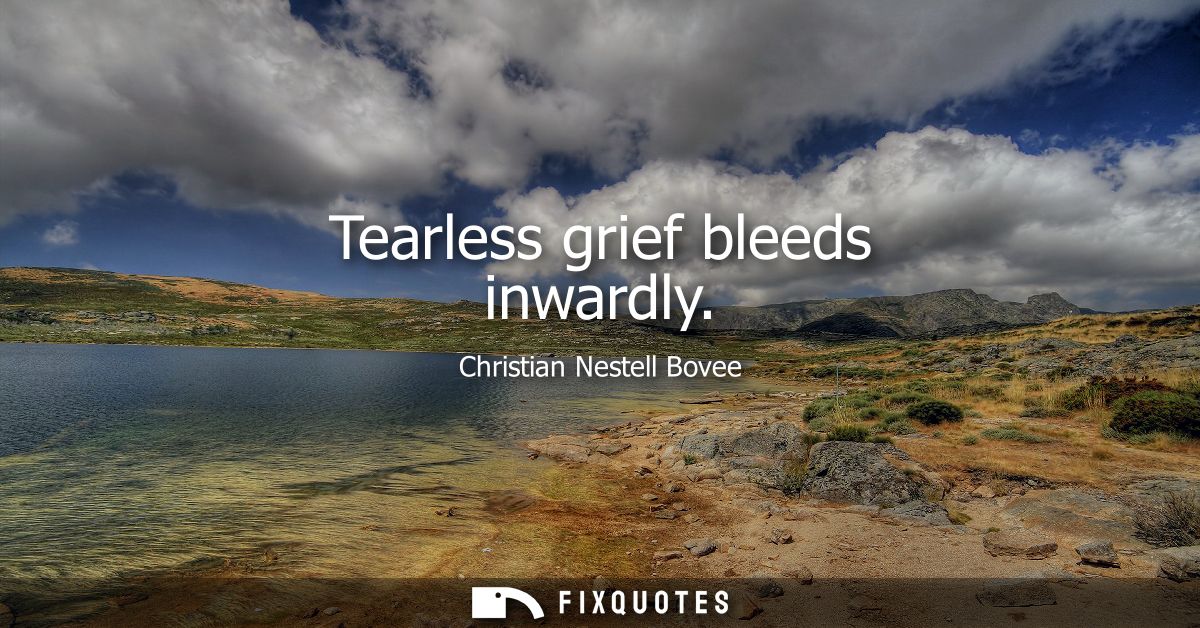
"Tearless grief bleeds inwardly"
About this Quote
There is something almost accusatory in Bovee's image: grief that does not perform itself becomes a private wound. "Tearless" isn’t stoic strength here; it’s a sealed valve. By making grief "bleed", Bovee smuggles the body into what could have been a moral lesson, turning emotion into physiology. The line insists that feeling has a circulatory system, and if you block the obvious outlet - tears - the pressure doesn’t disappear. It relocates.
The subtext is a quiet critique of the 19th-century premium on composure. In Bovee's era, respectable sorrow had rules: men were expected to keep a stiff upper lip, women to grieve within decorum, everyone to avoid messy public need. "Bleeds inwardly" exposes the cost of that discipline. It suggests that unexpressed grief doesn't become nobler; it becomes corrosive, turning the self into the site of damage. The metaphor also reframes tears as functional, even hygienic - not weakness but drainage.
Bovee, an American aphorist, wrote in a culture that loved moral maxims and self-command, the same ecosystem that produced "character-building" platitudes. This one works because it refuses the congratulatory tone of stoicism. It’s not praising restraint; it’s warning about it. The sting is that the absence of visible suffering can be mistaken for absence of suffering, leaving the tearless griever isolated, untreated, and slowly hemorrhaging where no one can see.
The subtext is a quiet critique of the 19th-century premium on composure. In Bovee's era, respectable sorrow had rules: men were expected to keep a stiff upper lip, women to grieve within decorum, everyone to avoid messy public need. "Bleeds inwardly" exposes the cost of that discipline. It suggests that unexpressed grief doesn't become nobler; it becomes corrosive, turning the self into the site of damage. The metaphor also reframes tears as functional, even hygienic - not weakness but drainage.
Bovee, an American aphorist, wrote in a culture that loved moral maxims and self-command, the same ecosystem that produced "character-building" platitudes. This one works because it refuses the congratulatory tone of stoicism. It’s not praising restraint; it’s warning about it. The sting is that the absence of visible suffering can be mistaken for absence of suffering, leaving the tearless griever isolated, untreated, and slowly hemorrhaging where no one can see.
Quote Details
| Topic | Sadness |
|---|---|
| Source | Help us find the source |
| Cite |
Citation Formats
APA Style (7th ed.)
Bovee, Christian Nestell. (2026, January 15). Tearless grief bleeds inwardly. FixQuotes. https://fixquotes.com/quotes/tearless-grief-bleeds-inwardly-41511/
Chicago Style
Bovee, Christian Nestell. "Tearless grief bleeds inwardly." FixQuotes. January 15, 2026. https://fixquotes.com/quotes/tearless-grief-bleeds-inwardly-41511/.
MLA Style (9th ed.)
"Tearless grief bleeds inwardly." FixQuotes, 15 Jan. 2026, https://fixquotes.com/quotes/tearless-grief-bleeds-inwardly-41511/. Accessed 27 Mar. 2026.
More Quotes by Christian
Add to List