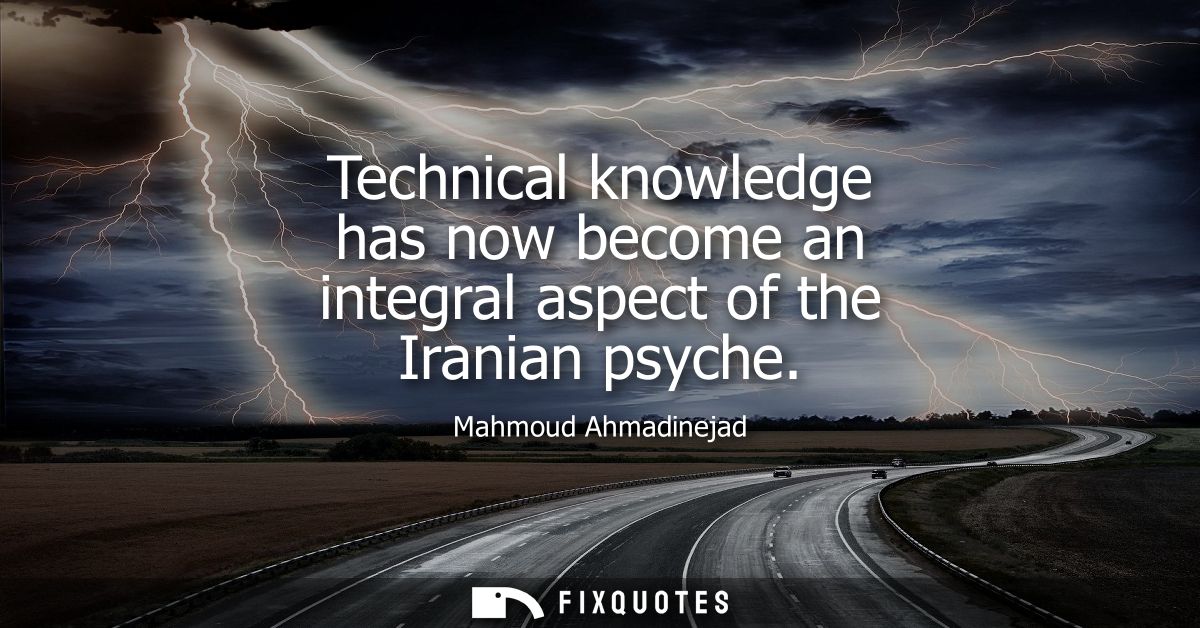
"Technical knowledge has now become an integral aspect of the Iranian psyche"
About this Quote
A statesman doesn’t talk about a nation’s “psyche” unless he’s trying to make policy sound like destiny. Ahmadinejad’s line turns technical capacity from a set of institutions and training programs into something innate, almost biological: Iranians don’t merely learn technology; they supposedly embody it. That rhetorical move matters because it reframes contested projects (especially nuclear development, missiles, and industrial self-sufficiency) as expressions of identity rather than choices with costs, risks, and oversight. If it’s “integral,” then skepticism becomes a kind of self-betrayal.
The phrase also smuggles a quiet rebuke to the familiar Western caricature of Iran as either premodern or irrational. By claiming technical knowledge as psychological inheritance, he flips the script: sanctions and pressure aren’t disciplining a laggard state, they’re obstructing a people whose modernity is presented as natural and overdue. It’s nationalism in the register of STEM, a bid to unite pride, grievance, and resilience under one banner.
Context sharpens the intent. Ahmadinejad governed during escalating standoffs over Iran’s nuclear program and tightening international sanctions. In that climate, “technical knowledge” doubles as a euphemism for strategic capability: what Iran knows how to do, it can refuse to un-know. The subtext is permanence. Negotiations may pause enrichment, but they can’t roll back an “integral aspect” of the national self. That’s not just messaging to foreign powers; it’s discipline at home, calling on students, engineers, and ordinary citizens to see endurance as patriotism and expertise as sovereignty.
The phrase also smuggles a quiet rebuke to the familiar Western caricature of Iran as either premodern or irrational. By claiming technical knowledge as psychological inheritance, he flips the script: sanctions and pressure aren’t disciplining a laggard state, they’re obstructing a people whose modernity is presented as natural and overdue. It’s nationalism in the register of STEM, a bid to unite pride, grievance, and resilience under one banner.
Context sharpens the intent. Ahmadinejad governed during escalating standoffs over Iran’s nuclear program and tightening international sanctions. In that climate, “technical knowledge” doubles as a euphemism for strategic capability: what Iran knows how to do, it can refuse to un-know. The subtext is permanence. Negotiations may pause enrichment, but they can’t roll back an “integral aspect” of the national self. That’s not just messaging to foreign powers; it’s discipline at home, calling on students, engineers, and ordinary citizens to see endurance as patriotism and expertise as sovereignty.
Quote Details
| Topic | Technology |
|---|
More Quotes by Mahmoud
Add to List