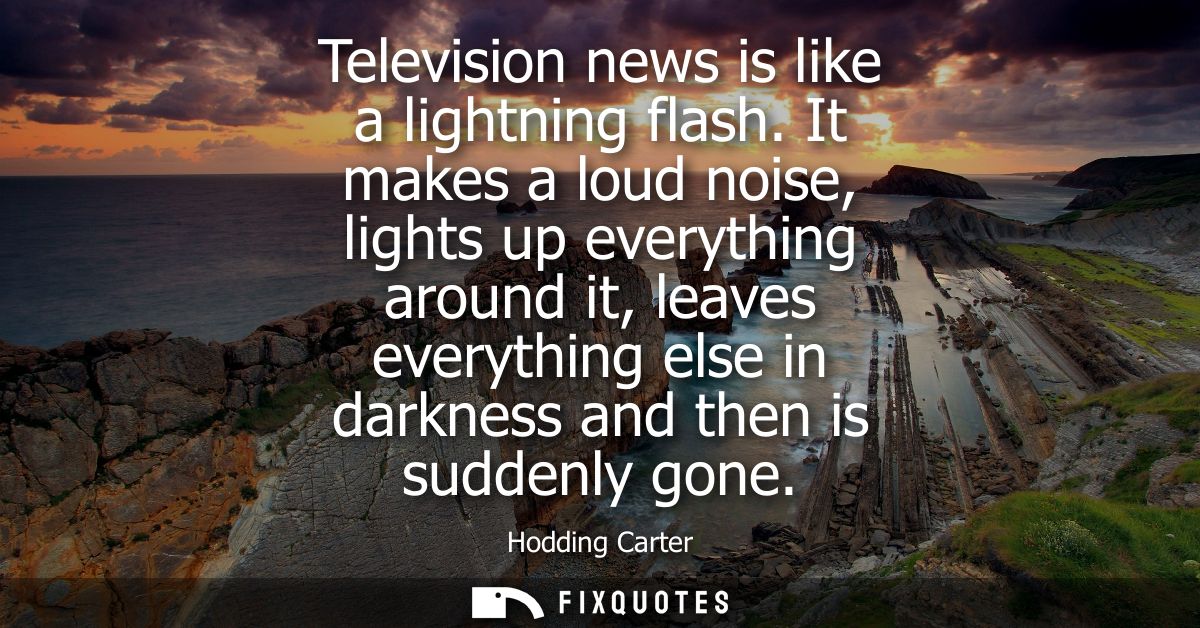
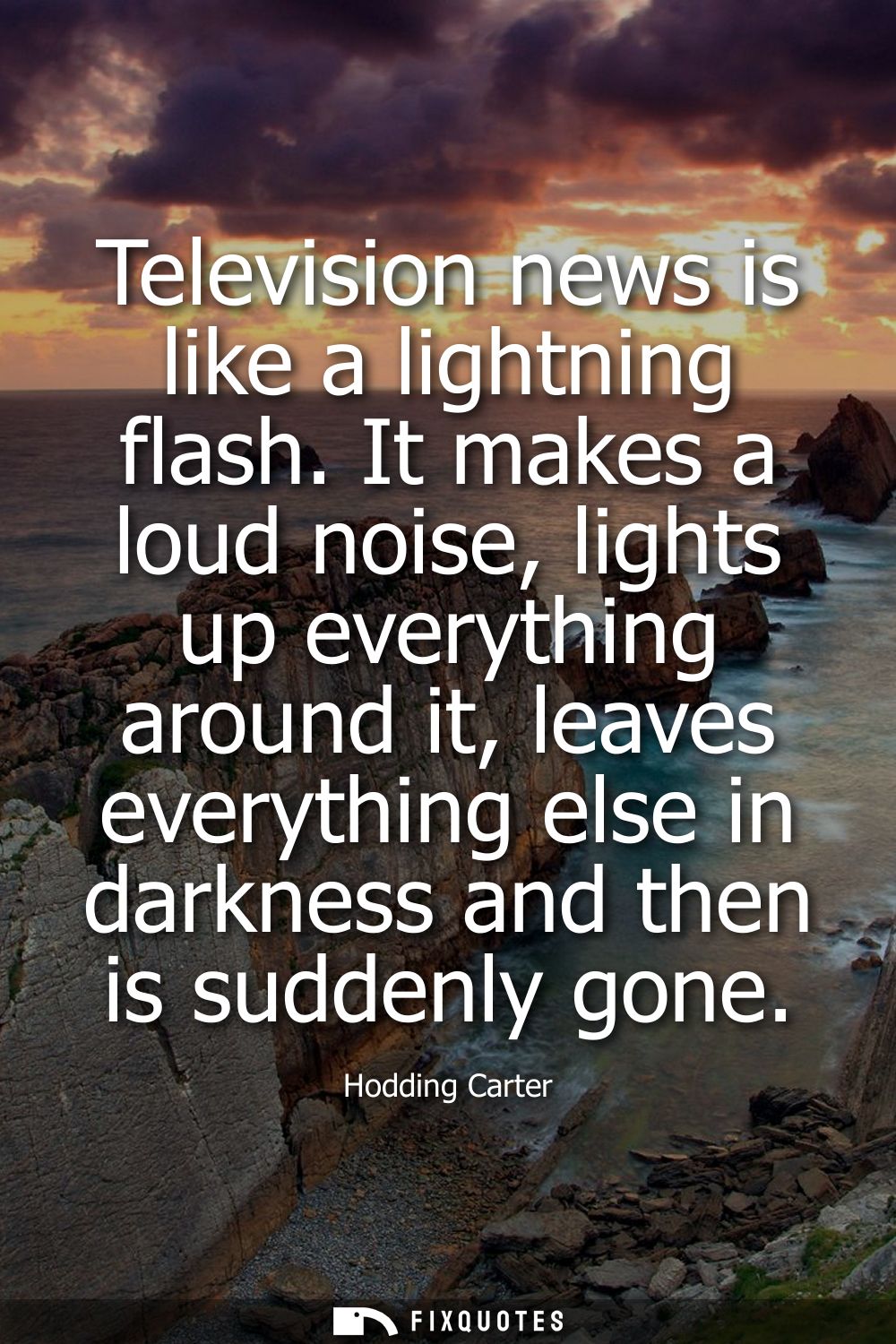
"Television news is like a lightning flash. It makes a loud noise, lights up everything around it, leaves everything else in darkness and then is suddenly gone"
About this Quote
Carter, a journalist shaped by the slower disciplines of print and civic reporting, is warning about a trade: intensity for understanding. The subtext is less "TV is bad" than "TV trains the public to mistake illumination for insight". The newscast delivers high-contrast fragments: a crisis, a face, a burning building, an election-night graphic. What it cannot easily deliver is the boring connective tissue - history, motives, competing accounts, consequences - because that requires duration, and duration risks channel-changing. The form pressures the content into breathless present tense, then moves on before meaning can congeal.
Context matters. Mid-century television was becoming the dominant national storyteller, compressing a sprawling country into a synchronized nightly ritual. That ritual created a shared agenda while narrowing the window through which reality appeared: if the cameras didn't point at it, it might as well be dark. Carter's line anticipates a problem that only intensifies in an attention economy: news as a sequence of detonations. The damage isn't only distraction. It's a civic mood of permanent emergency, where the next flash replaces the last before anyone can ask what, exactly, just happened.
Quote Details
| Topic | Witty One-Liners |
|---|---|
| Source | Later attribution: Almanac of the Infamous, the Incredible, and the Ignored (Juanita Rose Violini, 2009) modern compilationISBN: 9781578634477 · ID: gABJAwAAQBAJ
Evidence:
... Television news is like a lightning flash . It makes a loud noise , lights up everything around it , leaves everything else in darkness and then is suddenly gone . -HODDING CARTER SECRET POWER : Today's power brings the force of change ... |
| Cite |
Citation Formats
APA Style (7th ed.)
Carter, Hodding. (2026, February 13). Television news is like a lightning flash. It makes a loud noise, lights up everything around it, leaves everything else in darkness and then is suddenly gone. FixQuotes. https://fixquotes.com/quotes/television-news-is-like-a-lightning-flash-it-122461/
Chicago Style
Carter, Hodding. "Television news is like a lightning flash. It makes a loud noise, lights up everything around it, leaves everything else in darkness and then is suddenly gone." FixQuotes. February 13, 2026. https://fixquotes.com/quotes/television-news-is-like-a-lightning-flash-it-122461/.
MLA Style (9th ed.)
"Television news is like a lightning flash. It makes a loud noise, lights up everything around it, leaves everything else in darkness and then is suddenly gone." FixQuotes, 13 Feb. 2026, https://fixquotes.com/quotes/television-news-is-like-a-lightning-flash-it-122461/. Accessed 27 Mar. 2026.