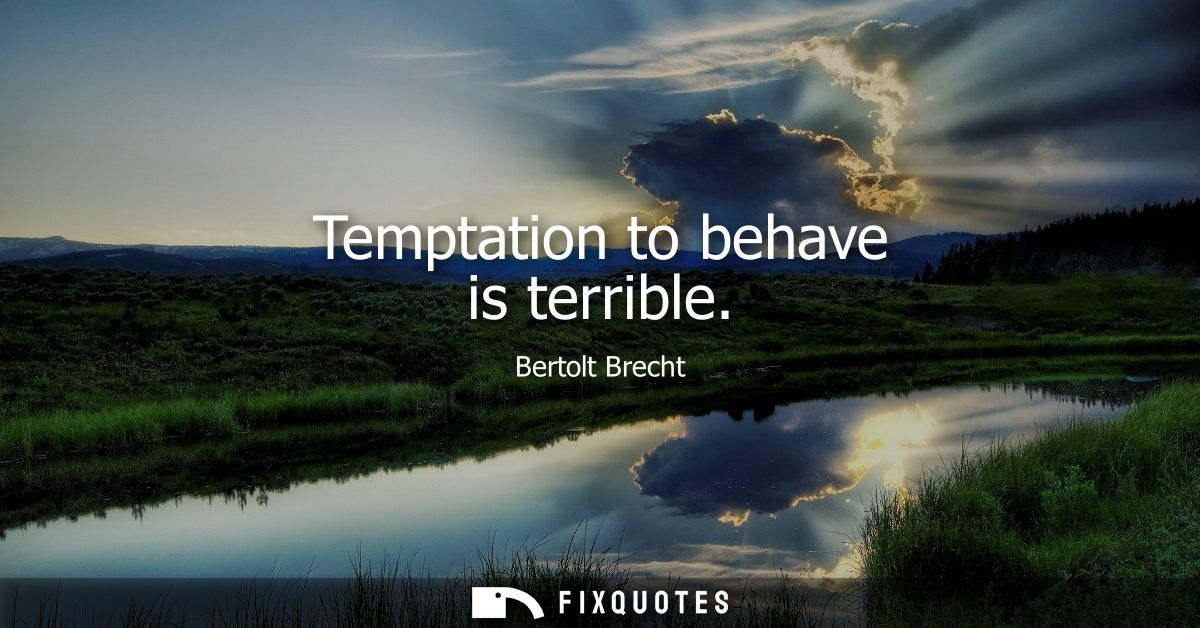
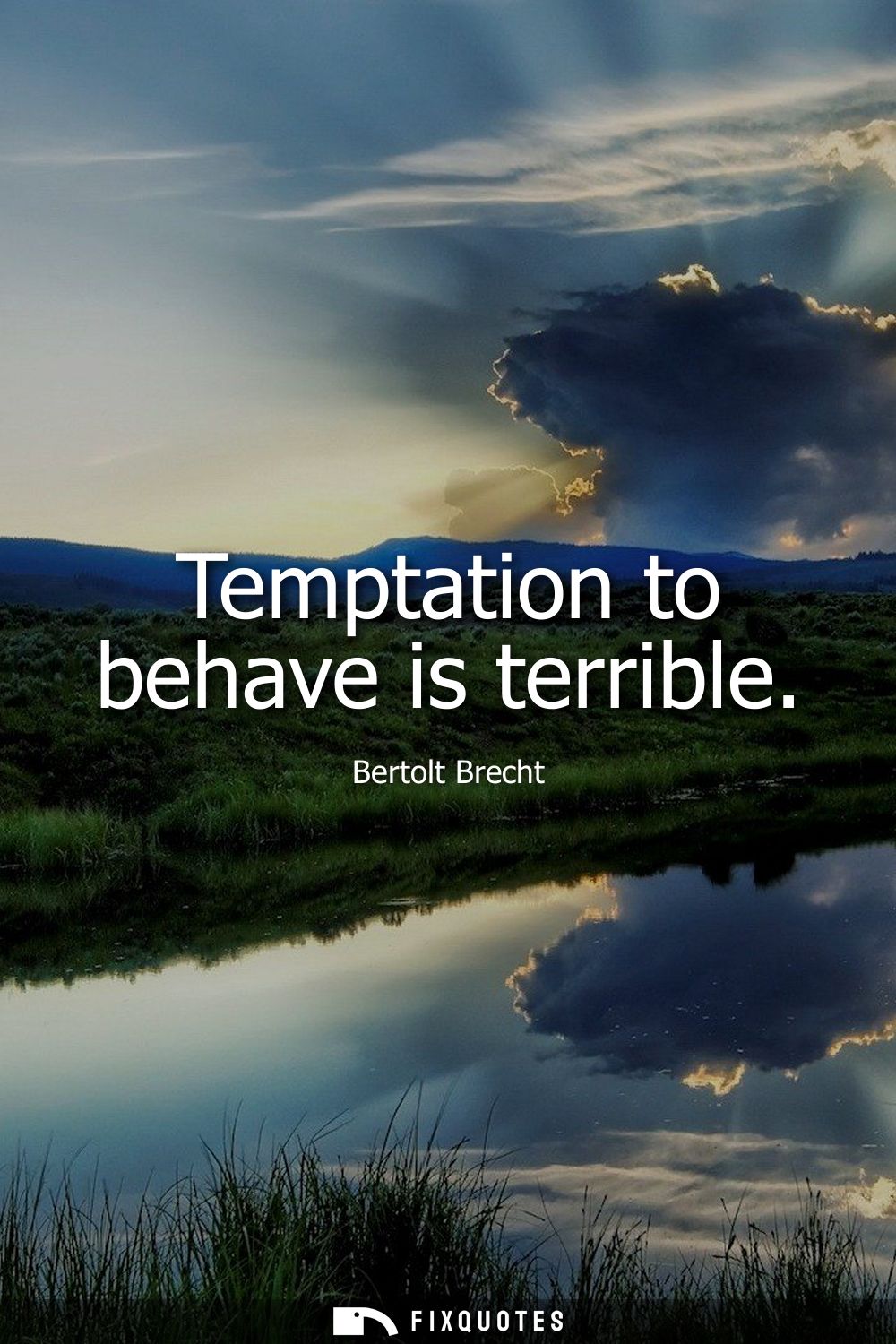
"Temptation to behave is terrible"
About this Quote
Brecht’s line is a small provocation with a knife hidden in it: “Temptation to behave” sounds like a virtue until you hear the sneer. “Behave” isn’t morality here; it’s compliance, the social reflex to stay quiet, keep your head down, and accept whatever order is already in place. By calling that impulse a “temptation,” Brecht flips the usual moral script. The real danger isn’t sinning. It’s choosing comfort over conscience.
The punch comes from the adjective. “Terrible” doesn’t mean mildly regrettable; it suggests something coercive, almost bodily. Brecht knew how obedience recruits fear, fatigue, and hunger. In the Germany that shaped him, “good behavior” could mean collaboration by default: not asking where your neighbor went, not noticing which books disappeared, not seeing the machinery because you’re busy being “reasonable.” The line reads like a warning to the politically awake: the state doesn’t only threaten; it seduces.
As a playwright and poet committed to agitprop and the alienation effect, Brecht specialized in making the familiar feel suspect. This is that technique in miniature. The phrase exposes how “being good” can become a self-justifying performance - a way to feel clean while doing nothing. It’s also self-incriminating. Brecht isn’t scolding a faceless public; he’s naming the private urge every dissenter recognizes: the longing to stop resisting, to be liked, to be safe. That’s why it works. It doesn’t romanticize rebellion; it admits how exhausting it is to keep refusing the easy part.
The punch comes from the adjective. “Terrible” doesn’t mean mildly regrettable; it suggests something coercive, almost bodily. Brecht knew how obedience recruits fear, fatigue, and hunger. In the Germany that shaped him, “good behavior” could mean collaboration by default: not asking where your neighbor went, not noticing which books disappeared, not seeing the machinery because you’re busy being “reasonable.” The line reads like a warning to the politically awake: the state doesn’t only threaten; it seduces.
As a playwright and poet committed to agitprop and the alienation effect, Brecht specialized in making the familiar feel suspect. This is that technique in miniature. The phrase exposes how “being good” can become a self-justifying performance - a way to feel clean while doing nothing. It’s also self-incriminating. Brecht isn’t scolding a faceless public; he’s naming the private urge every dissenter recognizes: the longing to stop resisting, to be liked, to be safe. That’s why it works. It doesn’t romanticize rebellion; it admits how exhausting it is to keep refusing the easy part.
Quote Details
| Topic | Witty One-Liners |
|---|---|
| Source | Help us find the source |
| Cite |
Citation Formats
APA Style (7th ed.)
Brecht, Bertolt. (2026, January 18). Temptation to behave is terrible. FixQuotes. https://fixquotes.com/quotes/temptation-to-behave-is-terrible-12930/
Chicago Style
Brecht, Bertolt. "Temptation to behave is terrible." FixQuotes. January 18, 2026. https://fixquotes.com/quotes/temptation-to-behave-is-terrible-12930/.
MLA Style (9th ed.)
"Temptation to behave is terrible." FixQuotes, 18 Jan. 2026, https://fixquotes.com/quotes/temptation-to-behave-is-terrible-12930/. Accessed 26 Mar. 2026.
More Quotes by Bertolt
Add to List