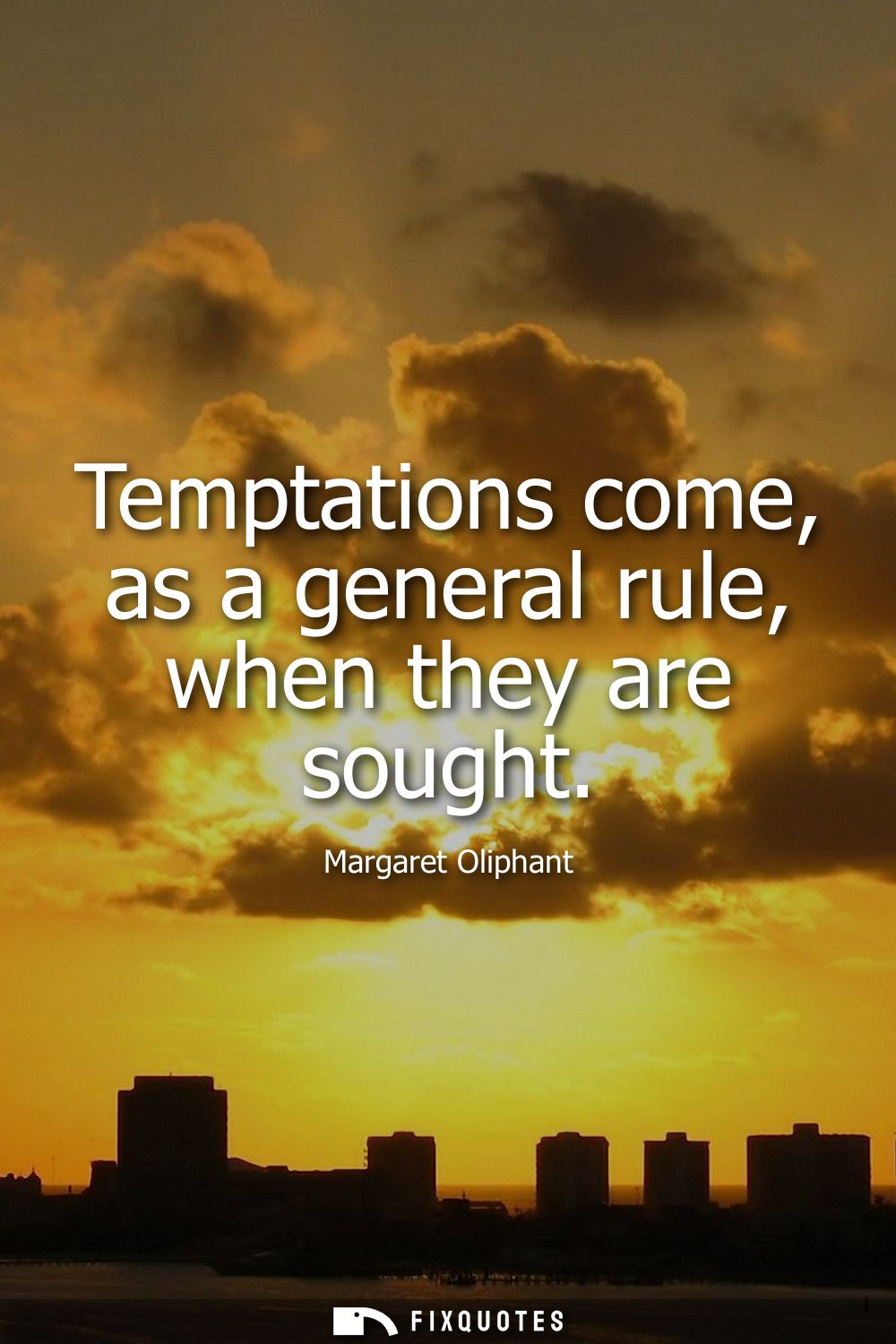
"Temptations come, as a general rule, when they are sought"
About this Quote
Temptation, in Oliphant's hands, isn’t some random lightning strike from the moral heavens; it’s an appointment you quietly schedule. The line lands with the cool practicality of a Victorian novelist who understands that “accident” is often just desire wearing a bonnet. By adding “as a general rule,” Oliphant avoids sermonizing and gains credibility: she’s not claiming people never get blindsided, only that most of what we call temptation is self-inflicted proximity. We drift toward the edge, then act surprised by the view.
The intent is less to shame than to diagnose. Oliphant is pointing at the pre-temptation moment, the small decisions that let the future bad choice feel inevitable: the extra visit, the private letter, the lingering glance, the carefully “innocent” scenario built to test one’s virtue while providing plausible deniability. In the Victorian moral universe, where reputation is both currency and cage, temptation is rarely a dramatic intruder; it’s a social choreography. You don’t have to announce your longings to pursue them. You just have to create conditions where they can plausibly happen.
The subtext is sharp: we like the story where we were tempted because it absolves us. “It happened to me” is cleaner than “I went looking.” Oliphant punctures that alibi, suggesting moral life is mostly logistics. Control the routes you take, the rooms you enter, the people you “happen” to see, and you control far more than your willpower ever could.
The intent is less to shame than to diagnose. Oliphant is pointing at the pre-temptation moment, the small decisions that let the future bad choice feel inevitable: the extra visit, the private letter, the lingering glance, the carefully “innocent” scenario built to test one’s virtue while providing plausible deniability. In the Victorian moral universe, where reputation is both currency and cage, temptation is rarely a dramatic intruder; it’s a social choreography. You don’t have to announce your longings to pursue them. You just have to create conditions where they can plausibly happen.
The subtext is sharp: we like the story where we were tempted because it absolves us. “It happened to me” is cleaner than “I went looking.” Oliphant punctures that alibi, suggesting moral life is mostly logistics. Control the routes you take, the rooms you enter, the people you “happen” to see, and you control far more than your willpower ever could.
Quote Details
| Topic | Self-Discipline |
|---|---|
| Source | Help us find the source |
| Cite |
Citation Formats
APA Style (7th ed.)
Oliphant, Margaret. (2026, January 16). Temptations come, as a general rule, when they are sought. FixQuotes. https://fixquotes.com/quotes/temptations-come-as-a-general-rule-when-they-are-93554/
Chicago Style
Oliphant, Margaret. "Temptations come, as a general rule, when they are sought." FixQuotes. January 16, 2026. https://fixquotes.com/quotes/temptations-come-as-a-general-rule-when-they-are-93554/.
MLA Style (9th ed.)
"Temptations come, as a general rule, when they are sought." FixQuotes, 16 Jan. 2026, https://fixquotes.com/quotes/temptations-come-as-a-general-rule-when-they-are-93554/. Accessed 12 Feb. 2026.
More Quotes by Margaret
Add to List