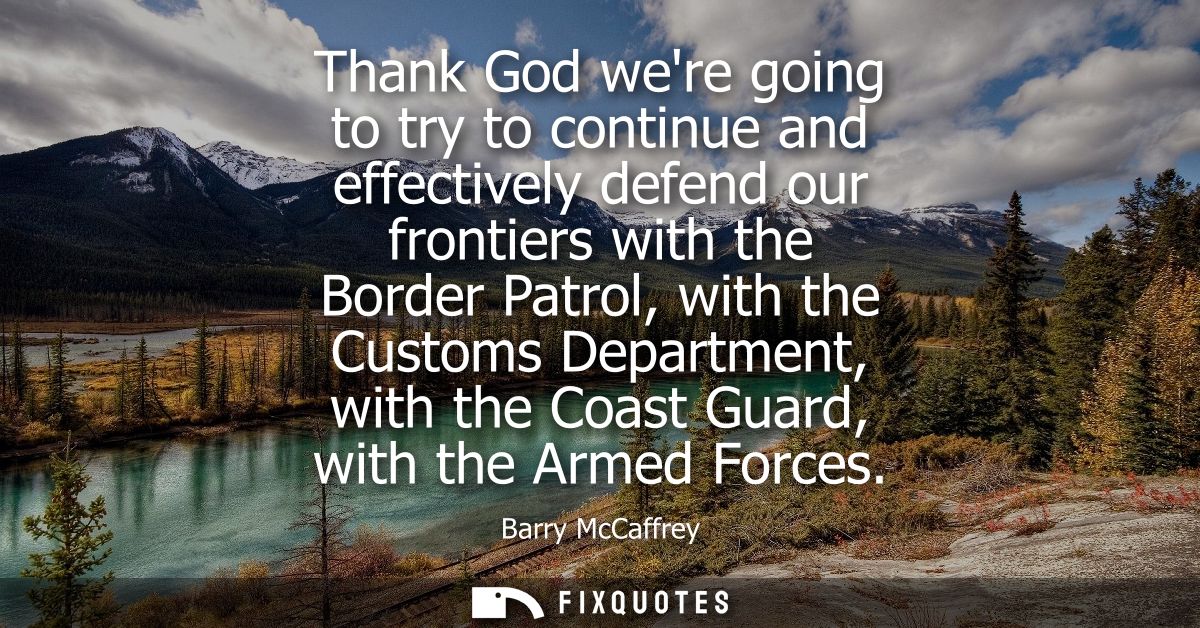
"Thank God we're going to try to continue and effectively defend our frontiers with the Border Patrol, with the Customs Department, with the Coast Guard, with the Armed Forces"
About this Quote
The phrasing "try to continue" sounds modest, even procedural, but it’s a rhetorical feint. What follows is a hard escalation: "effectively defend our frontiers" recasts immigration and customs enforcement in the language of territorial threat. "Frontiers" is a frontier-myth word, summoning the imagined perimeter of a besieged nation rather than the messy reality of ports, paperwork, labor markets, asylum claims, and human desperation. McCaffrey’s subtext is that the border is a battlefield and the state’s legitimacy is measured by its ability to project force there.
Then comes the institutional roll call: Border Patrol, Customs, Coast Guard, Armed Forces. It’s a cadence designed to reassure the public that every instrument of state power is aligned, professional, and ready. It also quietly normalizes militarization by placing civilian agencies and the military in one seamless continuum. In context - the late-20th-century pivot toward treating drugs, migration, and transnational crime as security crises - this is the language of a nation translating anxiety into hardware and hierarchy. The quote works because it offers a clean story: danger outside, order inside, and a line held by uniforms.
Quote Details
| Topic | War |
|---|---|
| Source | Help us find the source |
| Cite |
Citation Formats
APA Style (7th ed.)
McCaffrey, Barry. (2026, January 16). Thank God we're going to try to continue and effectively defend our frontiers with the Border Patrol, with the Customs Department, with the Coast Guard, with the Armed Forces. FixQuotes. https://fixquotes.com/quotes/thank-god-were-going-to-try-to-continue-and-108534/
Chicago Style
McCaffrey, Barry. "Thank God we're going to try to continue and effectively defend our frontiers with the Border Patrol, with the Customs Department, with the Coast Guard, with the Armed Forces." FixQuotes. January 16, 2026. https://fixquotes.com/quotes/thank-god-were-going-to-try-to-continue-and-108534/.
MLA Style (9th ed.)
"Thank God we're going to try to continue and effectively defend our frontiers with the Border Patrol, with the Customs Department, with the Coast Guard, with the Armed Forces." FixQuotes, 16 Jan. 2026, https://fixquotes.com/quotes/thank-god-were-going-to-try-to-continue-and-108534/. Accessed 3 Apr. 2026.