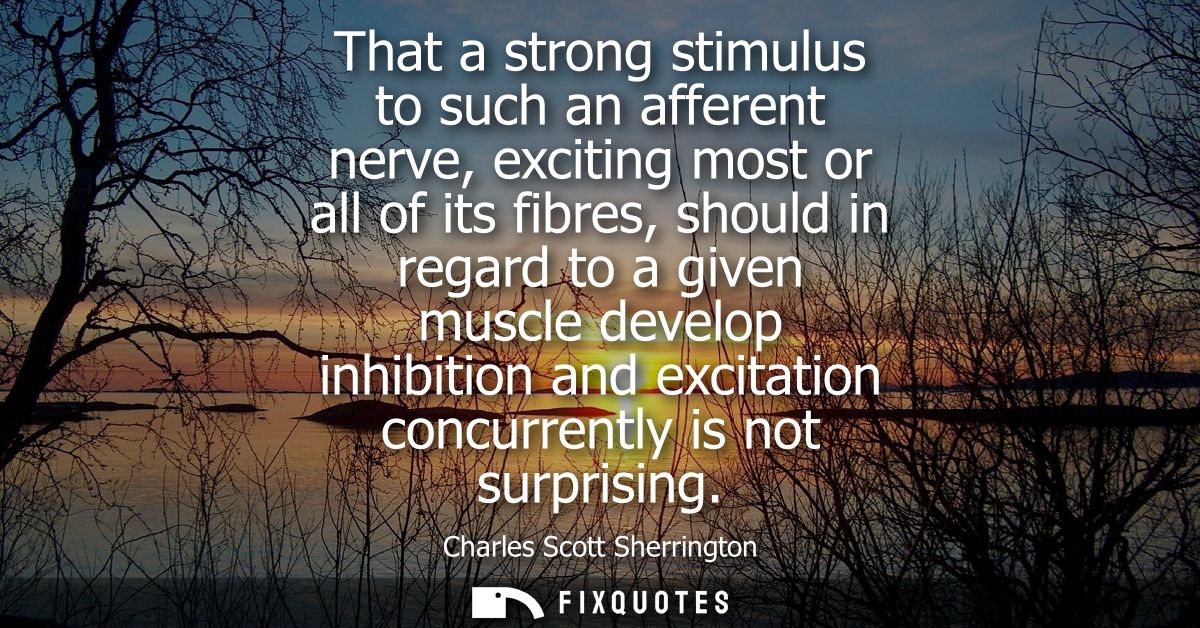
"That a strong stimulus to such an afferent nerve, exciting most or all of its fibres, should in regard to a given muscle develop inhibition and excitation concurrently is not surprising"
About this Quote
The specific intent is methodological as much as theoretical. Sherrington is warning the reader not to expect clean, one-to-one causality from sensory input to motor output. “Not surprising” is a strategic understatement; he’s normalizing complexity so that anomalous experimental results stop looking like errors and start looking like evidence. Subtext: if your lab setup delivers a big, indiscriminate shock, you are effectively summoning multiple pathways at once - reflex arcs that facilitate movement and interneuronal circuits that suppress it. The nervous system is already doing integrative computation, and crude stimulation exposes that integrative layer.
Context matters: Sherrington’s work on reflexes and reciprocal innervation helped overturn a simplistic “wire model” of nerves. This sentence is an argument for physiology as coordination, not mere conduction. It also smuggles in a broader view of control: effective movement depends on inhibition just as much as excitation, and the two are not sequential virtues but concurrent necessities.
Quote Details
| Topic | Science |
|---|---|
| Source | Help us find the source |
| Cite |
Citation Formats
APA Style (7th ed.)
Sherrington, Charles Scott. (2026, January 16). That a strong stimulus to such an afferent nerve, exciting most or all of its fibres, should in regard to a given muscle develop inhibition and excitation concurrently is not surprising. FixQuotes. https://fixquotes.com/quotes/that-a-strong-stimulus-to-such-an-afferent-nerve-121181/
Chicago Style
Sherrington, Charles Scott. "That a strong stimulus to such an afferent nerve, exciting most or all of its fibres, should in regard to a given muscle develop inhibition and excitation concurrently is not surprising." FixQuotes. January 16, 2026. https://fixquotes.com/quotes/that-a-strong-stimulus-to-such-an-afferent-nerve-121181/.
MLA Style (9th ed.)
"That a strong stimulus to such an afferent nerve, exciting most or all of its fibres, should in regard to a given muscle develop inhibition and excitation concurrently is not surprising." FixQuotes, 16 Jan. 2026, https://fixquotes.com/quotes/that-a-strong-stimulus-to-such-an-afferent-nerve-121181/. Accessed 23 Mar. 2026.