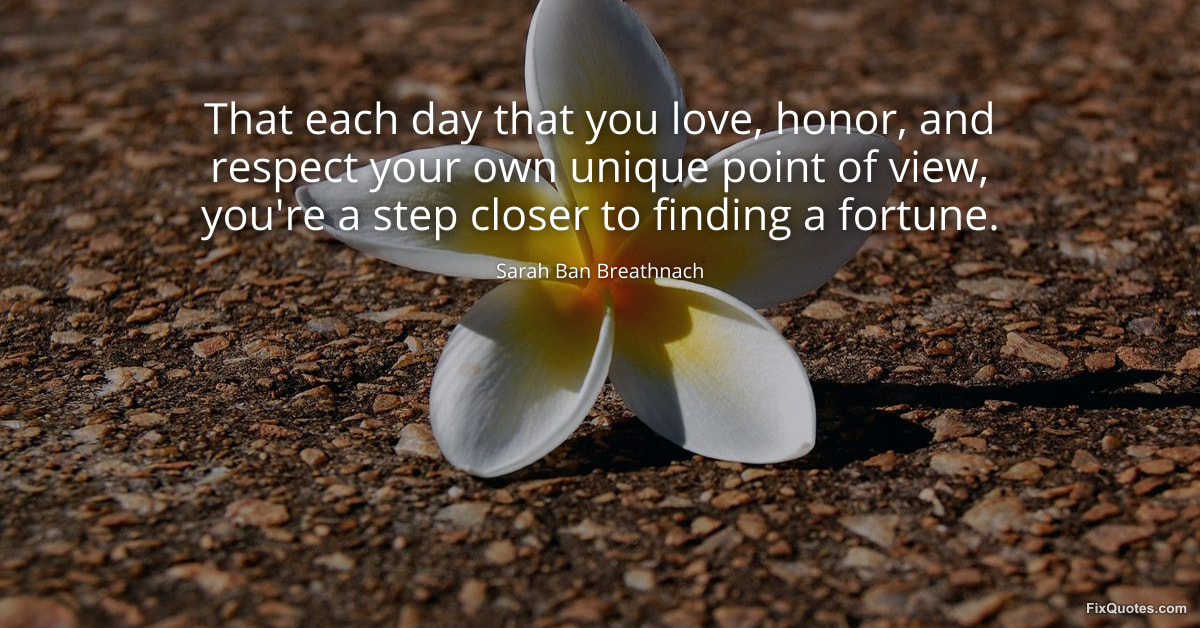
"That each day that you love, honor, and respect your own unique point of view, you're a step closer to finding a fortune"
About this Quote
The intent is classic late-20th/early-2000s self-help: relocate authority from institutions and experts to the self, then argue that inner alignment produces outer reward. The subtext is transactional, though dressed up as empowerment. If you don’t find your “fortune,” the implication is that you failed to honor yourself consistently enough. That’s motivating, but it also quietly shifts structural realities - opportunity, class, gatekeeping - into the background.
Context matters because Breathnach built a brand around everyday ritual and “simple abundance,” a gentler cousin of hustle culture. This isn’t grindset rhetoric; it’s soft-focus discipline. The cultural appeal is obvious in an economy where careers, identities, and communities are less stable: the one asset you can claim as reliably “yours” is a point of view. The quote works because it offers control without sounding controlling, ambition without sounding greedy, and a moral frame for self-expression that’s easy to repeat and hard to argue with.
Quote Details
| Topic | Self-Love |
|---|---|
| Source | Help us find the source |
| Cite |
Citation Formats
APA Style (7th ed.)
Breathnach, Sarah Ban. (2026, January 11). That each day that you love, honor, and respect your own unique point of view, you're a step closer to finding a fortune. FixQuotes. https://fixquotes.com/quotes/that-each-day-that-you-love-honor-and-respect-183951/
Chicago Style
Breathnach, Sarah Ban. "That each day that you love, honor, and respect your own unique point of view, you're a step closer to finding a fortune." FixQuotes. January 11, 2026. https://fixquotes.com/quotes/that-each-day-that-you-love-honor-and-respect-183951/.
MLA Style (9th ed.)
"That each day that you love, honor, and respect your own unique point of view, you're a step closer to finding a fortune." FixQuotes, 11 Jan. 2026, https://fixquotes.com/quotes/that-each-day-that-you-love-honor-and-respect-183951/. Accessed 31 Mar. 2026.