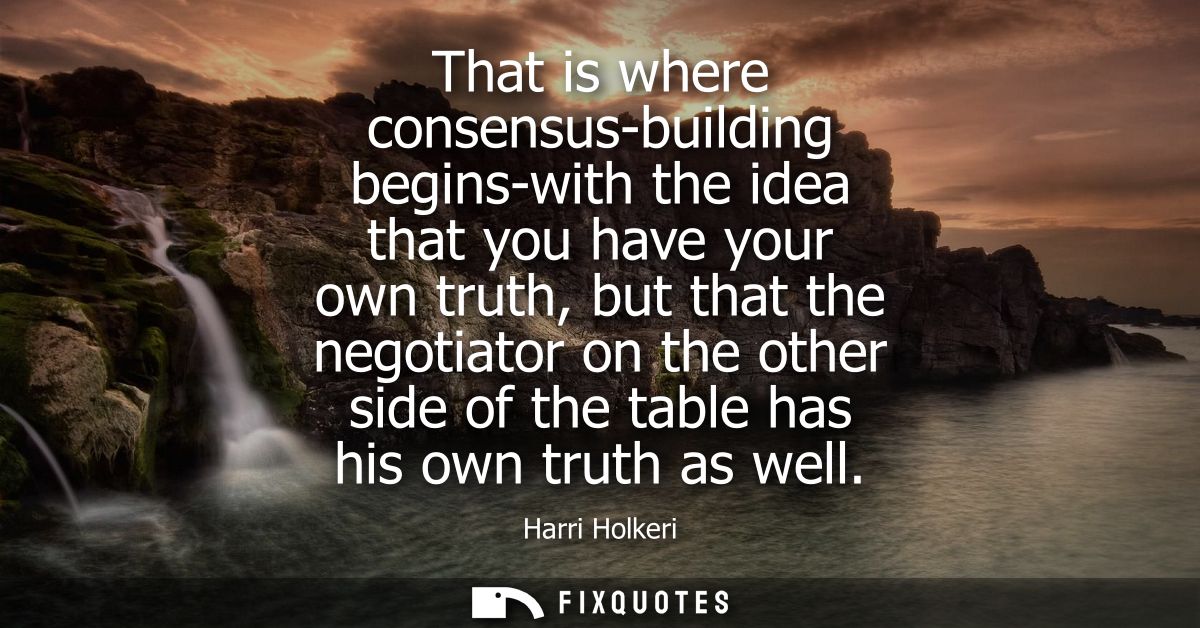
"That is where consensus-building begins-with the idea that you have your own truth, but that the negotiator on the other side of the table has his own truth as well"
About this Quote
The subtext is distinctly late-20th-century, post-ideological Europe: a smaller nation’s statesman trained in coalition government, multilateral institutions, and the daily grind of compromise. Holkeri (a Finnish prime minister and later a UN mediator in Kosovo) is speaking from arenas where moral clarity is rarely enough and where insisting on a single narrative can turn talks into theater. His “truths” aren’t necessarily equally valid in some philosophical sense; they’re equally real as political forces. Treat them as delusions and you harden the room. Treat them as lived convictions and you create the first sliver of movement.
There’s a strategic tenderness here, but not sentimentality. Holkeri is advocating a discipline: bracket your righteousness long enough to map the other side’s incentives, wounds, and face-saving needs. Consensus, in this view, isn’t agreement on reality; it’s an engineered overlap between competing realities, built by a negotiator who understands that people don’t abandon “truth” under pressure - they defend it.
Quote Details
| Topic | Decision-Making |
|---|---|
| Source | Help us find the source |
| Cite |
Citation Formats
APA Style (7th ed.)
Holkeri, Harri. (2026, January 15). That is where consensus-building begins-with the idea that you have your own truth, but that the negotiator on the other side of the table has his own truth as well. FixQuotes. https://fixquotes.com/quotes/that-is-where-consensus-building-begins-with-the-164777/
Chicago Style
Holkeri, Harri. "That is where consensus-building begins-with the idea that you have your own truth, but that the negotiator on the other side of the table has his own truth as well." FixQuotes. January 15, 2026. https://fixquotes.com/quotes/that-is-where-consensus-building-begins-with-the-164777/.
MLA Style (9th ed.)
"That is where consensus-building begins-with the idea that you have your own truth, but that the negotiator on the other side of the table has his own truth as well." FixQuotes, 15 Jan. 2026, https://fixquotes.com/quotes/that-is-where-consensus-building-begins-with-the-164777/. Accessed 3 Apr. 2026.