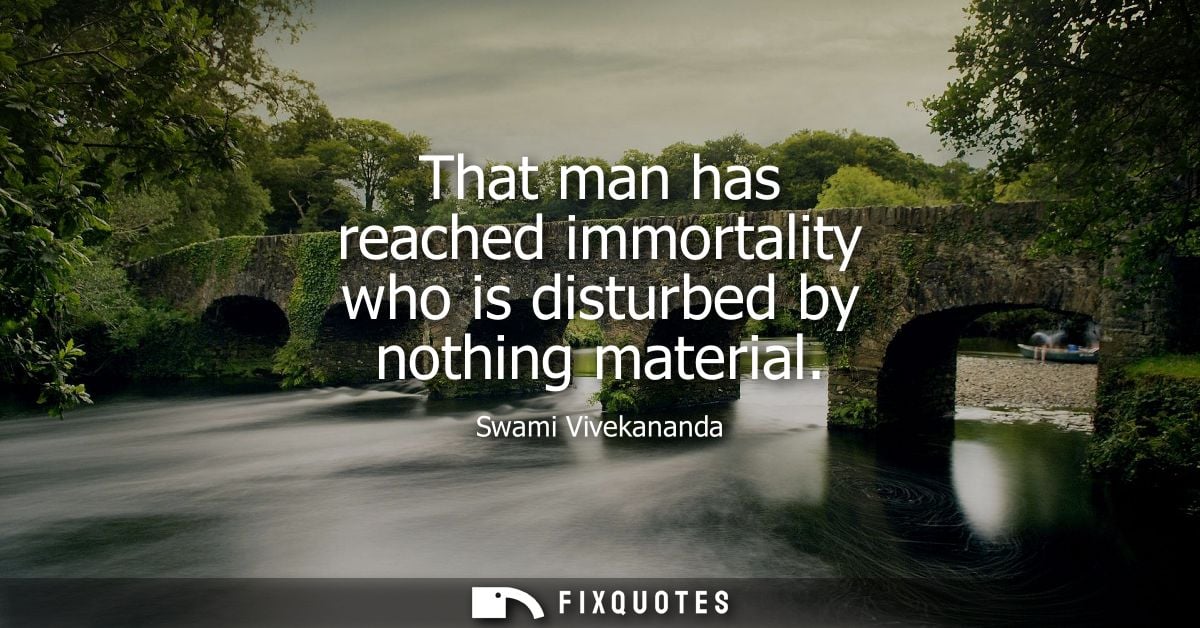
"That man has reached immortality who is disturbed by nothing material"
About this Quote
The intent is monastic in its severity and modern in its diagnosis. Vivekananda, speaking as a Hindu monk and public intellectual at the end of the 19th century, watched colonial modernity intensify the very attachments Vedanta warns against: prestige, consumption, the anxious need to prove oneself under an imperial gaze. His teaching often translated Indian spiritual concepts into a universalist idiom legible to Western audiences. "Immortality" becomes a rhetorical bridge: you don’t need to accept a specific theology to understand the appeal of unshakable equanimity.
The subtext is also quietly polemical. By defining immortality as imperturbability, he demotes the material world from master to weather: real, sometimes violent, but not sovereign. It’s an ethics of sovereignty from the inside out. The line works because it refuses consolation. Instead it offers a hard metric for freedom: not what you possess, but what can possess you.
Quote Details
| Topic | Wisdom |
|---|---|
| Source | Help us find the source |
| Cite |
Citation Formats
APA Style (7th ed.)
Vivekananda, Swami. (2026, January 18). That man has reached immortality who is disturbed by nothing material. FixQuotes. https://fixquotes.com/quotes/that-man-has-reached-immortality-who-is-disturbed-14970/
Chicago Style
Vivekananda, Swami. "That man has reached immortality who is disturbed by nothing material." FixQuotes. January 18, 2026. https://fixquotes.com/quotes/that-man-has-reached-immortality-who-is-disturbed-14970/.
MLA Style (9th ed.)
"That man has reached immortality who is disturbed by nothing material." FixQuotes, 18 Jan. 2026, https://fixquotes.com/quotes/that-man-has-reached-immortality-who-is-disturbed-14970/. Accessed 30 Mar. 2026.