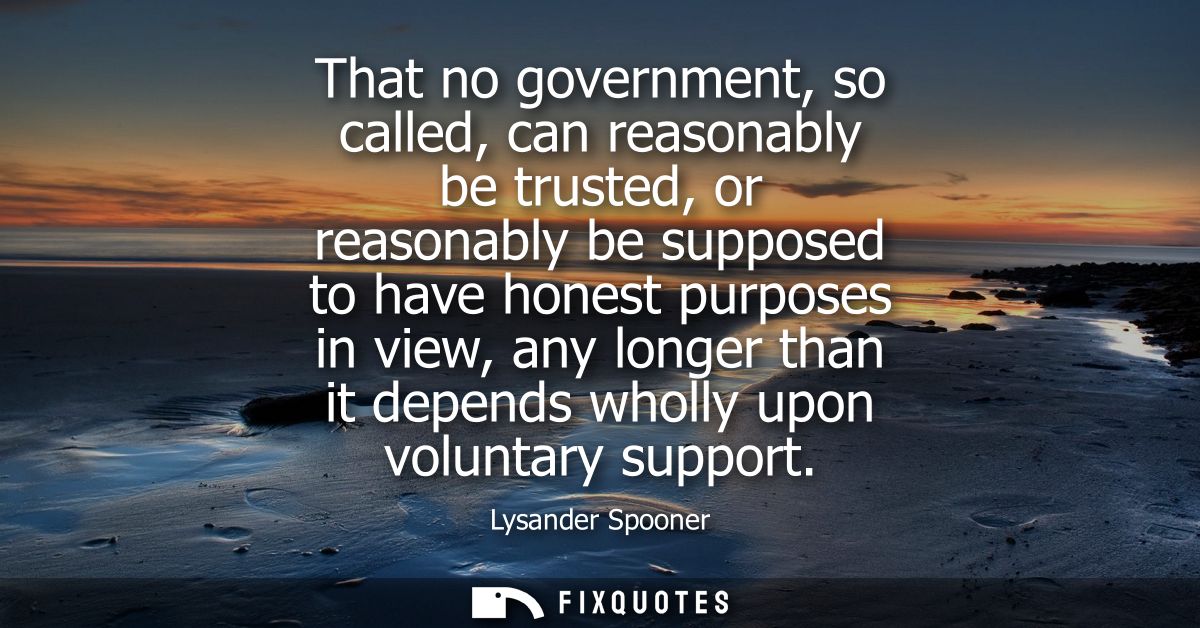
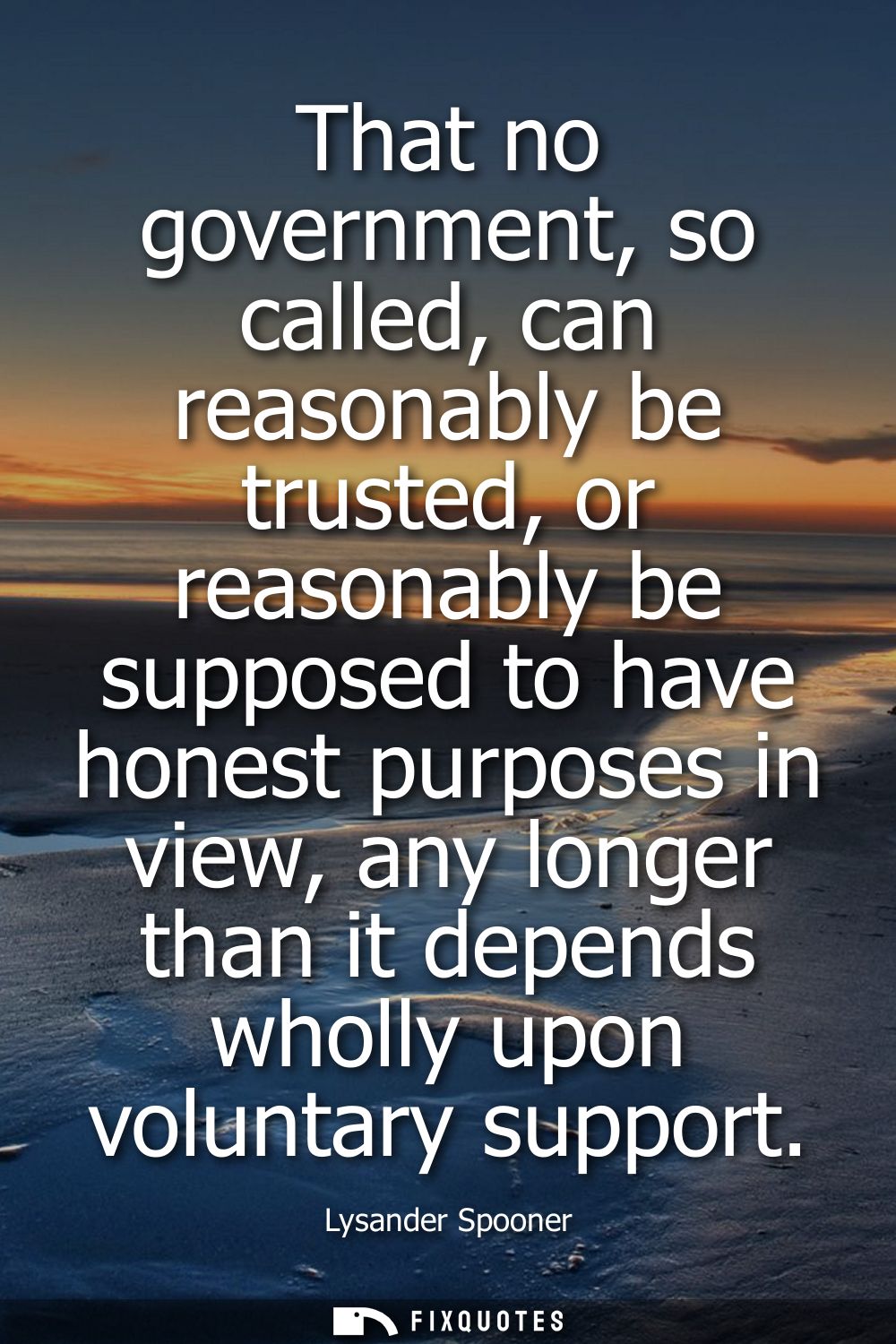
"That no government, so called, can reasonably be trusted, or reasonably be supposed to have honest purposes in view, any longer than it depends wholly upon voluntary support"
About this Quote
The subtext is an indictment of taxation and, deeper still, of the social contract tradition that treats obedience as implied. Spooner wants to flip the burden of proof. Instead of citizens justifying dissent, power must justify itself continuously, by attracting willing participation the way any other association would. If it can’t, that’s not a failure of civic virtue; it’s evidence the project can’t survive without force.
Context matters: Spooner is writing in a 19th-century America that sold itself as a consent-based republic while enforcing slavery, conscription, and punitive federal power. His skepticism isn’t abstract misanthropy; it’s a response to a state that preached liberty and practiced domination. The line lands because it translates moral outrage into a crisp metric: if you have to make people pay and comply, you’ve already admitted you can’t earn their allegiance.
Quote Details
| Topic | Freedom |
|---|---|
| Source | Help us find the source |
| Cite |
Citation Formats
APA Style (7th ed.)
Spooner, Lysander. (2026, January 16). That no government, so called, can reasonably be trusted, or reasonably be supposed to have honest purposes in view, any longer than it depends wholly upon voluntary support. FixQuotes. https://fixquotes.com/quotes/that-no-government-so-called-can-reasonably-be-99985/
Chicago Style
Spooner, Lysander. "That no government, so called, can reasonably be trusted, or reasonably be supposed to have honest purposes in view, any longer than it depends wholly upon voluntary support." FixQuotes. January 16, 2026. https://fixquotes.com/quotes/that-no-government-so-called-can-reasonably-be-99985/.
MLA Style (9th ed.)
"That no government, so called, can reasonably be trusted, or reasonably be supposed to have honest purposes in view, any longer than it depends wholly upon voluntary support." FixQuotes, 16 Jan. 2026, https://fixquotes.com/quotes/that-no-government-so-called-can-reasonably-be-99985/. Accessed 29 Mar. 2026.