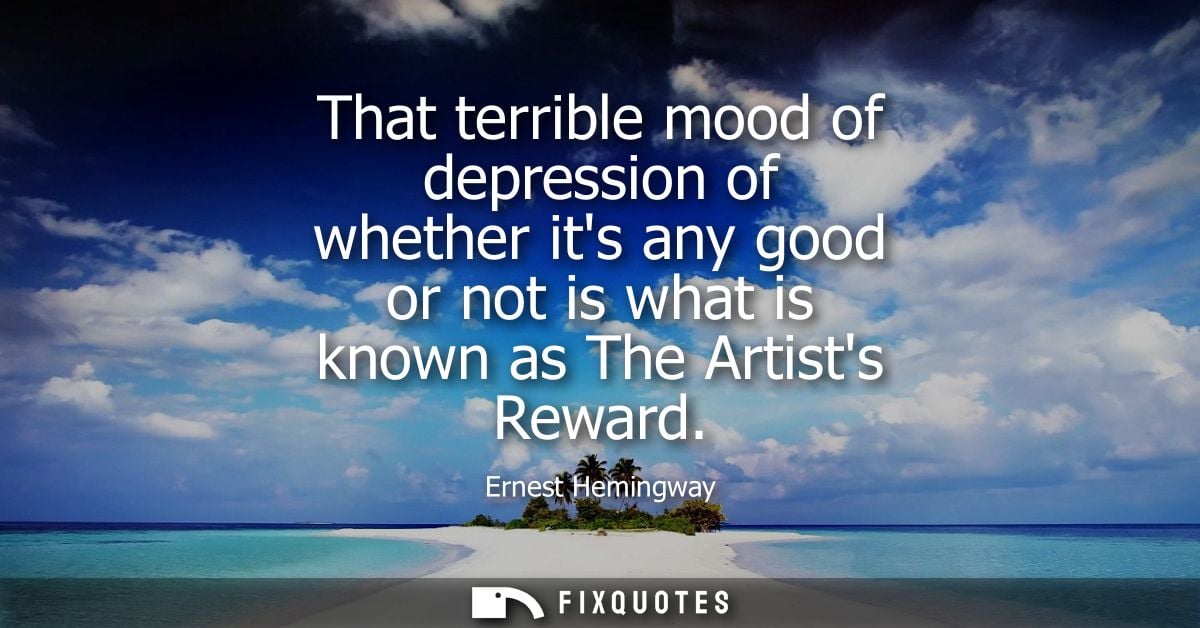
"That terrible mood of depression of whether it's any good or not is what is known as The Artist's Reward"
About this Quote
Hemingway reframes the artist’s presumed payoff - applause, immortality, the clean thrill of having “made it” - as something uglier and more private: a pit in the stomach. Calling depression “The Artist’s Reward” is classic Hemingway misdirection. Reward is supposed to arrive as relief; he insists the real prize is the inability to feel relief for long, the compulsive return to the same brutal question: was it any good?
The intent is corrective, almost disciplinary. Hemingway isn’t romanticizing suffering as mystical fuel; he’s naming a professional hazard of taking craft seriously. The subtext is that genuine ambition makes satisfaction suspect. If you can rest easy, you probably weren’t reaching far enough. That’s not a feel-good ethic, it’s a work ethic: the mind that can write a clean sentence is the same mind that can turn on itself the moment the sentence lands.
Context matters. Hemingway’s public image - swagger, war stories, big-game masculinity - often reads like armor against vulnerability. This line slips the armor and admits that the real arena is internal, fought after the applause, in the quiet hours when confidence curdles into assessment. It also nods to modernism’s hangover: when tradition is shattered and standards are self-imposed, the measuring stick lives inside you, and it’s merciless.
Why it works is the sting of its inversion. He doesn’t just confess doubt; he crowns it, turning misery into a perverse merit badge. The joke is dark, but the message is practical: if you’re making something that matters, the reward isn’t certainty - it’s the lifelong, gnawing refusal to settle.
The intent is corrective, almost disciplinary. Hemingway isn’t romanticizing suffering as mystical fuel; he’s naming a professional hazard of taking craft seriously. The subtext is that genuine ambition makes satisfaction suspect. If you can rest easy, you probably weren’t reaching far enough. That’s not a feel-good ethic, it’s a work ethic: the mind that can write a clean sentence is the same mind that can turn on itself the moment the sentence lands.
Context matters. Hemingway’s public image - swagger, war stories, big-game masculinity - often reads like armor against vulnerability. This line slips the armor and admits that the real arena is internal, fought after the applause, in the quiet hours when confidence curdles into assessment. It also nods to modernism’s hangover: when tradition is shattered and standards are self-imposed, the measuring stick lives inside you, and it’s merciless.
Why it works is the sting of its inversion. He doesn’t just confess doubt; he crowns it, turning misery into a perverse merit badge. The joke is dark, but the message is practical: if you’re making something that matters, the reward isn’t certainty - it’s the lifelong, gnawing refusal to settle.
Quote Details
| Topic | Art |
|---|---|
| Source | Help us find the source |
More Quotes by Ernest
Add to List