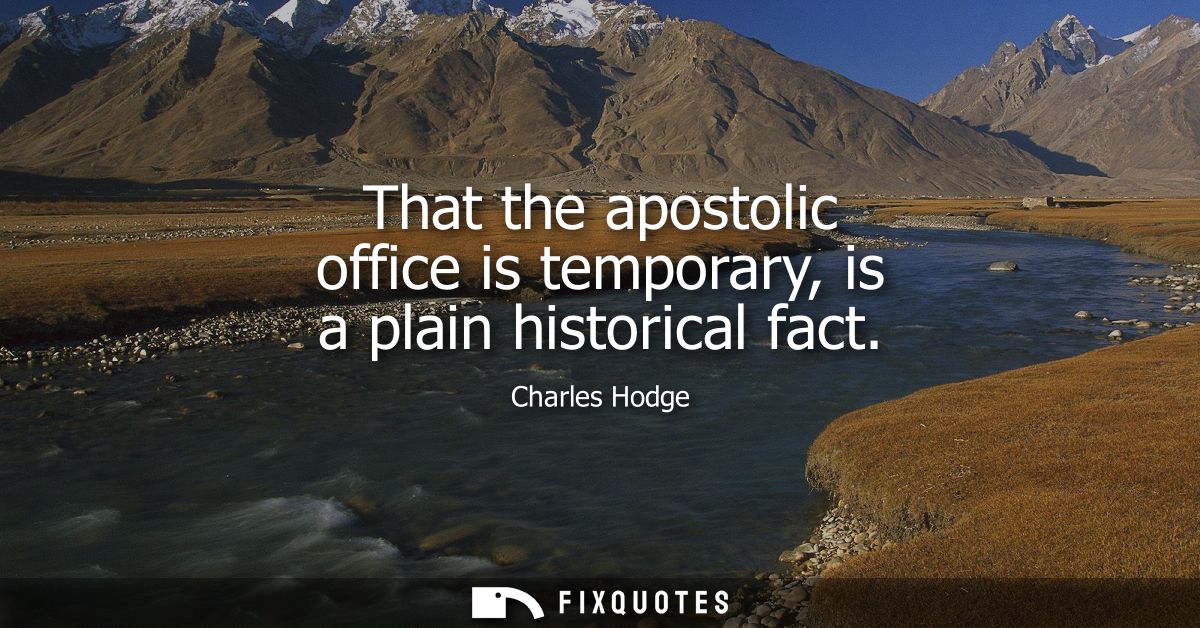
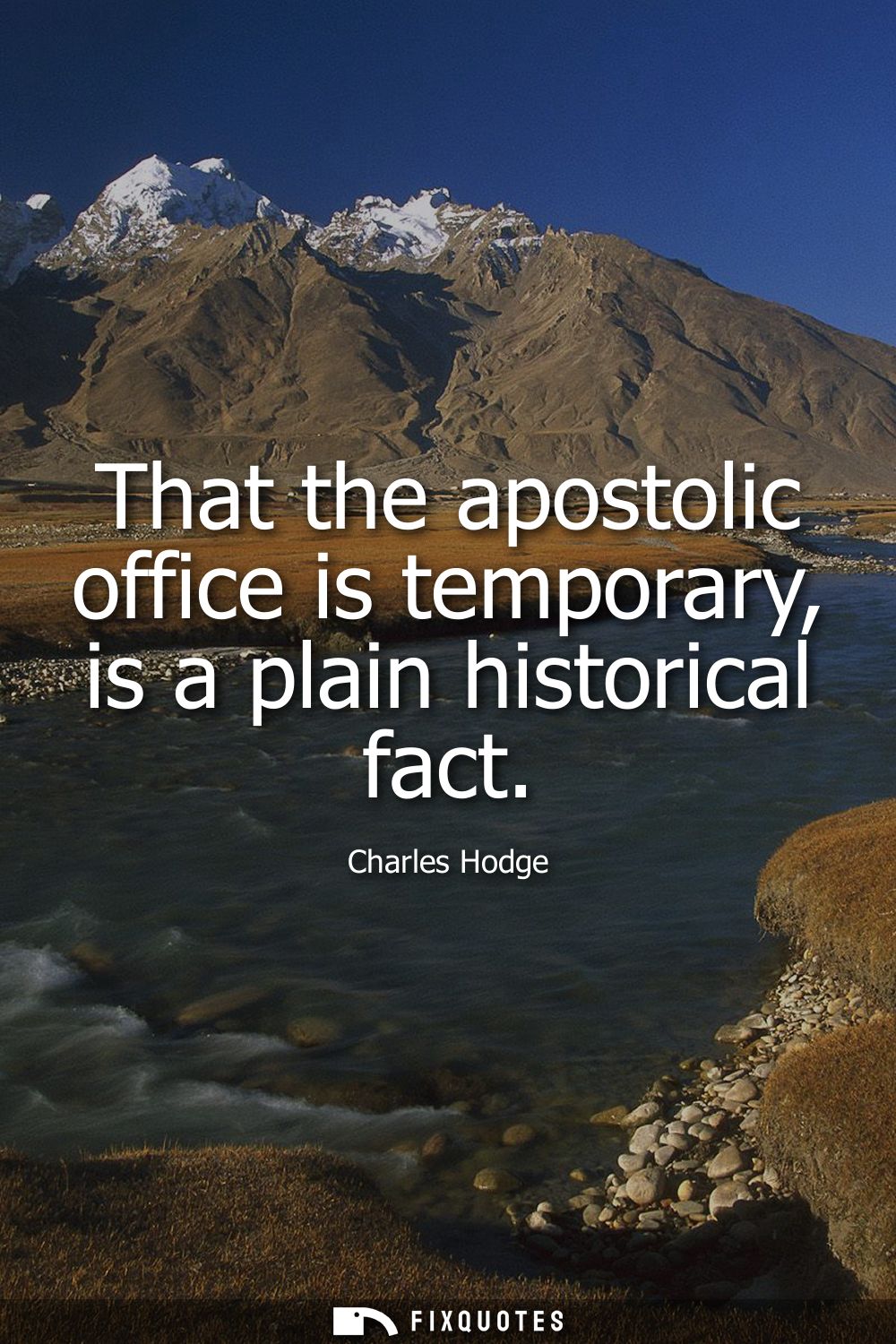
"That the apostolic office is temporary, is a plain historical fact"
About this Quote
Hodge is doing what good system-builders always do: taking a volatile question and trying to lock it into the safe of “plain historical fact.” The line reads like a shrug, but it’s a strategic shrug. By calling the temporariness of the apostolic office “apostolic” and “temporary” in the same breath, he collapses a live theological dispute into something that sounds as neutral as a date on a calendar.
The intent is polemical without sounding polemical. In 19th-century American Protestantism, arguments over authority weren’t abstract; they were institutional. Who gets to speak for God now that the first witnesses are gone? Hodge, a Princeton theologian steeped in Reformed confessionalism, is protecting a particular architecture of church authority: Scripture as the unique, closed deposit tied to the apostles, and the post-apostolic church as interpretive and ministerial rather than revelatory. If apostles are a permanent office, then revelation can be functionally ongoing, hierarchy can be reimagined, and charismatic claims gain leverage. If apostles were a one-time office, then the canon stays sealed, and later leaders are disciplined into continuity rather than innovation.
The subtext is anxiety about religious novelty dressed up as historical clarity. “Plain” is doing heavy lifting: it signals that dissenters aren’t just theologically wrong but historically inattentive, maybe even willfully so. It’s also a deft move in a culture where new movements (restorationist, charismatic, and authority-claiming) were proliferating. Hodge answers not with a fresh experience of God, but with a boundary: the age of foundational witnesses ended, and with it the right to speak with their kind of finality.
The intent is polemical without sounding polemical. In 19th-century American Protestantism, arguments over authority weren’t abstract; they were institutional. Who gets to speak for God now that the first witnesses are gone? Hodge, a Princeton theologian steeped in Reformed confessionalism, is protecting a particular architecture of church authority: Scripture as the unique, closed deposit tied to the apostles, and the post-apostolic church as interpretive and ministerial rather than revelatory. If apostles are a permanent office, then revelation can be functionally ongoing, hierarchy can be reimagined, and charismatic claims gain leverage. If apostles were a one-time office, then the canon stays sealed, and later leaders are disciplined into continuity rather than innovation.
The subtext is anxiety about religious novelty dressed up as historical clarity. “Plain” is doing heavy lifting: it signals that dissenters aren’t just theologically wrong but historically inattentive, maybe even willfully so. It’s also a deft move in a culture where new movements (restorationist, charismatic, and authority-claiming) were proliferating. Hodge answers not with a fresh experience of God, but with a boundary: the age of foundational witnesses ended, and with it the right to speak with their kind of finality.
Quote Details
| Topic | Faith |
|---|---|
| Source | Help us find the source |
| Cite |
Citation Formats
APA Style (7th ed.)
Hodge, Charles. (2026, January 18). That the apostolic office is temporary, is a plain historical fact. FixQuotes. https://fixquotes.com/quotes/that-the-apostolic-office-is-temporary-is-a-plain-9814/
Chicago Style
Hodge, Charles. "That the apostolic office is temporary, is a plain historical fact." FixQuotes. January 18, 2026. https://fixquotes.com/quotes/that-the-apostolic-office-is-temporary-is-a-plain-9814/.
MLA Style (9th ed.)
"That the apostolic office is temporary, is a plain historical fact." FixQuotes, 18 Jan. 2026, https://fixquotes.com/quotes/that-the-apostolic-office-is-temporary-is-a-plain-9814/. Accessed 20 Mar. 2026.
More Quotes by Charles
Add to List