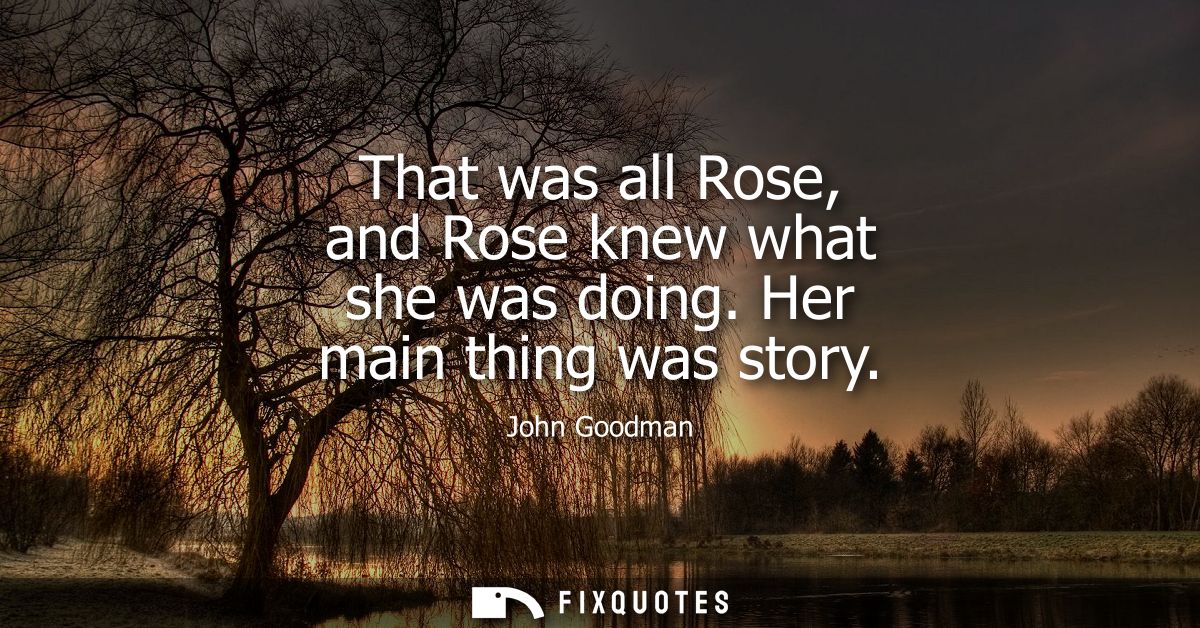
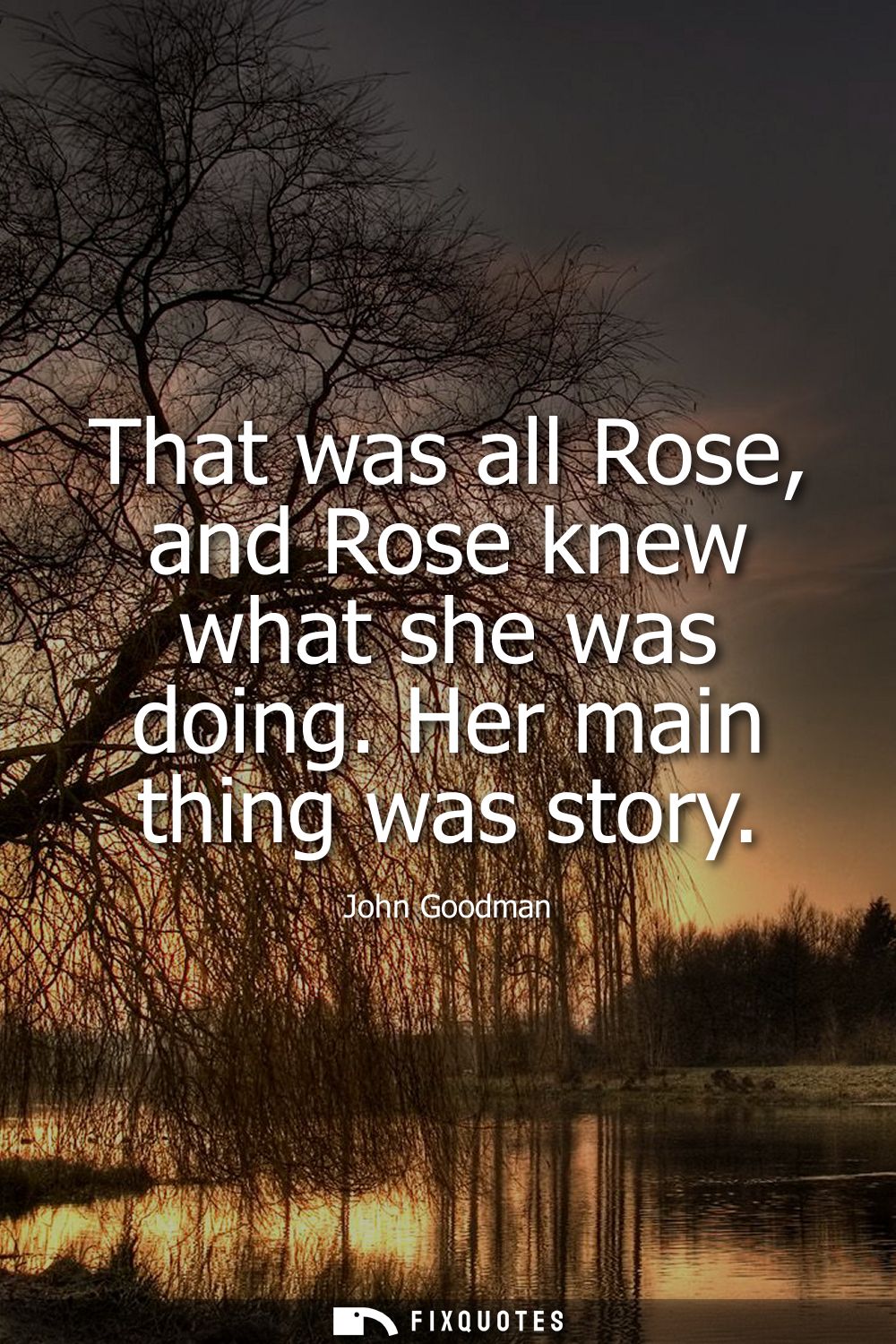
"That was all Rose, and Rose knew what she was doing. Her main thing was story"
About this Quote
The repetition of “Rose” works like a drumbeat, turning her into a force rather than a colleague. And “Rose knew what she was doing” carries actor-to-actor respect: competence as charisma. Goodman isn’t admiring mystery; he’s admiring craft. That matters because acting culture often romanticizes chaos, “instinct,” and happy accidents. Here, intention is the glamour.
Then the quiet tell: “Her main thing was story.” Not “performance,” not “image,” not “buzz.” Story is the old religion of good filmmaking, and Goodman is invoking it as a corrective. The subtext is that Rose’s authority came from narrative clarity; she could make choices that weren’t just stylish but inevitable. It also nods to a particular kind of leadership: the director/producer who corrals talent by giving them something sturdier than vibes. When story is the “main thing,” the set stops being a personality contest and starts being a machine built to move an audience.
Quote Details
| Topic | Writing |
|---|---|
| Source | Help us find the source |
| Cite |
Citation Formats
APA Style (7th ed.)
Goodman, John. (2026, January 17). That was all Rose, and Rose knew what she was doing. Her main thing was story. FixQuotes. https://fixquotes.com/quotes/that-was-all-rose-and-rose-knew-what-she-was-56588/
Chicago Style
Goodman, John. "That was all Rose, and Rose knew what she was doing. Her main thing was story." FixQuotes. January 17, 2026. https://fixquotes.com/quotes/that-was-all-rose-and-rose-knew-what-she-was-56588/.
MLA Style (9th ed.)
"That was all Rose, and Rose knew what she was doing. Her main thing was story." FixQuotes, 17 Jan. 2026, https://fixquotes.com/quotes/that-was-all-rose-and-rose-knew-what-she-was-56588/. Accessed 4 Apr. 2026.