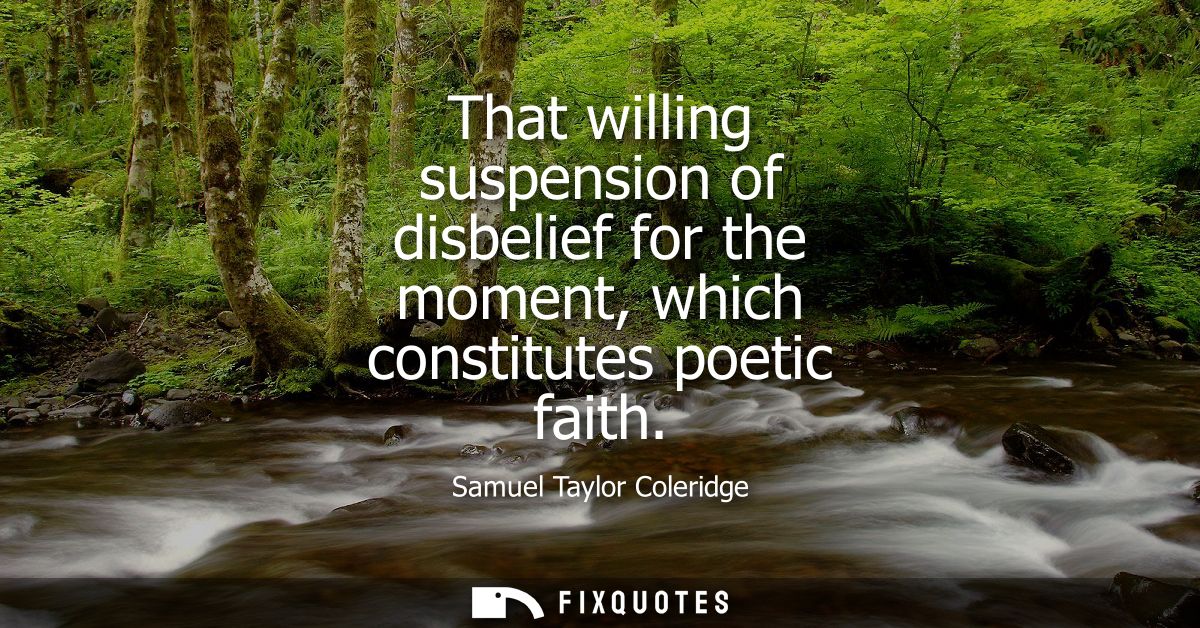
"That willing suspension of disbelief for the moment, which constitutes poetic faith"
About this Quote
The phrase suspension of disbelief has had a long afterlife as a catchall for plot holes and CGI dragons, but Coleridge’s intent is narrower and sharper. He’s talking about the moment when imagination becomes credible through craft. The subtext is almost managerial: the artist’s job is to earn that consent. Make the strange feel internally consistent, emotionally true, textured enough that the reader’s skepticism doesn’t vanish so much as stand aside.
Context matters here. Coleridge is writing as Romanticism is staking its claim against Enlightenment rationalism, arguing that truth isn’t only a matter of facts but of apprehension: the way an experience coheres inside you. Poetic faith is an alternate epistemology, one that privileges felt reality without pretending it’s the same as empirical proof.
What makes the line work is its cool precision. He frames enchantment as a mechanism, not a miracle, and in doing so smuggles in an ethic: art is a negotiation between maker and audience, and the deepest spell is the one we cast with our own permission.
Quote Details
| Topic | Poetry |
|---|---|
| Source | Verified source: Biographia Literaria (Samuel Taylor Coleridge, 1817)
Evidence: that willing suspension of disbelief for the moment, which constitutes poetic faith. (Volume 2, Chapter XIV, page 6). This is the primary source and the earliest publication located in Coleridge's own work. The phrase appears in the 1817 first edition of Biographia Literaria, published in two volumes. In the first edition, the passage is in Volume II, Chapter XIV, page 6. The fuller sentence begins: "In this idea originated the plan of the Lyrical Ballads; in which it was agreed that my endeavours should be directed to persons and characters supernatural, or at least romantic..." Google Books snippet evidence for the 1817 edition shows the passage on page 6 of Volume 2, and standard reference works consistently identify Chapter XIV of the 1817 Biographia Literaria as the origin. ([books.google.com](https://books.google.com/books/about/Biographia_Literaria.html?id=W9g6AAAAMAAJ&utm_source=openai)) Other candidates (1) Fundamentals of Game Design (Ernest Adams, 2010) compilation95.0% ... that willing suspension of disbelief for the moment , which constitutes poetic faith . -SAMUEL TAYLOR Coleridge ,... |
| Cite |
Citation Formats
APA Style (7th ed.)
Coleridge, Samuel Taylor. (2026, March 10). That willing suspension of disbelief for the moment, which constitutes poetic faith. FixQuotes. https://fixquotes.com/quotes/that-willing-suspension-of-disbelief-for-the-164974/
Chicago Style
Coleridge, Samuel Taylor. "That willing suspension of disbelief for the moment, which constitutes poetic faith." FixQuotes. March 10, 2026. https://fixquotes.com/quotes/that-willing-suspension-of-disbelief-for-the-164974/.
MLA Style (9th ed.)
"That willing suspension of disbelief for the moment, which constitutes poetic faith." FixQuotes, 10 Mar. 2026, https://fixquotes.com/quotes/that-willing-suspension-of-disbelief-for-the-164974/. Accessed 31 Mar. 2026.