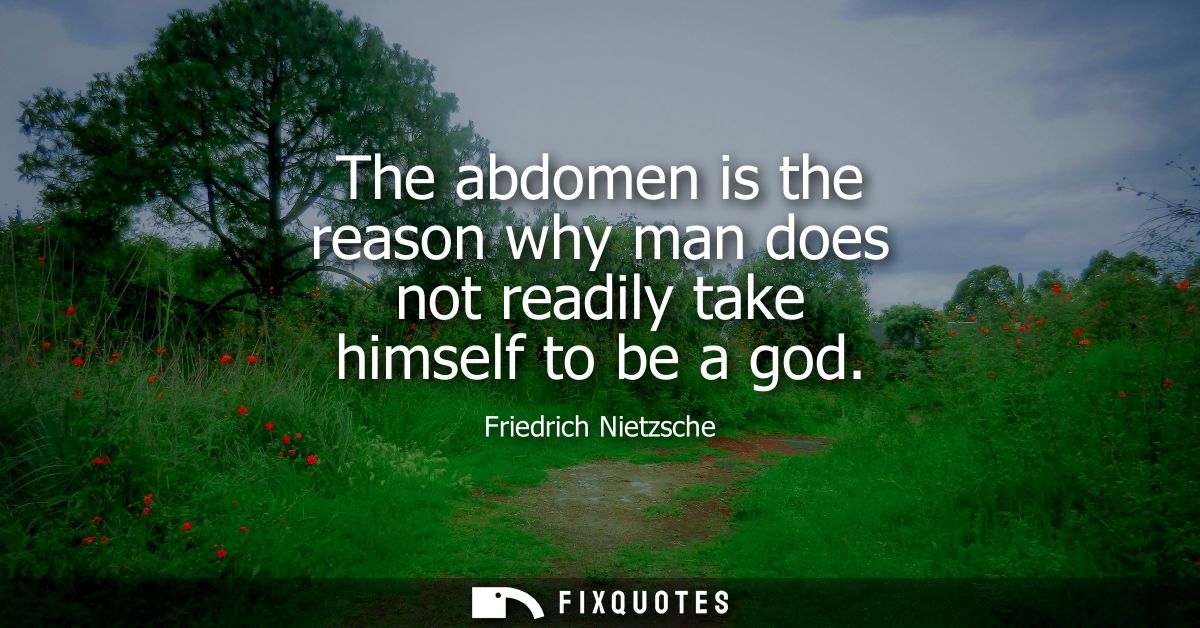
"The abdomen is the reason why man does not readily take himself to be a god"
About this Quote
The intent is partly comic, partly corrective. Nietzsche is mocking the human habit of dressing up wish-fulfillment as theology. If people were truly “made for” transcendence, why are they so easily felled by something as ignoble as the gut? The abdomen becomes a built-in skepticism, a biological heckler that keeps the self from floating off into flattering myths. He’s also taking a shot at philosophical and religious traditions that treat the body as an inconvenience on the way to “higher” truth. For Nietzsche, that hierarchy is backwards: our drives, our metabolism, our health are not embarrassing footnotes but the engine room of value-making.
Context matters. Nietzsche writes in the wake of Christian moralism and German idealism, both prone to spiritualize suffering and sanctify self-denial. His broader project is to unmask “otherworldly” thinking as a symptom, often of weakness. The abdomen, in this line, is more than anatomy; it’s a reminder that every lofty self-image sits on top of animal necessity. The punchline is also the thesis: any philosophy that forgets digestion is already lying about what a human is.
Quote Details
| Topic | Wisdom |
|---|---|
| Source | Help us find the source |
| Cite |
Citation Formats
APA Style (7th ed.)
Nietzsche, Friedrich. (2026, January 15). The abdomen is the reason why man does not readily take himself to be a god. FixQuotes. https://fixquotes.com/quotes/the-abdomen-is-the-reason-why-man-does-not-291/
Chicago Style
Nietzsche, Friedrich. "The abdomen is the reason why man does not readily take himself to be a god." FixQuotes. January 15, 2026. https://fixquotes.com/quotes/the-abdomen-is-the-reason-why-man-does-not-291/.
MLA Style (9th ed.)
"The abdomen is the reason why man does not readily take himself to be a god." FixQuotes, 15 Jan. 2026, https://fixquotes.com/quotes/the-abdomen-is-the-reason-why-man-does-not-291/. Accessed 12 Feb. 2026.