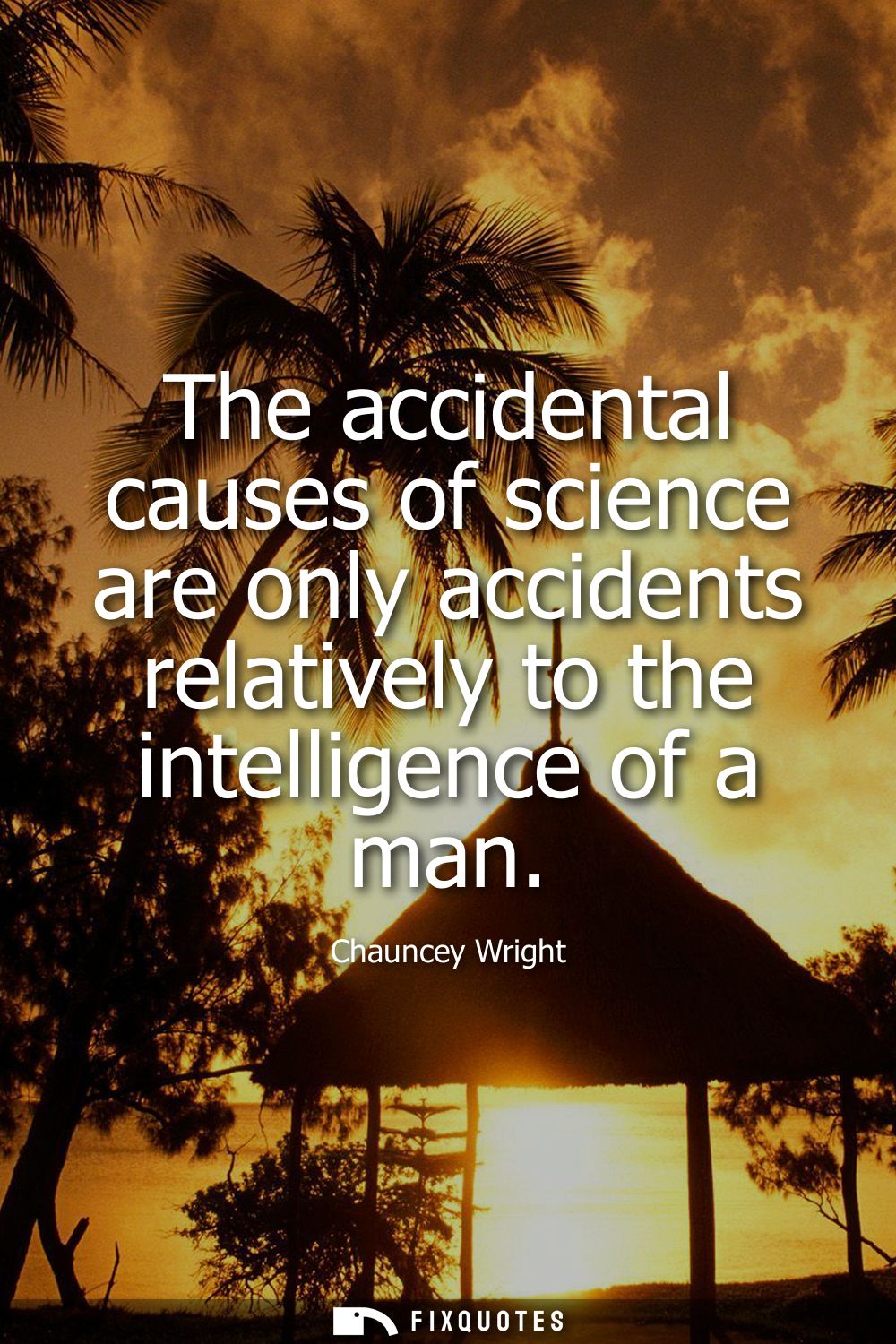
"The accidental causes of science are only accidents relatively to the intelligence of a man"
About this Quote
The subtext is a defense of disciplined attention. Wright, writing in a 19th-century moment when Darwin’s ideas were unsettling old certainties, is wary of metaphysical explanations sneaking back in through the language of chance. Calling something an “accident” can be a way of quitting early, of treating the world as a slot machine rather than a system. He’s not denying contingency; he’s insisting that contingency is filtered through competence. A lab is full of “accidents” every day. Most evaporate as noise. One becomes signal because someone has the habits - conceptual, technical, imaginative - to see it.
That “relatively” does a lot of work. It refuses absolute claims. Chance exists, but it’s indexed to perspective. Wright’s point lands as a moral about modern knowledge: the frontier isn’t just out there in nature; it’s in the calibration of human judgment that turns surprises into explanations.
Quote Details
| Topic | Science |
|---|---|
| Source | Help us find the source |
| Cite |
Citation Formats
APA Style (7th ed.)
Wright, Chauncey. (2026, January 17). The accidental causes of science are only accidents relatively to the intelligence of a man. FixQuotes. https://fixquotes.com/quotes/the-accidental-causes-of-science-are-only-49820/
Chicago Style
Wright, Chauncey. "The accidental causes of science are only accidents relatively to the intelligence of a man." FixQuotes. January 17, 2026. https://fixquotes.com/quotes/the-accidental-causes-of-science-are-only-49820/.
MLA Style (9th ed.)
"The accidental causes of science are only accidents relatively to the intelligence of a man." FixQuotes, 17 Jan. 2026, https://fixquotes.com/quotes/the-accidental-causes-of-science-are-only-49820/. Accessed 27 Mar. 2026.