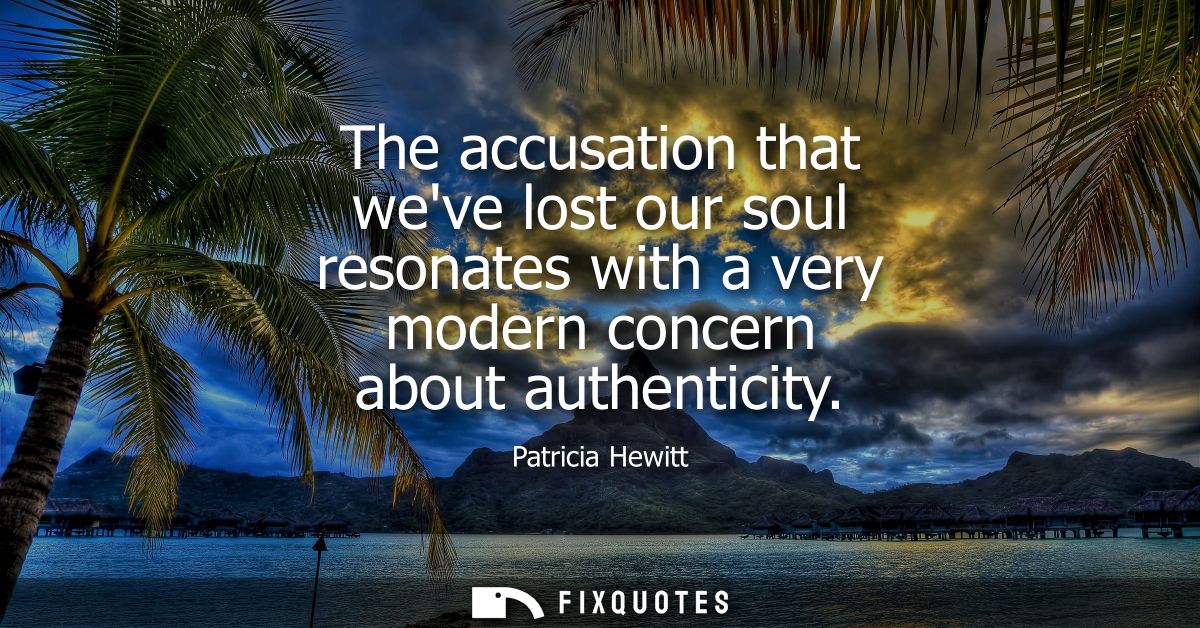
"The accusation that we've lost our soul resonates with a very modern concern about authenticity"
About this Quote
The subtext is a warning about the politics of authenticity. Modern voters don’t just demand competence; they demand the performance of a coherent self. Parties, institutions, and leaders are expected to be “real” in a world shaped by branding, spin, and media cycles that reward posture over process. By calling authenticity a “very modern concern,” Hewitt hints that the yardstick itself may be unstable - a cultural obsession born from consumer choice, image management, and the suspicion that everyone is selling something.
Contextually, it reads like late-20th/early-21st-century center-left self-defense: an era when modernization, professionalized messaging, and policy pragmatism were criticized as technocratic, bloodless, or unmoored from core values. Hewitt isn’t denying the ache behind the accusation; she’s trying to domesticate it, turning a moral crisis into a diagnosable mood - and, implicitly, something a savvy politician can manage.
Quote Details
| Topic | Deep |
|---|---|
| Source | Help us find the source |
| Cite |
Citation Formats
APA Style (7th ed.)
Hewitt, Patricia. (2026, January 16). The accusation that we've lost our soul resonates with a very modern concern about authenticity. FixQuotes. https://fixquotes.com/quotes/the-accusation-that-weve-lost-our-soul-resonates-89591/
Chicago Style
Hewitt, Patricia. "The accusation that we've lost our soul resonates with a very modern concern about authenticity." FixQuotes. January 16, 2026. https://fixquotes.com/quotes/the-accusation-that-weve-lost-our-soul-resonates-89591/.
MLA Style (9th ed.)
"The accusation that we've lost our soul resonates with a very modern concern about authenticity." FixQuotes, 16 Jan. 2026, https://fixquotes.com/quotes/the-accusation-that-weve-lost-our-soul-resonates-89591/. Accessed 13 Feb. 2026.