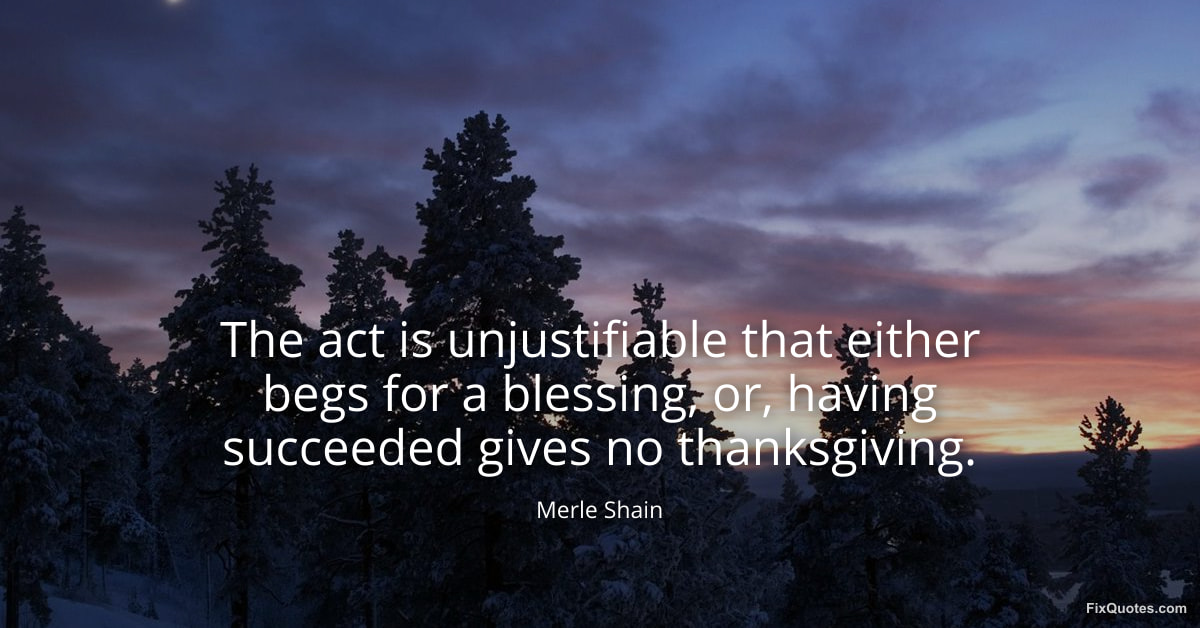
"The act is unjustifiable that either begs for a blessing, or, having succeeded, gives no thanksgiving"
About this Quote
The second clause turns the knife. If the act "having succeeded gives no thanksgiving", the problem isn't just impiety; it is entitlement. Success without gratitude implies a worldview where gains are self-authored and costs are someone else's. Shain connects the before-and-after ethics: the same person who pleads for a blessing to soothe their conscience is often the person who forgets to acknowledge what made the outcome possible once the risk pays off.
Contextually, Shain wrote in an era when personal fulfillment was being sold as a kind of spiritual right, especially in popular psychology and self-help culture. The quote reads like a corrective to that trend: a reminder that meaning isn't manufactured by affirmations, and morality can't be reduced to "feeling good about it". The intent is less to police faith than to expose a pattern of self-justification that treats the sacred as a tool and gratitude as optional.
Quote Details
| Topic | Gratitude |
|---|---|
| Source | Help us find the source |
| Cite |
Citation Formats
APA Style (7th ed.)
Shain, Merle. (2026, February 16). The act is unjustifiable that either begs for a blessing, or, having succeeded, gives no thanksgiving. FixQuotes. https://fixquotes.com/quotes/the-act-is-unjustifiable-that-either-begs-for-a-117208/
Chicago Style
Shain, Merle. "The act is unjustifiable that either begs for a blessing, or, having succeeded, gives no thanksgiving." FixQuotes. February 16, 2026. https://fixquotes.com/quotes/the-act-is-unjustifiable-that-either-begs-for-a-117208/.
MLA Style (9th ed.)
"The act is unjustifiable that either begs for a blessing, or, having succeeded, gives no thanksgiving." FixQuotes, 16 Feb. 2026, https://fixquotes.com/quotes/the-act-is-unjustifiable-that-either-begs-for-a-117208/. Accessed 8 Apr. 2026.