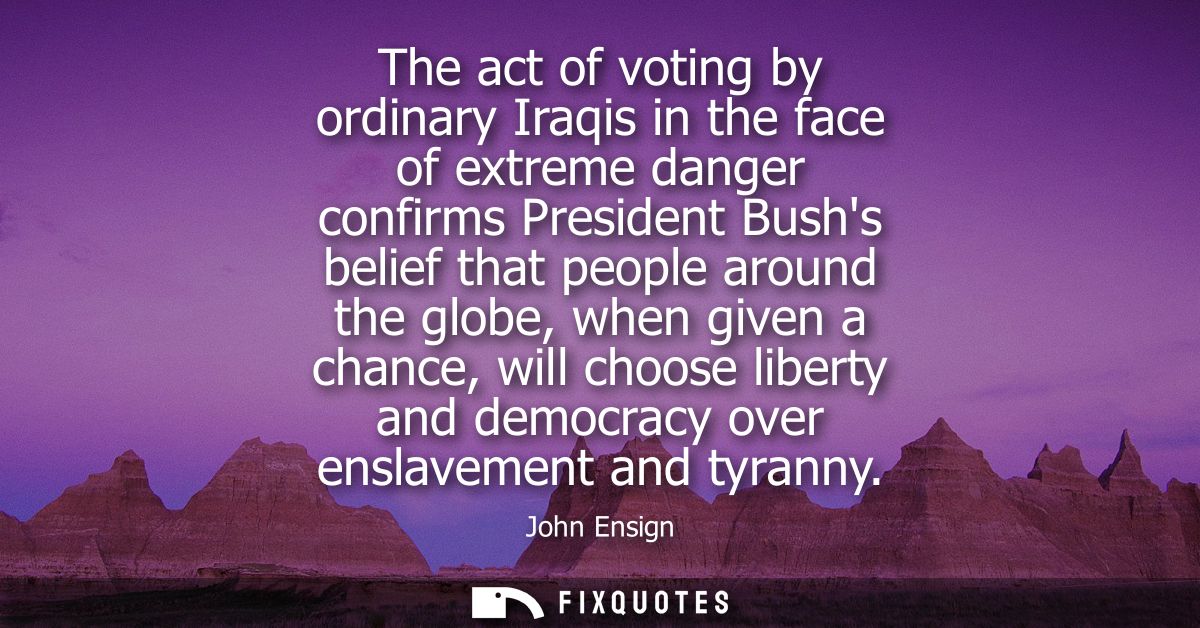
"The act of voting by ordinary Iraqis in the face of extreme danger confirms President Bush's belief that people around the globe, when given a chance, will choose liberty and democracy over enslavement and tyranny"
About this Quote
The key maneuver is the word “confirms.” Ensign frames a messy, contingent event - people voting for dozens of reasons, including sectarian power, local patronage, fear, hope, and survival - as a simple referendum on American ideology. Iraq becomes a stage where “ordinary” citizens audition for a role in a familiar U.S. narrative: freedom-seekers awaiting their chance. That phrase, “when given a chance,” quietly recenters agency with the giver. Iraqis choose, but only after Washington grants the opportunity.
The moral architecture is stark: “liberty and democracy” versus “enslavement and tyranny.” It’s not analysis; it’s a binary designed to discipline doubt. If voting equals “liberty,” then skepticism about the war reads as skepticism about liberty itself. In that context - early elections amid insurgency, rising casualties, and domestic American unease - the line functions as political insulation: a valorization of Iraqi bravery deployed to validate U.S. strategy, and to convert a single democratic ritual into a sweeping verdict on history.
Quote Details
| Topic | Freedom |
|---|---|
| Source | Help us find the source |
| Cite |
Citation Formats
APA Style (7th ed.)
Ensign, John. (2026, January 17). The act of voting by ordinary Iraqis in the face of extreme danger confirms President Bush's belief that people around the globe, when given a chance, will choose liberty and democracy over enslavement and tyranny. FixQuotes. https://fixquotes.com/quotes/the-act-of-voting-by-ordinary-iraqis-in-the-face-52212/
Chicago Style
Ensign, John. "The act of voting by ordinary Iraqis in the face of extreme danger confirms President Bush's belief that people around the globe, when given a chance, will choose liberty and democracy over enslavement and tyranny." FixQuotes. January 17, 2026. https://fixquotes.com/quotes/the-act-of-voting-by-ordinary-iraqis-in-the-face-52212/.
MLA Style (9th ed.)
"The act of voting by ordinary Iraqis in the face of extreme danger confirms President Bush's belief that people around the globe, when given a chance, will choose liberty and democracy over enslavement and tyranny." FixQuotes, 17 Jan. 2026, https://fixquotes.com/quotes/the-act-of-voting-by-ordinary-iraqis-in-the-face-52212/. Accessed 5 Apr. 2026.