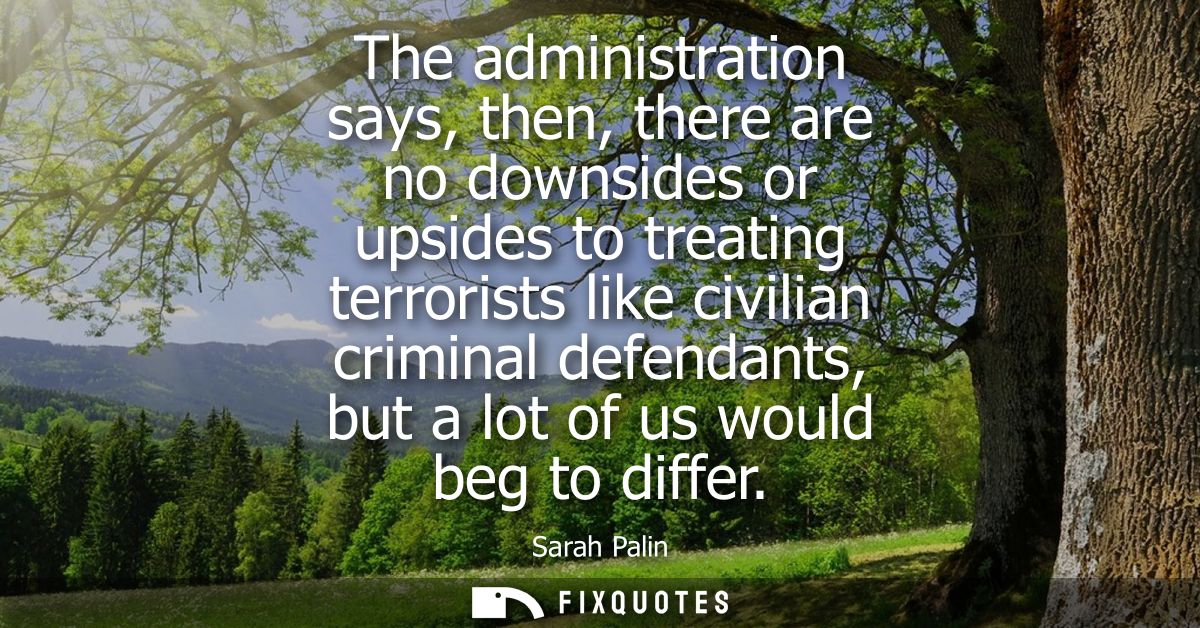
"The administration says, then, there are no downsides or upsides to treating terrorists like civilian criminal defendants, but a lot of us would beg to differ"
About this Quote
The core move is in the double negative: “no downsides or upsides.” It paints the administration’s position as not just wrong, but absurdly flat - as if the government is pretending the stakes don’t exist. That’s important because the debate Palin is tapping into (late-2000s/early-2010s fights over Guantanamo, civilian trials, and the legal status of terror suspects) was never really about courtroom procedure. It was about identity and vulnerability: are we a country that treats terrorism as crime, or as war?
“Treating terrorists like civilian criminal defendants” compresses a set of contested legal questions into a single insinuation: that normal due process is an indulgence, maybe even a weakness, when the defendant is labeled “terrorist.” Then comes the kicker: “a lot of us would beg to differ.” It’s a soft phrase with a hard function. “Beg” borrows moral urgency; “a lot of us” manufactures a majority without evidence. The subtext is less “I have a better argument” than “if you disagree, you’re out of touch with the people who are paying attention and afraid.”
Quote Details
| Topic | Justice |
|---|---|
| Source | Help us find the source |
| Cite |
Citation Formats
APA Style (7th ed.)
Palin, Sarah. (2026, January 18). The administration says, then, there are no downsides or upsides to treating terrorists like civilian criminal defendants, but a lot of us would beg to differ. FixQuotes. https://fixquotes.com/quotes/the-administration-says-then-there-are-no-21131/
Chicago Style
Palin, Sarah. "The administration says, then, there are no downsides or upsides to treating terrorists like civilian criminal defendants, but a lot of us would beg to differ." FixQuotes. January 18, 2026. https://fixquotes.com/quotes/the-administration-says-then-there-are-no-21131/.
MLA Style (9th ed.)
"The administration says, then, there are no downsides or upsides to treating terrorists like civilian criminal defendants, but a lot of us would beg to differ." FixQuotes, 18 Jan. 2026, https://fixquotes.com/quotes/the-administration-says-then-there-are-no-21131/. Accessed 10 Mar. 2026.