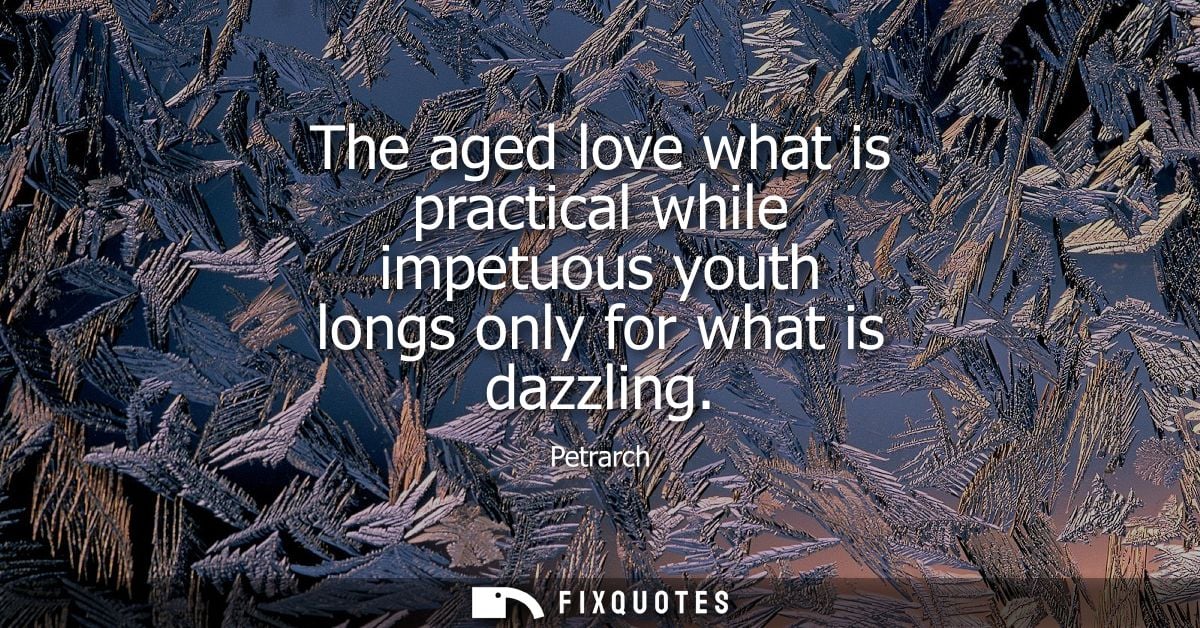
"The aged love what is practical, while impetuous youth longs only for what is dazzling"
About this Quote
As a 14th-century poet straddling medieval piety and early humanist self-scrutiny, Petrarch is writing in a culture that prized restraint but was newly fascinated by inner life. He’s famous for turning the self into a stage where conflicting impulses perform: aspiration vs. appetite, virtue vs. vanity, eternity vs. the glitter of the present. This epigram compresses that drama into an age-based contrast, but the subtext is less about chronology than about training: time tutors you into practicality the way dazzlement tutors you into disappointment.
There’s also a rhetorical trapdoor here. “Dazzling” isn’t condemned outright; it’s described in the language of spectacle, a force that overwhelms the senses. Petrarch knows how beauty works on a person because his poetry runs on that charge. The line’s bite comes from self-implication: the poet chastises youthful longing while admitting how intoxicating it is, and how thoroughly it can organize a life.
Quote Details
| Topic | Aging |
|---|---|
| Source | Help us find the source |
| Cite |
Citation Formats
APA Style (7th ed.)
Petrarch. (2026, February 20). The aged love what is practical, while impetuous youth longs only for what is dazzling. FixQuotes. https://fixquotes.com/quotes/the-aged-love-what-is-practical-while-impetuous-15558/
Chicago Style
Petrarch. "The aged love what is practical, while impetuous youth longs only for what is dazzling." FixQuotes. February 20, 2026. https://fixquotes.com/quotes/the-aged-love-what-is-practical-while-impetuous-15558/.
MLA Style (9th ed.)
"The aged love what is practical, while impetuous youth longs only for what is dazzling." FixQuotes, 20 Feb. 2026, https://fixquotes.com/quotes/the-aged-love-what-is-practical-while-impetuous-15558/. Accessed 27 Mar. 2026.