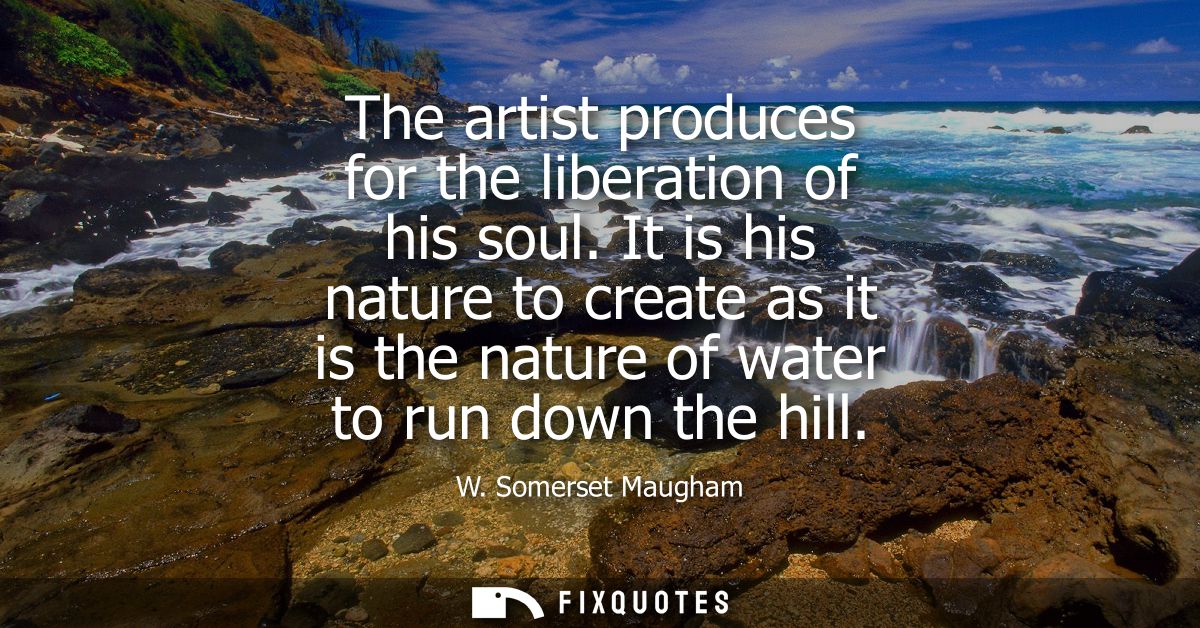
"The artist produces for the liberation of his soul. It is his nature to create as it is the nature of water to run down the hill"
About this Quote
The second sentence does the heavier rhetorical work. Comparing the artist to water running downhill strips away heroics and replaces them with physics. Water doesn’t debate, posture, or seek permission; it moves because gravity makes stasis impossible. Maugham’s subtext is quietly defensive: if you’re judging the artist by moral utility or social service, you’re already missing the point. Art isn’t primarily a public good; it’s a natural discharge that sometimes becomes one.
There’s also a bracing modernity in how he resists mystical language. No muses, no destiny, just nature. That aligns with Maugham’s own reputation for cool observation and skepticism about grand ideals. In the early 20th-century literary world - crowded with manifestos, movements, and moral arguments about what art should do - he slips in an unfashionable claim: the deepest justification for making work is not ideology. It’s gravity.
Quote Details
| Topic | Art |
|---|---|
| Source | Later attribution: An Artist and a Writer Travel Highway 1 North (Janice Stevens, 2012) modern compilationISBN: 9781610351836 · ID: Ny_y_xHYeRUC
Evidence:
... THE ARTIST PRODUCES FOR THE LIBERATION OF HIS SOUL . IT IS HIS NATURE TO CREATE AS IT IS THE NATURE OF WATER TO RUN DOWN THE HILL . -W . Somerset Maugham WITH A FULL DAY ahead of us , we rise Crescent City to Pelican State Beach. |
| Cite |
Citation Formats
APA Style (7th ed.)
Maugham, W. Somerset. (2026, March 28). The artist produces for the liberation of his soul. It is his nature to create as it is the nature of water to run down the hill. FixQuotes. https://fixquotes.com/quotes/the-artist-produces-for-the-liberation-of-his-87106/
Chicago Style
Maugham, W. Somerset. "The artist produces for the liberation of his soul. It is his nature to create as it is the nature of water to run down the hill." FixQuotes. March 28, 2026. https://fixquotes.com/quotes/the-artist-produces-for-the-liberation-of-his-87106/.
MLA Style (9th ed.)
"The artist produces for the liberation of his soul. It is his nature to create as it is the nature of water to run down the hill." FixQuotes, 28 Mar. 2026, https://fixquotes.com/quotes/the-artist-produces-for-the-liberation-of-his-87106/. Accessed 29 Mar. 2026.