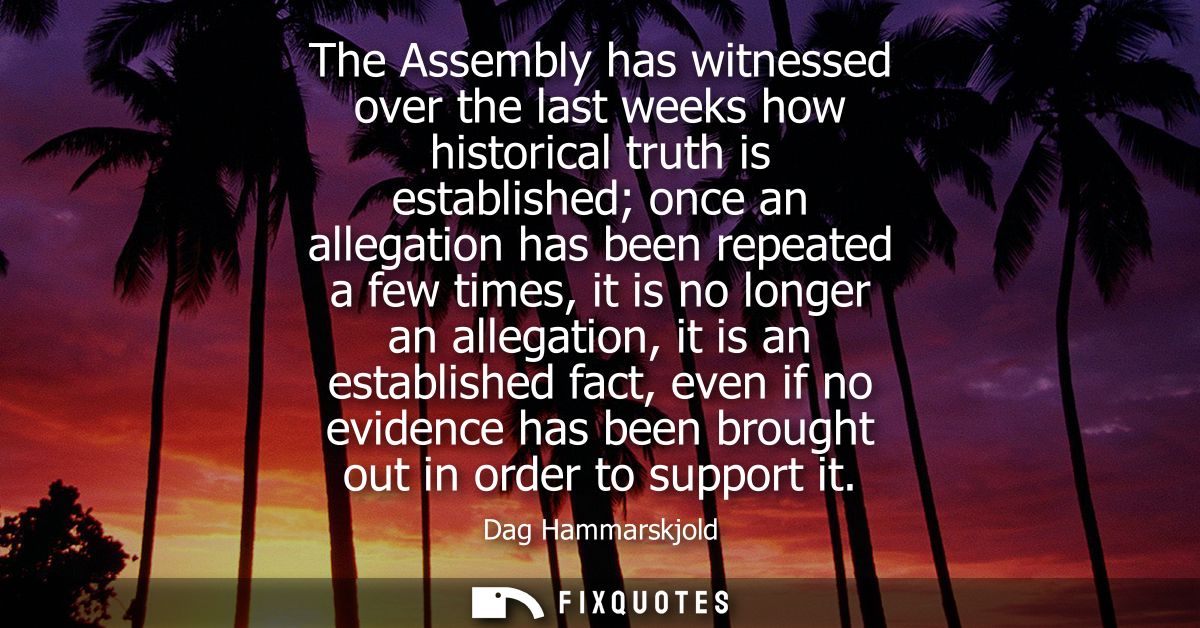
"The Assembly has witnessed over the last weeks how historical truth is established; once an allegation has been repeated a few times, it is no longer an allegation, it is an established fact, even if no evidence has been brought out in order to support it"
About this Quote
The subtext is sharper than the measured diction suggests. Hammarskjold is implying that delegates may be laundering rumor into record, weaponizing ambiguity to corner opponents while preserving plausible deniability. “Even if no evidence has been brought out” stings because it points to a shared complicity: everyone in the chamber knows the evidentiary gap, yet the incentives of diplomacy reward narrative momentum over verification. In that environment, “historical truth” becomes less about what happened and more about what can be made legible, repeatable, and politically useful.
Context matters: a mid-century international order still defining its norms, with propaganda, decolonization conflicts, and Cold War alignments turning the UN into both forum and battleground. Hammarskjold, as Secretary-General, is defending the idea that legitimacy requires more than consensus; it requires standards. The intent is prophylactic: stop treating repetition as proof before the institution’s memory calcifies into “history” and policy calcifies with it.
Quote Details
| Topic | Truth |
|---|---|
| Source | Help us find the source |
| Cite |
Citation Formats
APA Style (7th ed.)
Hammarskjold, Dag. (2026, January 17). The Assembly has witnessed over the last weeks how historical truth is established; once an allegation has been repeated a few times, it is no longer an allegation, it is an established fact, even if no evidence has been brought out in order to support it. FixQuotes. https://fixquotes.com/quotes/the-assembly-has-witnessed-over-the-last-weeks-35171/
Chicago Style
Hammarskjold, Dag. "The Assembly has witnessed over the last weeks how historical truth is established; once an allegation has been repeated a few times, it is no longer an allegation, it is an established fact, even if no evidence has been brought out in order to support it." FixQuotes. January 17, 2026. https://fixquotes.com/quotes/the-assembly-has-witnessed-over-the-last-weeks-35171/.
MLA Style (9th ed.)
"The Assembly has witnessed over the last weeks how historical truth is established; once an allegation has been repeated a few times, it is no longer an allegation, it is an established fact, even if no evidence has been brought out in order to support it." FixQuotes, 17 Jan. 2026, https://fixquotes.com/quotes/the-assembly-has-witnessed-over-the-last-weeks-35171/. Accessed 6 Apr. 2026.