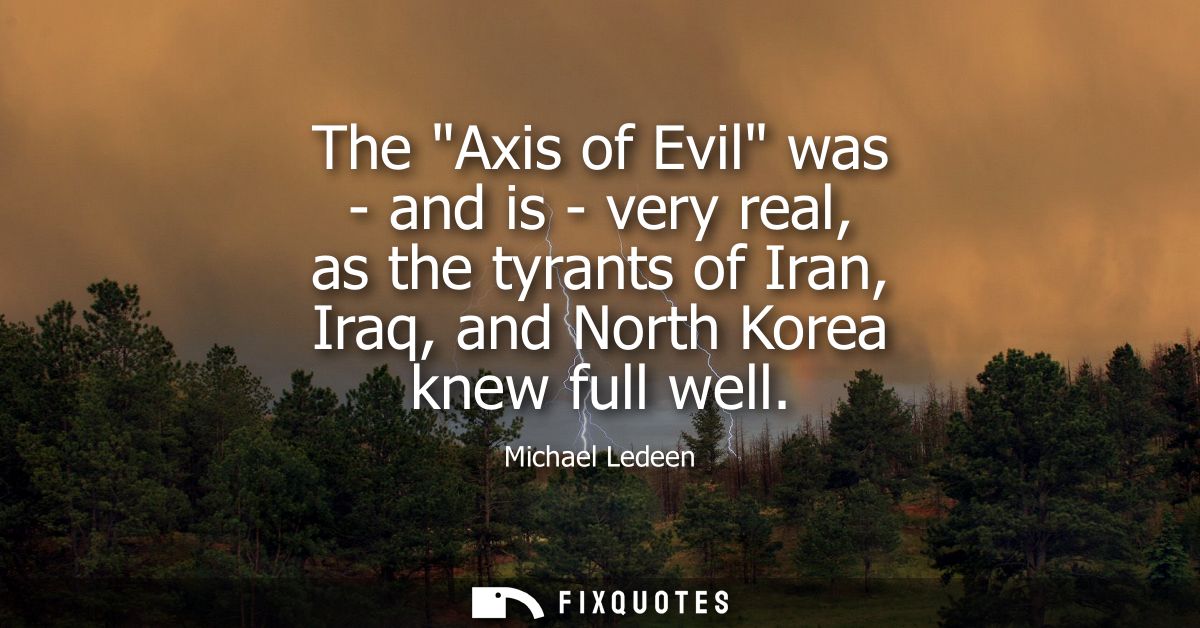
"The "Axis of Evil" was - and is - very real, as the tyrants of Iran, Iraq, and North Korea knew full well"
About this Quote
The subtext is less about describing Iran, Iraq, and North Korea than about disciplining the debate around them. If the "Axis" is real, then skepticism starts to look like naivete, and diplomacy risks sounding like indulgence. Ledeen’s aside - "as the tyrants... knew full well" - is a rhetorical move that claims privileged access to the enemy’s mind. It closes the gap where uncertainty lives, swapping evidence for certainty, and it flatters the reader into feeling strategically clear-eyed.
Context matters: the phrase was popularized in George W. Bush’s 2002 State of the Union, when the U.S. was consolidating a post-9/11 worldview and building a case for confrontational foreign policy. By bundling three very different states into one moral category, the slogan invites a single posture - resolve, pressure, force - while downplaying the inconvenient differences that would otherwise demand tailored strategy.
Quote Details
| Topic | War |
|---|---|
| Source | Help us find the source |
| Cite |
Citation Formats
APA Style (7th ed.)
Ledeen, Michael. (2026, January 16). The "Axis of Evil" was - and is - very real, as the tyrants of Iran, Iraq, and North Korea knew full well. FixQuotes. https://fixquotes.com/quotes/the-axis-of-evil-was-and-is-very-real-as-the-133687/
Chicago Style
Ledeen, Michael. "The "Axis of Evil" was - and is - very real, as the tyrants of Iran, Iraq, and North Korea knew full well." FixQuotes. January 16, 2026. https://fixquotes.com/quotes/the-axis-of-evil-was-and-is-very-real-as-the-133687/.
MLA Style (9th ed.)
"The "Axis of Evil" was - and is - very real, as the tyrants of Iran, Iraq, and North Korea knew full well." FixQuotes, 16 Jan. 2026, https://fixquotes.com/quotes/the-axis-of-evil-was-and-is-very-real-as-the-133687/. Accessed 19 Mar. 2026.