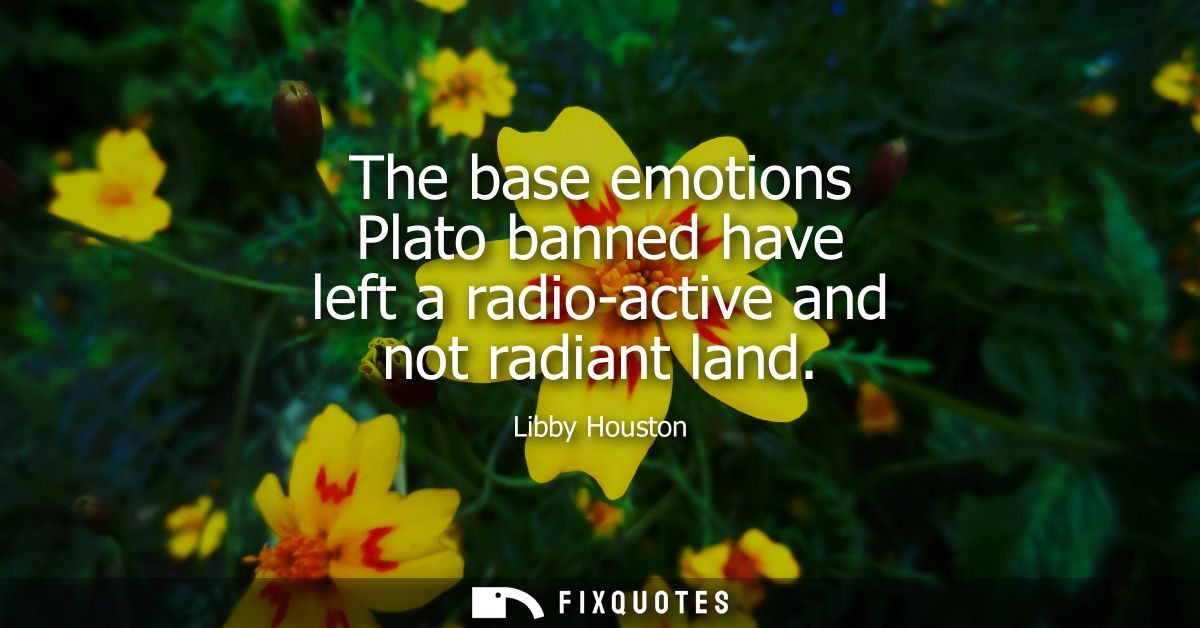
"The base emotions Plato banned have left a radioactive and not radiant land"
About this Quote
The hyphen does real work. “Radio-active” reads as process, not adjective: emotions made active in the wrong way, charged up by denial until they start leaking. It suggests fallout culture - the legacy of pretending you can seal off what’s inconvenient and still live normally on the surface. Houston’s pivot from “radiant” to “radio-active” is a near-pun that stings because it maps onto contemporary life: institutions that prize composure, productivity, and “civility” often end up breeding the very volatility they’re trying to eliminate. Anger doesn’t disappear; it finds a more toxic outlet.
The “land” is moral and political as much as physical. A society that bans desire, grief, envy, lust - anything not easily dignified - doesn’t become enlightened. It becomes irradiated: glossy on the outside, dangerous underneath, haunted by what it tried to deny.
Quote Details
| Topic | Deep |
|---|---|
| Source | Help us find the source |
| Cite |
Citation Formats
APA Style (7th ed.)
Houston, Libby. (2026, February 17). The base emotions Plato banned have left a radioactive and not radiant land. FixQuotes. https://fixquotes.com/quotes/the-base-emotions-plato-banned-have-left-a-104460/
Chicago Style
Houston, Libby. "The base emotions Plato banned have left a radioactive and not radiant land." FixQuotes. February 17, 2026. https://fixquotes.com/quotes/the-base-emotions-plato-banned-have-left-a-104460/.
MLA Style (9th ed.)
"The base emotions Plato banned have left a radioactive and not radiant land." FixQuotes, 17 Feb. 2026, https://fixquotes.com/quotes/the-base-emotions-plato-banned-have-left-a-104460/. Accessed 9 Mar. 2026.