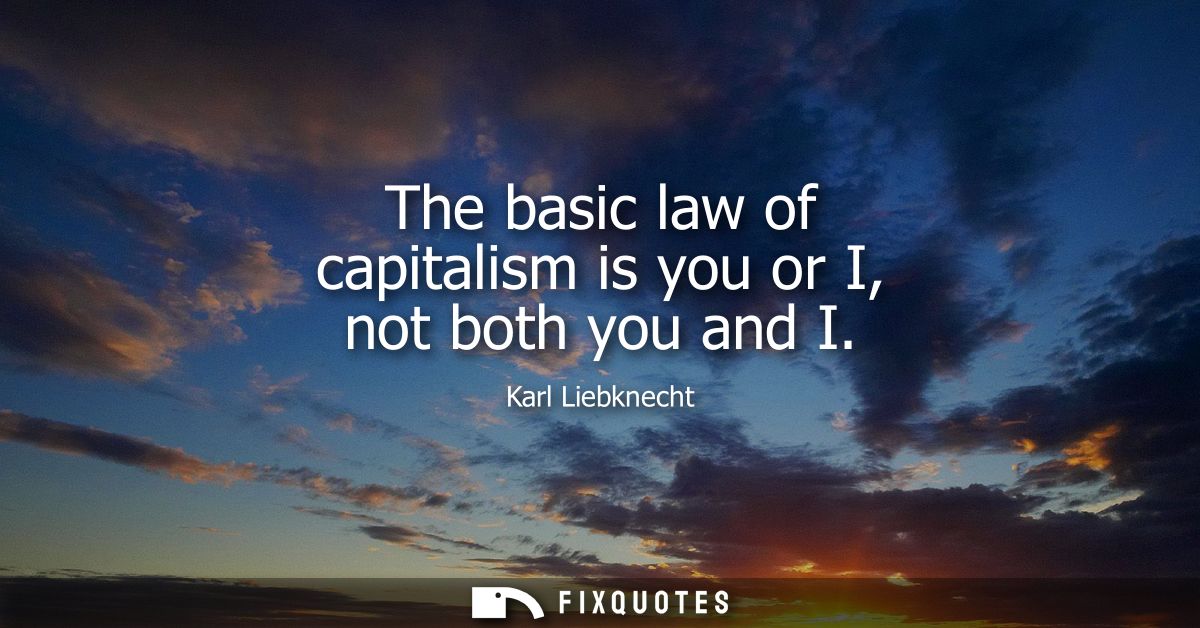
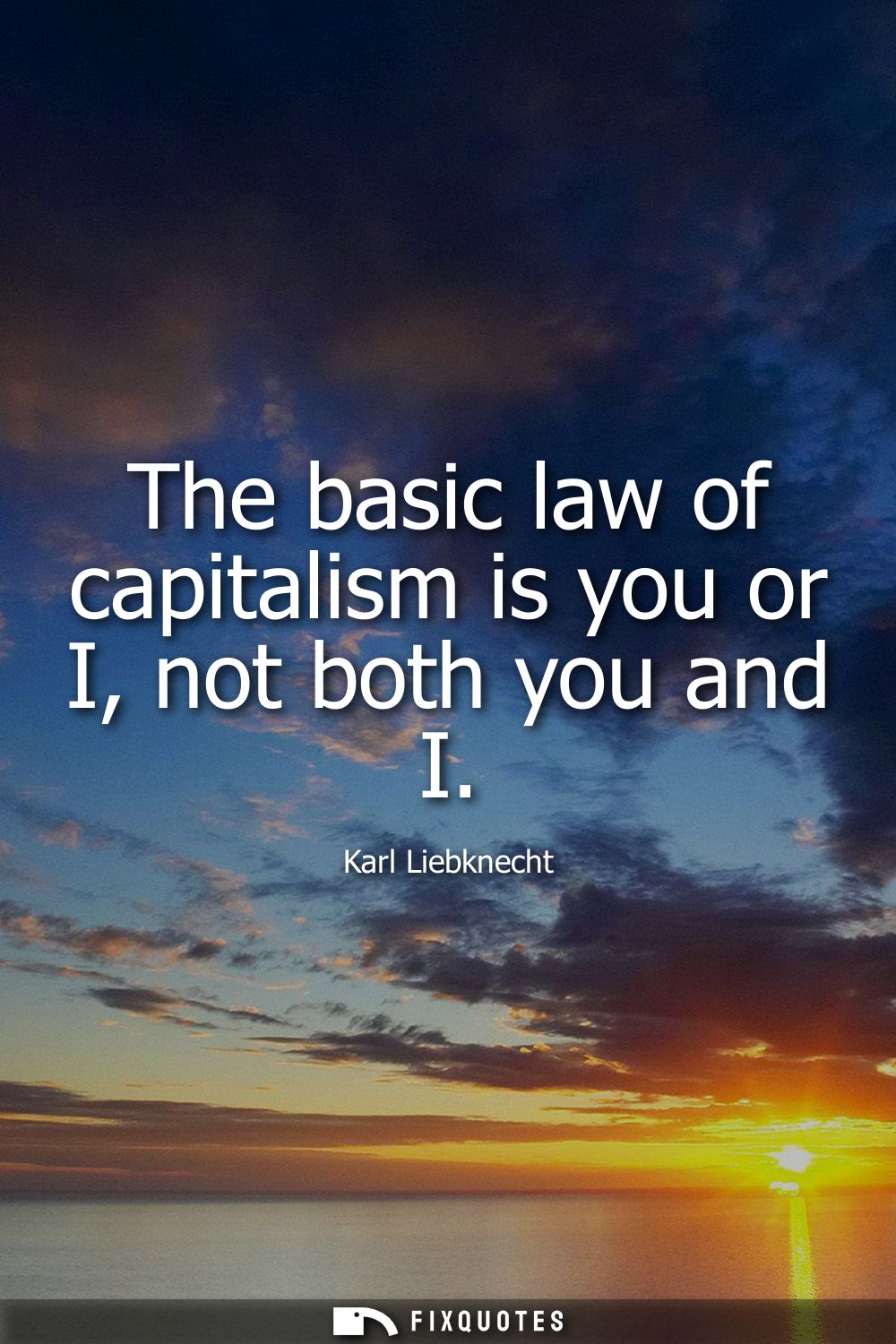
"The basic law of capitalism is you or I, not both you and I"
About this Quote
A knife-edge sentence like this is designed to make capitalism feel less like an “economic system” and more like a relationship of permanent threat. Liebknecht reduces the whole order to a primal grammar: “you or I.” No coexistence, no shared horizon, just selection. The line works because it borrows the intimacy of everyday speech and turns it into class warfare logic, smuggling an indictment into something that sounds almost obvious. The “basic law” framing is also a rhetorical power move: he’s not arguing policy details, he’s claiming a natural law as cold as gravity, and daring you to disprove it with lived experience.
The subtext is that the violence is structural, not accidental. If capitalism’s rule is exclusion, then charity, reforms, even “fair” competition become cosmetics on a zero-sum engine. It’s a direct rebuttal to liberal promises that everyone can rise together if the market is left to work its magic. By making the conflict personal (“you or I”) rather than abstract (“labor and capital”), he forces identification: pick a side, because the system already has.
Context sharpens the menace. Liebknecht was a German socialist and anti-militarist who opposed World War I and helped found the Spartacist movement amid the collapse of the German Empire. In that moment, “law” wasn’t metaphorical: state power, war profiteering, and crackdowns on dissent were daily realities. The line is propaganda in the best sense - a compact moral instrument meant to radicalize, to make compromise sound like self-deception, and to frame solidarity as the only escape from the market’s implied ultimatum.
The subtext is that the violence is structural, not accidental. If capitalism’s rule is exclusion, then charity, reforms, even “fair” competition become cosmetics on a zero-sum engine. It’s a direct rebuttal to liberal promises that everyone can rise together if the market is left to work its magic. By making the conflict personal (“you or I”) rather than abstract (“labor and capital”), he forces identification: pick a side, because the system already has.
Context sharpens the menace. Liebknecht was a German socialist and anti-militarist who opposed World War I and helped found the Spartacist movement amid the collapse of the German Empire. In that moment, “law” wasn’t metaphorical: state power, war profiteering, and crackdowns on dissent were daily realities. The line is propaganda in the best sense - a compact moral instrument meant to radicalize, to make compromise sound like self-deception, and to frame solidarity as the only escape from the market’s implied ultimatum.
Quote Details
| Topic | Equality |
|---|---|
| Source | Later attribution: Atheists, Agnostics, Progressive Minds (John Cannon, 2010) modern compilationISBN: 9781453829851 · ID: tBFwiApGAyUC
Evidence:
... The basic law of capitalism is you or I, not both you and I. Karl Liebknecht The trouble with the profit system has always been that it was highly unprofitable to most people. E.B. White The brain is like a muscle. When we think well, |
| Cite |
Citation Formats
APA Style (7th ed.)
Liebknecht, Karl. (2026, February 23). The basic law of capitalism is you or I, not both you and I. FixQuotes. https://fixquotes.com/quotes/the-basic-law-of-capitalism-is-you-or-i-not-both-85993/
Chicago Style
Liebknecht, Karl. "The basic law of capitalism is you or I, not both you and I." FixQuotes. February 23, 2026. https://fixquotes.com/quotes/the-basic-law-of-capitalism-is-you-or-i-not-both-85993/.
MLA Style (9th ed.)
"The basic law of capitalism is you or I, not both you and I." FixQuotes, 23 Feb. 2026, https://fixquotes.com/quotes/the-basic-law-of-capitalism-is-you-or-i-not-both-85993/. Accessed 29 Mar. 2026.
More Quotes by Karl
Add to List