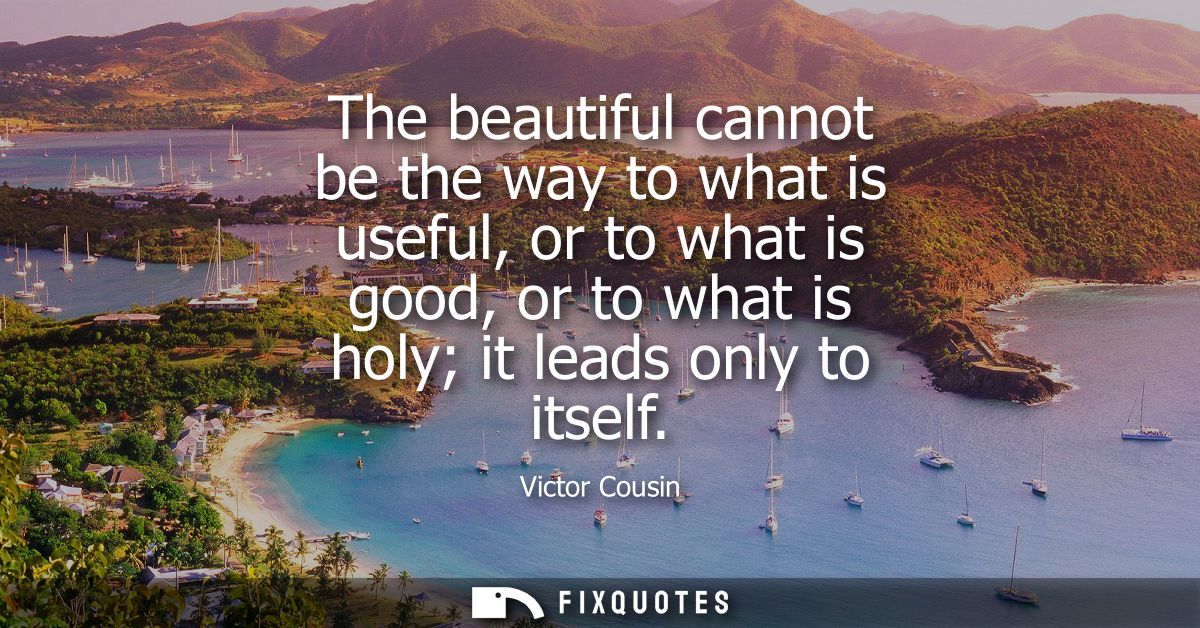
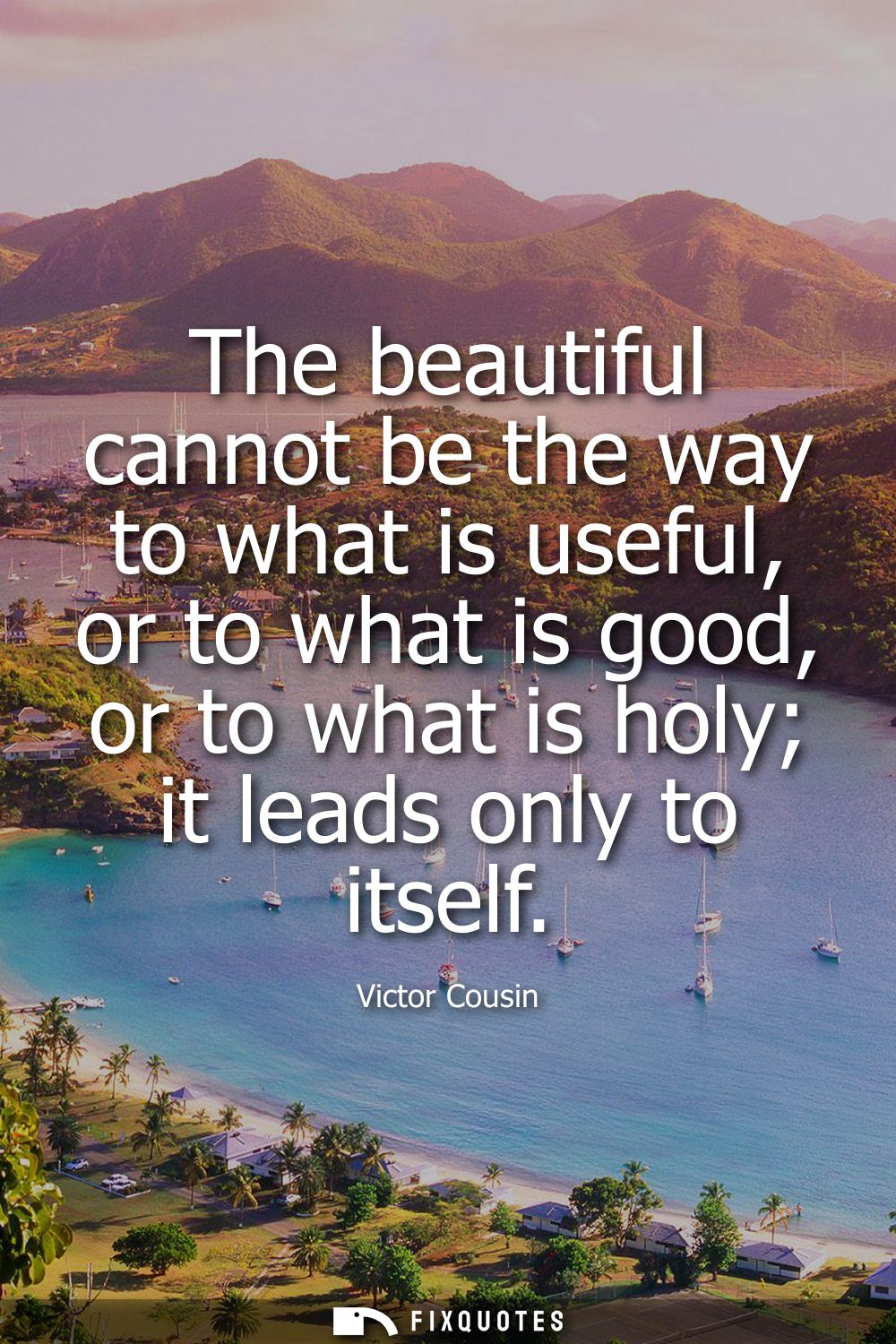
"The beautiful cannot be the way to what is useful, or to what is good, or to what is holy; it leads only to itself"
About this Quote
The subtext is a defense of autonomy, but also a warning. If beauty "leads only to itself", then it cannot be conscripted as evidence that something is true, good, or holy. Pretty churches do not prove God; elegant arguments do not prove justice. Cousin is separating the pleasure of form from the demands of conscience, and he does it with a near-theological severity: beauty has its own law, and mixing it with the sacred only contaminates both.
Context matters. Cousin is a key figure in 19th-century French spiritual eclecticism, writing in a period when Romanticism inflated art into a surrogate religion and when the modern state increasingly instrumentalized culture. His sentence pushes against both trends. It anticipates later "art for art's sake" talk, but without bohemian swagger. It reads more like a moral quarantine: stop asking beauty to do the work of goodness. Let it be ravishing, even useless - and therefore, strangely, honest.
Quote Details
| Topic | Wisdom |
|---|---|
| Source | Help us find the source |
| Cite |
Citation Formats
APA Style (7th ed.)
Cousin, Victor. (2026, January 18). The beautiful cannot be the way to what is useful, or to what is good, or to what is holy; it leads only to itself. FixQuotes. https://fixquotes.com/quotes/the-beautiful-cannot-be-the-way-to-what-is-useful-2700/
Chicago Style
Cousin, Victor. "The beautiful cannot be the way to what is useful, or to what is good, or to what is holy; it leads only to itself." FixQuotes. January 18, 2026. https://fixquotes.com/quotes/the-beautiful-cannot-be-the-way-to-what-is-useful-2700/.
MLA Style (9th ed.)
"The beautiful cannot be the way to what is useful, or to what is good, or to what is holy; it leads only to itself." FixQuotes, 18 Jan. 2026, https://fixquotes.com/quotes/the-beautiful-cannot-be-the-way-to-what-is-useful-2700/. Accessed 8 Mar. 2026.