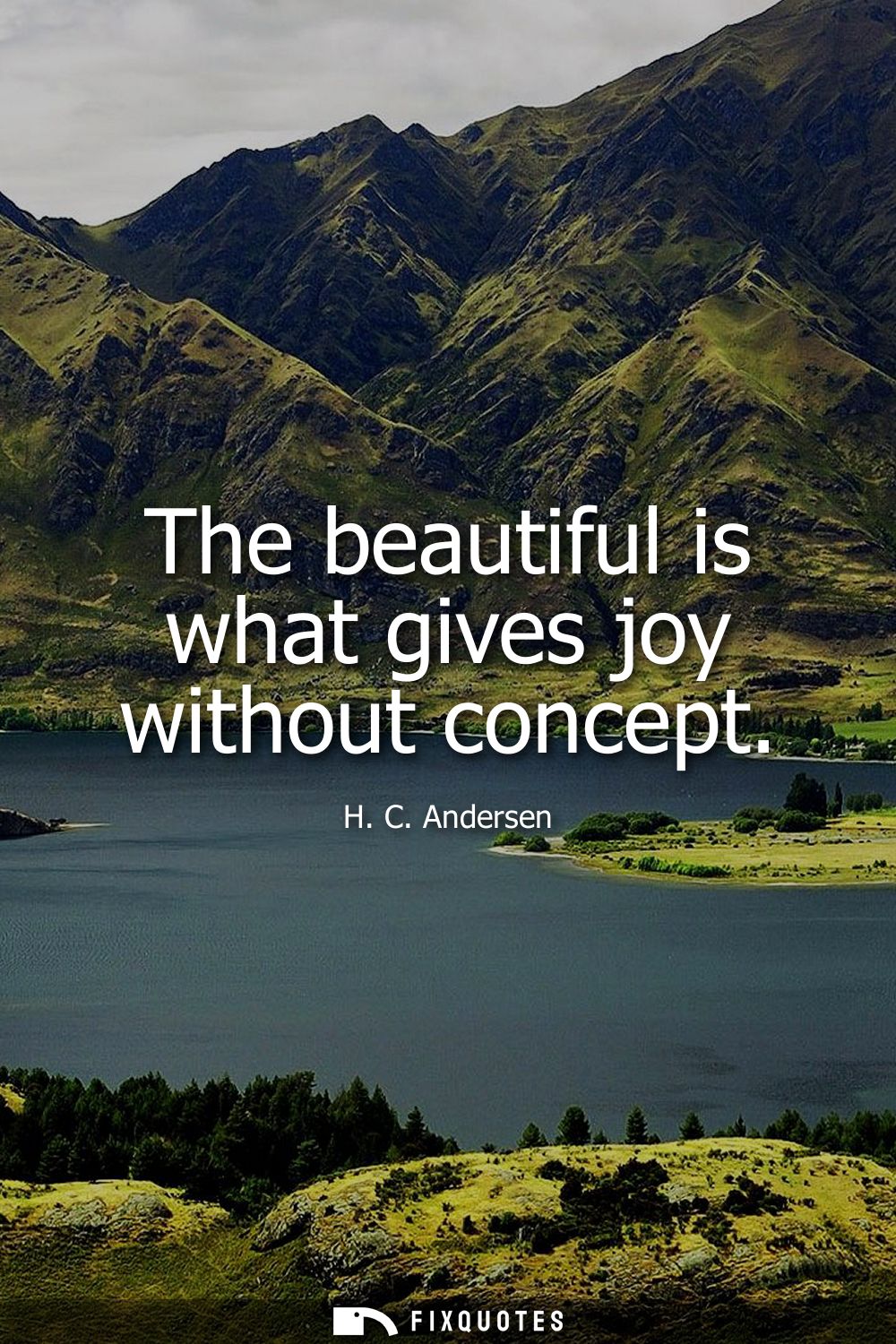
"The beautiful is what gives joy without concept"
About this Quote
Beauty, Andersen implies, is the rare pleasure that doesn’t ask to be “understood” first. “Joy without concept” is a quiet rebuke to the 19th-century hunger for classification - the era’s moral lessons, scientific taxonomies, and social rules that tried to pin everything down like a specimen. Against that impulse, he proposes an experience that lands before the mind starts filing it into categories. The line flatters the body and the senses: you feel the lift, you smile, and only afterward do you scramble for reasons.
The phrasing also sneaks in a defense of art that doesn’t behave. If joy arrives “without concept,” then beauty isn’t obligated to justify itself with a lesson, a civic purpose, or a neat allegory. That’s a useful claim for a writer whose best-known work often gets misread as children’s morality tales. Andersen’s stories are full of enchantment that seduces first and stings later; they operate on mood, image, and ache before they resolve into meaning. This quote argues that the seduction isn’t decorative - it’s the point.
There’s subtextual politics here, too: concept is the language of institutions. When beauty bypasses it, it becomes private, ungovernable, a small revolt against the adult world’s insistence that everything must be legible. The line doesn’t deny meaning; it demotes meaning. In Andersen’s universe, the heart’s immediate recognition outranks the critic’s explanation, and that hierarchy is its own kind of daring.
The phrasing also sneaks in a defense of art that doesn’t behave. If joy arrives “without concept,” then beauty isn’t obligated to justify itself with a lesson, a civic purpose, or a neat allegory. That’s a useful claim for a writer whose best-known work often gets misread as children’s morality tales. Andersen’s stories are full of enchantment that seduces first and stings later; they operate on mood, image, and ache before they resolve into meaning. This quote argues that the seduction isn’t decorative - it’s the point.
There’s subtextual politics here, too: concept is the language of institutions. When beauty bypasses it, it becomes private, ungovernable, a small revolt against the adult world’s insistence that everything must be legible. The line doesn’t deny meaning; it demotes meaning. In Andersen’s universe, the heart’s immediate recognition outranks the critic’s explanation, and that hierarchy is its own kind of daring.
Quote Details
| Topic | Art |
|---|---|
| Source | Help us find the source |
| Cite |
Citation Formats
APA Style (7th ed.)
Andersen, H. C. (2026, January 15). The beautiful is what gives joy without concept. FixQuotes. https://fixquotes.com/quotes/the-beautiful-is-what-gives-joy-without-concept-171980/
Chicago Style
Andersen, H. C. "The beautiful is what gives joy without concept." FixQuotes. January 15, 2026. https://fixquotes.com/quotes/the-beautiful-is-what-gives-joy-without-concept-171980/.
MLA Style (9th ed.)
"The beautiful is what gives joy without concept." FixQuotes, 15 Jan. 2026, https://fixquotes.com/quotes/the-beautiful-is-what-gives-joy-without-concept-171980/. Accessed 10 Mar. 2026.
More Quotes by C. Andersen
Add to List