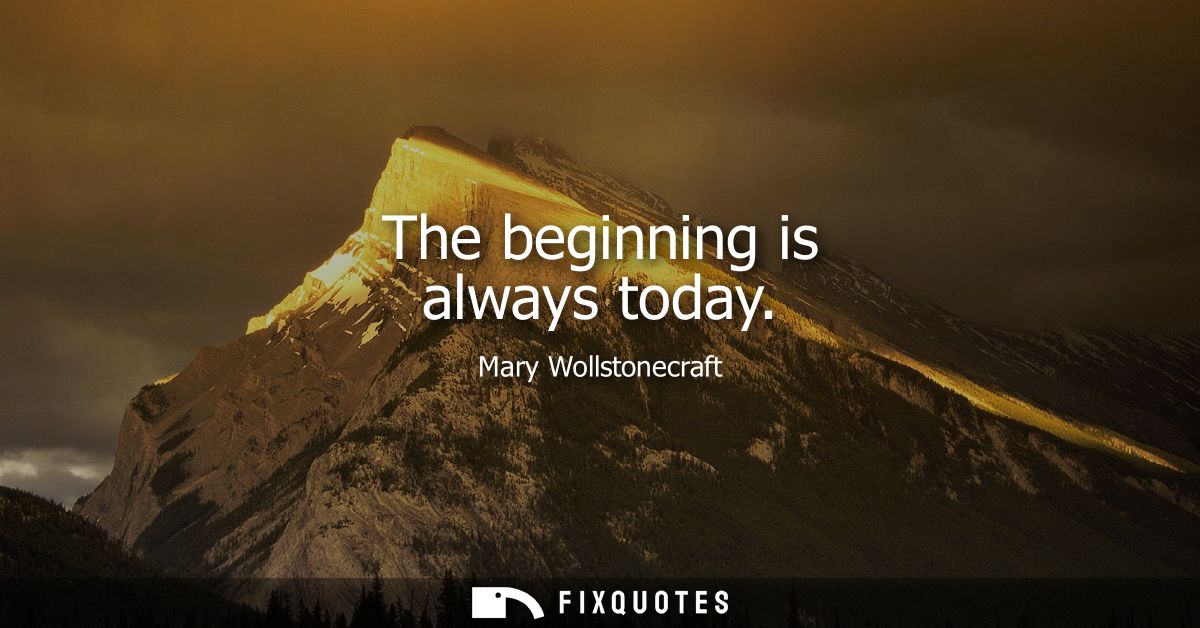
"The beginning is always today"
About this Quote
A radical sentence disguised as a calendar slogan, "The beginning is always today" rejects the comfort of delay. Wollstonecraft, writing in an age that treated women as perpetual minors and custom as fate, is not offering gentle encouragement. She is issuing a philosophical rebuke: if you can locate your liberation in some distant "soon" - after marriage, after permission, after a revolution led by other people - you have already surrendered agency to the very structures you claim to oppose.
The line works because it compresses an Enlightenment wager into eight words. "Beginning" is usually mythic: origins, founding fathers, grand declarations. Wollstonecraft drags it down to the daily, almost procedural present tense. That grammatical choice is the subtext. Today is not inspirational; today is accountable. It leaves no room for the sentimental alibi of "my circumstances". In her world, circumstances were the argument used to keep women uneducated, economically dependent, and politically irrelevant. Reframing the starting point as now is a way of reassigning responsibility back to the self without pretending the obstacles aren't real.
Context sharpens the edge: Wollstonecraft watched the French Revolution promise universal rights while quietly reserving them for men. Against that hypocrisy, "always today" reads as both personal ethic and political tactic. Rights aren't granted by the future; they are practiced into existence in the present - through study, work, dissent, refusal. It's a writer's line with organizer energy: history doesn't open the door, you do, and you do it on a Tuesday.
The line works because it compresses an Enlightenment wager into eight words. "Beginning" is usually mythic: origins, founding fathers, grand declarations. Wollstonecraft drags it down to the daily, almost procedural present tense. That grammatical choice is the subtext. Today is not inspirational; today is accountable. It leaves no room for the sentimental alibi of "my circumstances". In her world, circumstances were the argument used to keep women uneducated, economically dependent, and politically irrelevant. Reframing the starting point as now is a way of reassigning responsibility back to the self without pretending the obstacles aren't real.
Context sharpens the edge: Wollstonecraft watched the French Revolution promise universal rights while quietly reserving them for men. Against that hypocrisy, "always today" reads as both personal ethic and political tactic. Rights aren't granted by the future; they are practiced into existence in the present - through study, work, dissent, refusal. It's a writer's line with organizer energy: history doesn't open the door, you do, and you do it on a Tuesday.
Quote Details
| Topic | New Beginnings |
|---|---|
| Source | Later attribution: A Life of Mystery (Daaood William Mayfield, 2009) modern compilationISBN: 9781462816040 · ID: QWnsKeAgyX0C
Evidence:
... The beginning is always today . — Mary Wollstonecraft Shelly ( 1797-1851 ) , British novelist The Beginning What is the true beginning and when will. 12 The Beginning. |
| Cite |
Citation Formats
APA Style (7th ed.)
Wollstonecraft, Mary. (2026, February 11). The beginning is always today. FixQuotes. https://fixquotes.com/quotes/the-beginning-is-always-today-12873/
Chicago Style
Wollstonecraft, Mary. "The beginning is always today." FixQuotes. February 11, 2026. https://fixquotes.com/quotes/the-beginning-is-always-today-12873/.
MLA Style (9th ed.)
"The beginning is always today." FixQuotes, 11 Feb. 2026, https://fixquotes.com/quotes/the-beginning-is-always-today-12873/. Accessed 26 Mar. 2026.
More Quotes by Mary
Add to List