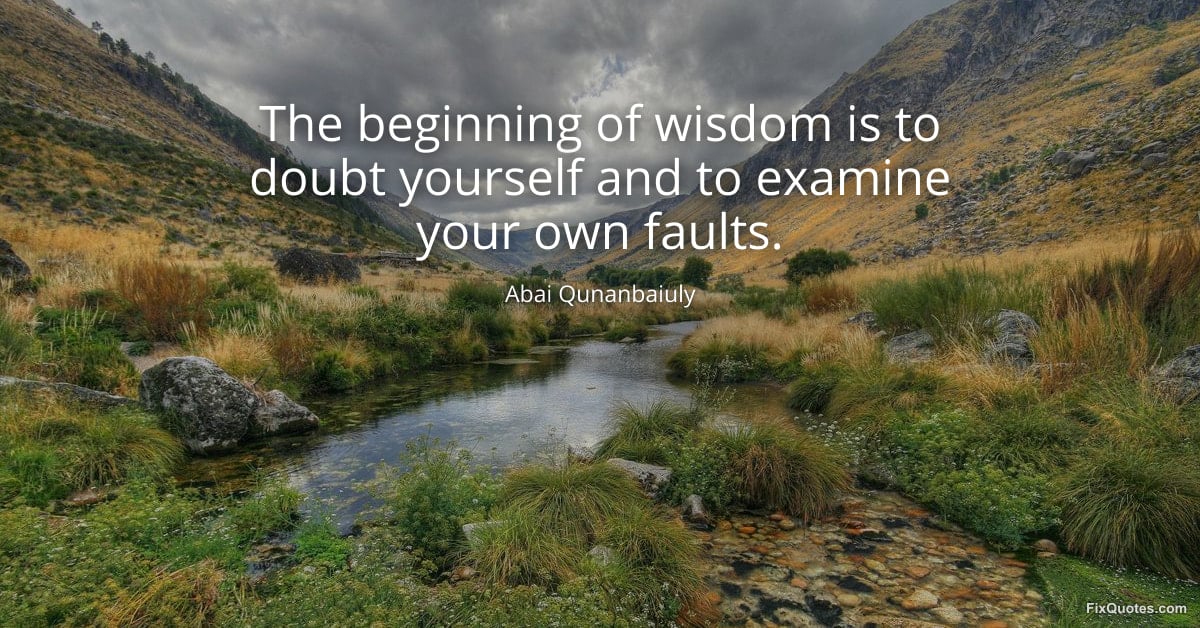
"The beginning of wisdom is to doubt yourself and to examine your own faults"
About this Quote
The intent is ethical, but also political. Abai wrote in a Kazakh steppe society pressured by Russian imperial administration and strained by internal hierarchies and clan politics. In that context, self-scrutiny isn’t merely personal improvement; it’s a strategy for cultural survival. A community navigating modernization, colonization, and elite complacency can’t afford the soothing myth that the problem is always “out there”. Abai’s reformist spirit often targeted ignorance, laziness, and vanity, especially among the educated classes who mistook status for insight. This line carries that same sting: if you want progress, start by interrogating the habits that keep you comfortable.
The subtext is how modern it feels: skepticism directed inward rather than outward. Today doubt is often branded as weakness, while “confidence” sells everything from politicians to personal brands. Abai flips the script. He treats humility as discipline, not vibe - the kind of honesty that makes learning possible and makes power less corrupting.
Quote Details
| Topic | Wisdom |
|---|---|
| Source | The Book of Words (Kara Sozder), on self-knowledge, 19th century. [translated] |
| Cite |
Citation Formats
APA Style (7th ed.)
Qunanbaiuly, Abai. (2026, February 14). The beginning of wisdom is to doubt yourself and to examine your own faults. FixQuotes. https://fixquotes.com/quotes/the-beginning-of-wisdom-is-to-doubt-yourself-and-185310/
Chicago Style
Qunanbaiuly, Abai. "The beginning of wisdom is to doubt yourself and to examine your own faults." FixQuotes. February 14, 2026. https://fixquotes.com/quotes/the-beginning-of-wisdom-is-to-doubt-yourself-and-185310/.
MLA Style (9th ed.)
"The beginning of wisdom is to doubt yourself and to examine your own faults." FixQuotes, 14 Feb. 2026, https://fixquotes.com/quotes/the-beginning-of-wisdom-is-to-doubt-yourself-and-185310/. Accessed 28 Mar. 2026.