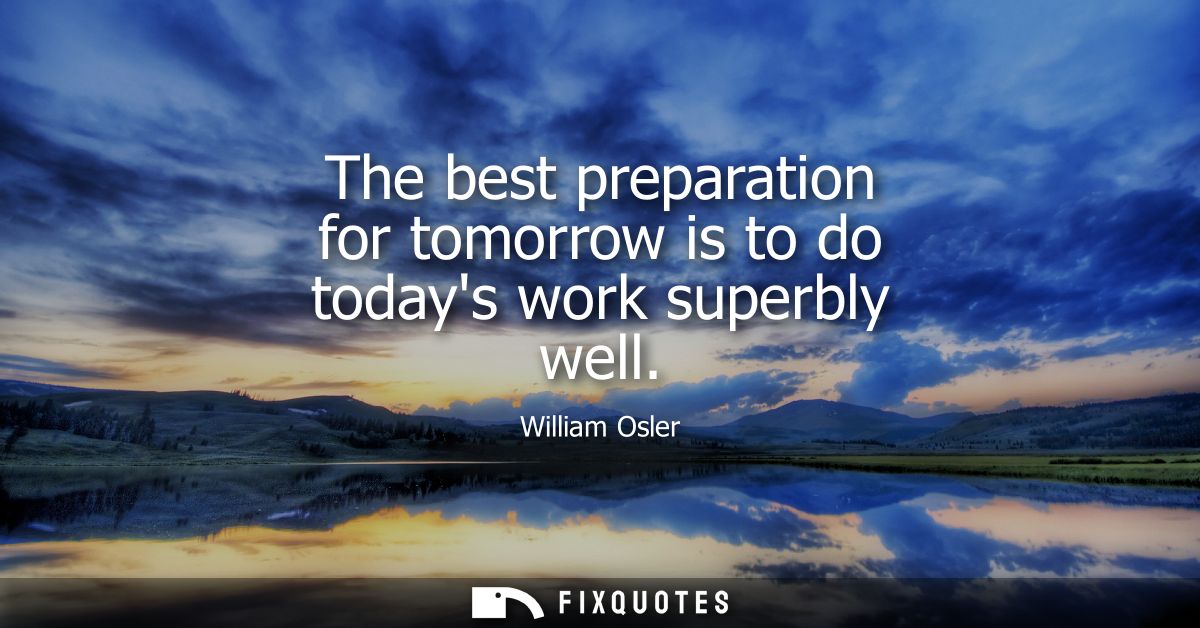
"The best preparation for tomorrow is to do today's work superbly well"
About this Quote
The subtext is a rebuke to two temptations: romanticizing “big plans” and outsourcing responsibility to fate. Osler treats time like a lab variable you can’t control directly. You don’t get to calibrate tomorrow; you can calibrate your procedures today. That’s why the sentence pivots on “superbly well,” a demanding adverb that smuggles in standards, discipline, and humility. Not just done, but done with care. It’s the ethos of bedside medicine and scientific rigor fused: observe, record, act precisely, repeat.
Context matters: Osler popularized a pragmatic, patient-centered training model, insisting students learn by doing, not by abstract theorizing. The quote doubles as an institutional philosophy for modern expertise. It makes a quiet argument about agency: the best defense against an unknowable future is competence you can demonstrate now. In an era that rewards forecasting and branding, Osler’s maxim lands as a hard-edged reminder that credibility is built in the unglamorous present tense.
Quote Details
| Topic | Work Ethic |
|---|---|
| Source | Help us find the source |
| Cite |
Citation Formats
APA Style (7th ed.)
Osler, William. (2026, January 16). The best preparation for tomorrow is to do today's work superbly well. FixQuotes. https://fixquotes.com/quotes/the-best-preparation-for-tomorrow-is-to-do-todays-114051/
Chicago Style
Osler, William. "The best preparation for tomorrow is to do today's work superbly well." FixQuotes. January 16, 2026. https://fixquotes.com/quotes/the-best-preparation-for-tomorrow-is-to-do-todays-114051/.
MLA Style (9th ed.)
"The best preparation for tomorrow is to do today's work superbly well." FixQuotes, 16 Jan. 2026, https://fixquotes.com/quotes/the-best-preparation-for-tomorrow-is-to-do-todays-114051/. Accessed 12 Feb. 2026.