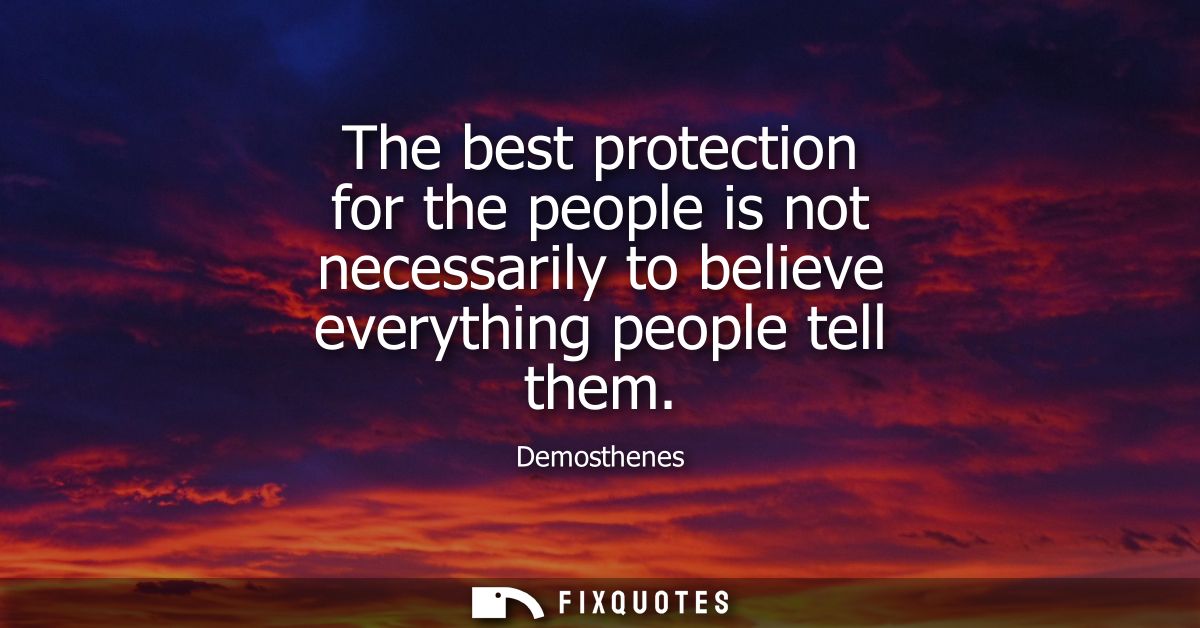
"The best protection for the people is not necessarily to believe everything people tell them"
About this Quote
The phrasing is doing quiet work. “Not necessarily” is lawyerly restraint from a professional persuader who knows the danger of sounding anti-popular. He isn’t flattering the crowd with “trust yourselves”; he’s warning them that trust is precisely what skilled rhetoricians exploit. Coming from a statesman famed for his speeches against Macedonian expansion, the subtext is pointed: Philip doesn’t need to win every battle if he can win Athens’ attention, delay its decisions, or purchase its confidence through envoys and friendly talk. Disinformation, soft power, and the seductions of plausible reassurance are already in play.
There’s also an ethical sting. Demosthenes is implicitly indicting a political culture that treats persuasion as entertainment and consensus as comfort. The “best protection” is a habit: skepticism disciplined by civic responsibility. He’s not advocating cynicism for its own sake; he’s urging citizens to demand evidence, interrogate motives, and resist being managed by speeches that offer safety at the price of vigilance. In Demosthenes’ Athens, credulity isn’t innocence - it’s strategic weakness.
Quote Details
| Topic | Truth |
|---|---|
| Source | Help us find the source |
| Cite |
Citation Formats
APA Style (7th ed.)
Demosthenes. (2026, January 17). The best protection for the people is not necessarily to believe everything people tell them. FixQuotes. https://fixquotes.com/quotes/the-best-protection-for-the-people-is-not-72841/
Chicago Style
Demosthenes. "The best protection for the people is not necessarily to believe everything people tell them." FixQuotes. January 17, 2026. https://fixquotes.com/quotes/the-best-protection-for-the-people-is-not-72841/.
MLA Style (9th ed.)
"The best protection for the people is not necessarily to believe everything people tell them." FixQuotes, 17 Jan. 2026, https://fixquotes.com/quotes/the-best-protection-for-the-people-is-not-72841/. Accessed 12 Mar. 2026.