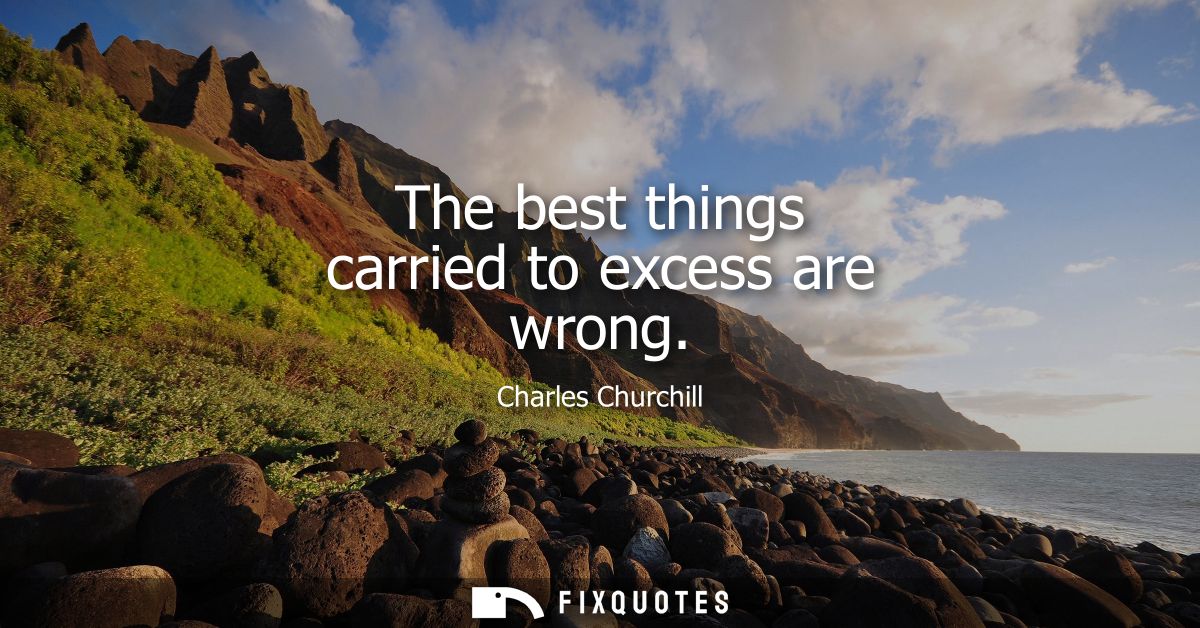
"The best things, carried to excess, are wrong"
About this Quote
Aphorisms like this one work by taking the reader’s favorite defense of indulgence - “it’s a good thing, so more must be better” - and snapping it in half. Charles Churchill, an 18th-century poet best known for satire, isn’t offering a pious warning against pleasure so much as a weapon against self-justification. The line is clean, almost mathematical: “best” sets a high bar, “carried” implies deliberate transport past a sensible boundary, and “wrong” arrives with blunt finality. No hand-wringing, no sermonizing. Just a verdict.
The subtext is aimed at a culture that loved declaring virtues while quietly monetizing their excesses. Churchill’s England was drenched in moral language and status performance: politeness, patriotism, taste, religion. Those “best things” were often real ideals, but also convenient costumes. By insisting that even the noblest goods become corrupt when overextended, Churchill collapses the comforting binary between virtue and vice. The problem isn’t wickedness; it’s overreach. The same appetite that powers excellence also powers exploitation, fanaticism, and vanity once it stops recognizing limits.
There’s also a satirist’s implied smirk here: people rarely “carry to excess” what they openly know is bad. They overdo what they can praise. Ambition becomes ruthlessness, frugality becomes miserliness, devotion becomes tyranny, love becomes possession. Churchill’s intent is less about moderation as bland middle ground than about diagnosing how virtue itself can become a loophole - a moral alibi for going too far.
The subtext is aimed at a culture that loved declaring virtues while quietly monetizing their excesses. Churchill’s England was drenched in moral language and status performance: politeness, patriotism, taste, religion. Those “best things” were often real ideals, but also convenient costumes. By insisting that even the noblest goods become corrupt when overextended, Churchill collapses the comforting binary between virtue and vice. The problem isn’t wickedness; it’s overreach. The same appetite that powers excellence also powers exploitation, fanaticism, and vanity once it stops recognizing limits.
There’s also a satirist’s implied smirk here: people rarely “carry to excess” what they openly know is bad. They overdo what they can praise. Ambition becomes ruthlessness, frugality becomes miserliness, devotion becomes tyranny, love becomes possession. Churchill’s intent is less about moderation as bland middle ground than about diagnosing how virtue itself can become a loophole - a moral alibi for going too far.
Quote Details
| Topic | Wisdom |
|---|---|
| Source | Verified source: The Rosciad (Charles Churchill, 1761)
Evidence: The best things carried to excess are wrong; (Line 715 (commonly numbered editions; exact page varies by edition)). This line appears in Charles Churchill’s satirical poem *The Rosciad*, first published in 1761 (originally published anonymously; Churchill’s authorship quickly became known). The wording most often seen in modern quotation sites matches the poem’s line exactly (including the semicolon at the end). Page number cannot be stated reliably without selecting a specific printed edition, because pagination differs across 18th–19th century printings and modern collected editions; however, line numbering is stable across many transcriptions and scholarly editions. Other candidates (1) The Poetical Works of (Charles) Churchill, (Thomas) Parne... (Charles Churchill, 1879) compilation95.0% With a Life of Each Charles Churchill. The best things carried to excess are wrong ; The start may be too frequent , ... |
| Cite |
Citation Formats
APA Style (7th ed.)
Churchill, Charles. (2026, February 19). The best things, carried to excess, are wrong. FixQuotes. https://fixquotes.com/quotes/the-best-things-carried-to-excess-are-wrong-170064/
Chicago Style
Churchill, Charles. "The best things, carried to excess, are wrong." FixQuotes. February 19, 2026. https://fixquotes.com/quotes/the-best-things-carried-to-excess-are-wrong-170064/.
MLA Style (9th ed.)
"The best things, carried to excess, are wrong." FixQuotes, 19 Feb. 2026, https://fixquotes.com/quotes/the-best-things-carried-to-excess-are-wrong-170064/. Accessed 25 Mar. 2026.
More Quotes by Charles
Add to List